
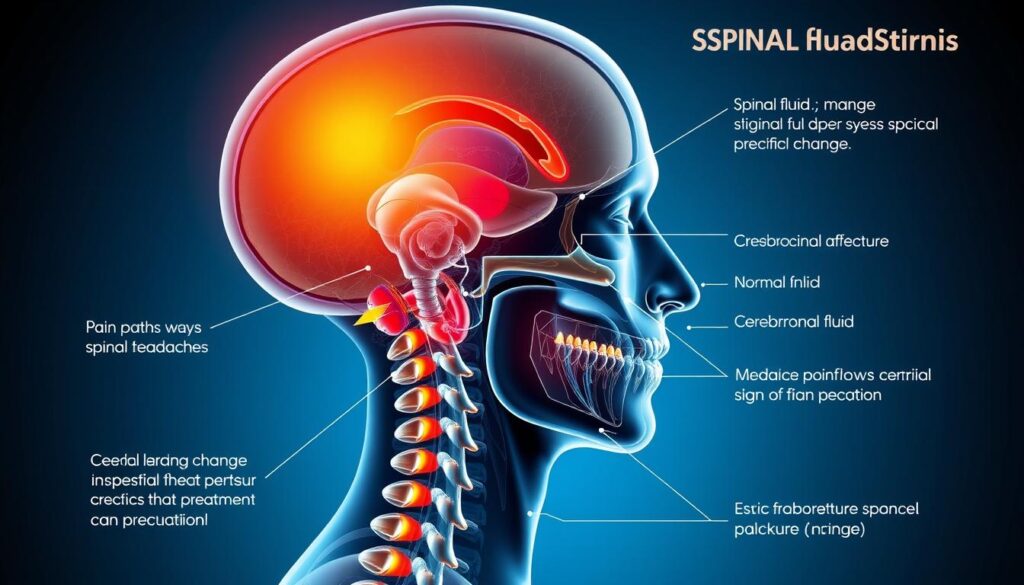
Spinal headaches can arise after certain medical procedures. They occur when cerebrospinal fluid leaks through a small puncture in the spinal cord membrane. This type of headache is known as a post-dural puncture headache1.
One in four patients who undergo a lumbar puncture develop these headaches2. The pain can range from mild to intense. Spinal headaches usually appear within 48 to 72 hours after the procedure1.
Your risk increases if you’re 18 to 30 years old, female, or pregnant. A history of frequent headaches also raises your chances. Some medical procedures using larger needles can increase the risk too1.
Key Takeaways
- Spinal headaches result from cerebrospinal fluid leakage
- 25% of lumbar puncture patients experience these headaches
- Symptoms typically resolve within 1-2 weeks
- Risk factors include age, gender, and medical history
- Most spinal headaches resolve without specific treatment
Understanding Spinal Headaches: An Overview
Spinal headaches are a complex medical issue that can occur after certain procedures. They stem from changes in your body’s spinal fluid system3.
What Causes Cerebrospinal Fluid Leaks
Cerebrospinal fluid leaks are the main reason for spinal headaches. A small puncture in the dura mater during procedures can cause fluid loss.
This drop in spinal fluid pressure leads to headache symptoms3.
- Potential causes of cerebrospinal fluid leaks include:
- Myelograms
- Spinal tap procedures
- Epidural anesthesia
Common Medical Procedures Leading to Spinal Headaches
Some medical procedures raise your risk of spinal headaches. Cervicogenic headaches can result from spinal tap issues.
These problems are more likely with larger needles or multiple punctures4.
Time Frame for Symptom Development
Spinal headaches usually appear within a specific time after medical procedures. Symptoms can start in the first few days.
Most cases show up between 48 to 72 hours after the procedure34.
Understanding the timing and potential causes of spinal headaches can help you manage your symptoms effectively.
Risk factors for spinal headaches include:
- Age between 18-30 years
- Female gender
- Pregnancy
- History of frequent headaches
- Low body mass
Not everyone who has spinal procedures gets headaches. But knowing the signs helps you seek medical help quickly3.
Key Symptoms and Risk Factors of Spinal Headaches
Spinal headaches can disrupt your daily life. Knowing their symptoms and risk factors helps with early detection and management5.
https://www.youtube.com/watch?v=S0sk8tO30RU&pp=ygUJI2hlYWRoY2hl
Spinal headaches cause a unique pain that changes with body position. You might feel dull, throbbing pain that worsens when sitting or standing. The pain often improves when lying down5.
- Dizziness and vision changes
- Neck stiffness and pain
- Nausea and potential vomiting
- Sensitivity to light
- Hearing disturbances
Several factors increase your risk of spinal headaches. These include personal traits and characteristics.
- Being female6
- Age between 20-40 years7
- Pregnancy status
- Low body mass index
- History of chronic headaches
“Understanding your individual risk can help you prepare and manage potential spinal headache symptoms more effectively.”
Some medical procedures raise the chances of spinal headaches. Larger needles or multiple punctures increase the risk6. Needles bigger than 24-25 gauge can lead to these headaches.
Positioning the needle perpendicular to the spinal cord also increases the risk6. For relief, talk to healthcare professionals. They can create personalized treatment plans for your symptoms and risk factors5.
Diagnosis and Treatment Options
Spinal headaches often occur after spine procedures. They require careful medical assessment and targeted treatments. Understanding your options helps manage this condition effectively.
Initial Medical Assessment
Your doctor will perform a thorough spinal headache diagnosis. This includes a detailed medical history and physical exam. About 40% of patients who have spinal procedures experience these headaches8.
The medical team will assess your symptoms and recent procedures. They’ll also consider your individual risk factors.
Conservative Treatment Methods
Initial treatment typically involves conservative approaches. Healthcare professionals suggest several methods to manage symptoms.
- Bed rest to reduce pain
- Adequate hydration
- Caffeine consumption
- Over-the-counter pain medications
Young adults aged 18 to 30 are more likely to get these headaches8. Conservative treatments often work well for many patients9.
Blood Patch Procedure
If conservative methods don’t work, an epidural blood patch might be needed. This procedure injects your blood into the spinal fluid leak area.
The blood creates a seal that increases spinal fluid pressure. This helps relieve pain8.
Recovery Timeline
Most spinal headaches go away within six weeks. Many patients feel better with targeted treatments8. Recovery time varies based on individual factors and the treatment used.
| Treatment Approach | Success Rate | Average Recovery Time |
|---|---|---|
| Conservative Treatment | 60-70% | 1-2 weeks |
| Epidural Blood Patch | 85-90% | 24-48 hours |
“Understanding your treatment options is the first step toward effective spinal headache management.”
Conclusion
Spinal headaches can often be prevented and treated effectively. Most cases are manageable with proper care. Your knowledge of symptoms and risk factors is key to handling these headaches1011.
Choose experienced doctors to reduce the risk of spinal headaches. Many patients have mild symptoms that go away in a few days. Self-care and medical help can provide relief11.
A blood patch might be used to seal cerebrospinal fluid leaks. Your active role in healthcare makes a difference. Stay informed and follow medical advice carefully1110.
Understanding spinal headache management helps you make smart health choices. Remember, most spinal headaches are short-lived and treatable. With proper guidance, you can minimize their impact11.
FAQ
What exactly is a spinal headache?
A spinal headache happens when cerebrospinal fluid leaks through a puncture in the spinal cord membrane. This leak reduces pressure on your brain and spinal cord. The resulting headache typically worsens when sitting or standing and improves when lying down.
What medical procedures can cause spinal headaches?
Spinal headaches often result from lumbar punctures, spinal anesthesia, and sometimes epidural anesthesia. These procedures create a small puncture in the spinal membrane. This can potentially lead to cerebrospinal fluid leakage.
Who is most at risk for developing spinal headaches?
You’re more likely to get spinal headaches if you’re between 18-30 years old or female. Pregnancy, frequent headaches, and small body mass also increase risk. Procedures using larger needles or multiple punctures can raise your chances too.
What are the typical symptoms of a spinal headache?
The main symptom is a dull, throbbing pain that worsens when sitting or standing. It usually gets better when lying down. You might also feel dizzy or have ringing in your ears.
Other symptoms can include hearing loss, blurred vision, and sensitivity to light. Nausea, neck pain, and rarely, seizures may occur too.
How are spinal headaches diagnosed?
Diagnosis is mainly based on your symptoms and recent medical history. Your doctor will ask about any recent spinal procedures. They’ll evaluate the timing, characteristics, and symptoms of your headache.
What are the treatment options for spinal headaches?
Initial treatment usually involves bed rest, staying hydrated, and drinking caffeine. Over-the-counter pain medications can also help. For severe cases, your doctor might recommend an epidural blood patch.
How long do spinal headaches typically last?
Most spinal headaches start within 48 to 72 hours after a procedure. They often clear up in a few days with proper treatment. Severe cases lasting over 24 hours might need medical intervention.
Can spinal headaches be prevented?
While not always preventable, you can reduce risks. Using smaller needles during spinal procedures helps. Proper technique is crucial. Discuss your risk factors with your doctor before any spinal interventions.
Source Links
- Spinal headaches – Symptoms and causes – https://www.mayoclinic.org/diseases-conditions/spinal-headaches/symptoms-causes/syc-20377913
- Spinal headache: Symptoms, causes, treatment, and more – https://www.medicalnewstoday.com/articles/spinal-headache
- Learning About Spinal Headaches – https://myhealth.alberta.ca/Health/aftercareinformation/pages/conditions.aspx?hwid=acd7517
- Spinal headaches – https://www.uofmhealthsparrow.org/departments-conditions/conditions/spinal-headaches
- Spinal Headaches: Causes, Risk Factors, Symptoms, Treatment – https://continentalhospitals.com/diseases/spinal-headaches/
- The Symptoms and Causes of Spinal Headaches – http://coloradopaincare.com/the-symptoms-and-causes-of-spinal-headaches/
- A Complete Guide to Spinal Headache – https://resources.healthgrades.com/right-care/migraine-and-headache/spinal-headache
- Spinal Headaches: What They Are and What Can Be Done – https://friscospine.com/conditions/head-pain/spinal-headaches-what-they-are-and-what-can-be-done/
- Post lumbar puncture headache: diagnosis and management – https://pmc.ncbi.nlm.nih.gov/articles/PMC2660496/
- Post spinal puncture headache, an old problem and new concepts: review of articles about predisposing factors – https://pmc.ncbi.nlm.nih.gov/articles/PMC3762227/
- Learning About Spinal Headaches | Kaiser Permanente – https://healthy.kaiserpermanente.org/health-wellness/health-encyclopedia/he.learning-about-spinal-headaches.acd7517

