
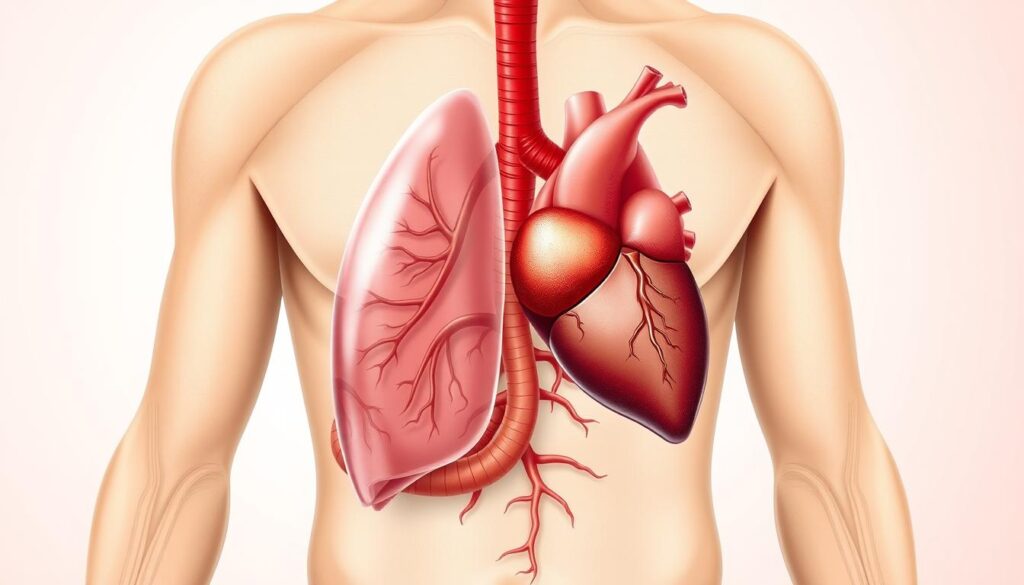
Your body is a remarkable machine with 79 organs working together. Each organ plays a crucial role in keeping you alive and healthy. Let’s explore the largest organs and their unique features.
The skin is often called the largest organ. It covers your entire body and makes up 16 percent of your mass12. However, new research suggests another contender: the interstitium.
The interstitium is a network of fluid-filled spaces throughout your body1. It may be even larger than the skin.
The liver is the biggest solid internal organ. It weighs about 3-3.5 pounds1. Other vital organs include the brain, lungs, heart, and kidneys2.
Key Takeaways
- The human body contains approximately 79 recognized organs
- Skin is traditionally considered the largest organ
- The liver is the largest solid internal organ
- The interstitium may be a newly discovered large organ
- Each organ has a unique and essential function
Understanding Your Body’s Largest Organs: Skin and Interstitium
Your body has two amazing protective systems. These are your skin and the interstitium. Let’s explore these fascinating organs and their incredible functions.
The Skin: Your Ultimate Protective Shield
Your skin is more than just a covering. It’s one of your body’s largest organs, spanning about 20 square feet. This incredible organ acts as a vital barrier against outside threats3.
Your skin performs many key functions:
- Protects against pathogens and UV rays
- Regulates body temperature
- Stores water, fat, and vitamin D
- Serves as your first line of defense
The Interstitium: A Newly Discovered Protective Network
Scientists have found a new network in your body called the interstitium. It’s a series of fluid-filled spaces supported by connective tissue3. This potential 80th organ might be one of the largest internal organs4.
Essential Functions of Protective Organs
The interstitium has important roles in keeping you healthy:
- Transports interstitial fluid throughout the body4
- Supports immune system functions
- Acts as shock absorbers for tissues3
- Potentially explains disease progression4
Ongoing research explores these remarkable organs, promising breakthrough medical insights4.
Largest Organs in the Body: A Complete Overview
Your body is a complex network of vital organs. They work together to keep you alive and healthy. These remarkable components play crucial roles in maintaining your overall well-being5.
The liver stands out as a powerhouse among major body organs. It weighs about 3-3.5 pounds and performs many critical functions. These include blood filtration and bile production6.
The human body’s organ systems are designed to work seamlessly together. Each system relies on others to function properly.
- Brain: Weighing about 3 pounds, controls all bodily functions6
- Heart: Pumps blood through four distinct chambers6
- Lungs: Responsible for oxygen exchange and blood oxygenation6
- Kidneys: Filter waste and maintain fluid balance6
Each organ plays a unique and irreplaceable role in keeping your body functioning optimally. The kidneys contain about one million nephrons. These tiny structures work tirelessly to maintain your body’s chemical balance6.
Your body is a masterpiece of biological engineering, with each organ contributing to your survival and well-being.
Several additional components support your body’s complex systems. The pancreas serves as both an exocrine and endocrine gland. The stomach breaks down nutrients through its specialized sections6.
Conclusion
Your body organs work together with amazing precision. The skin protects you, while other organs maintain your health789. Each organ plays a crucial role in keeping you healthy.
The largest organs, like skin and muscles, are biological marvels. New research reveals the complexity of our internal systems9. These discoveries challenge what we thought we knew about human anatomy.
Your body’s organs work together to support life. They filter toxins, regulate processes, and protect against threats7. Understanding these organs helps you appreciate your body’s delicate balance.
Taking care of your organs is vital for good health. Regular check-ups and a healthy lifestyle are important. These habits support your body’s incredible biological machinery.
FAQ
What is the largest organ in the human body?
The skin is usually seen as the largest organ. It covers about 20 square feet and makes up 16% of body mass. But new research suggests the interstitium might be even larger.
The interstitium is a network of fluid-filled spaces throughout your body. It could be a newly discovered organ that’s bigger than the skin.
How large is the liver, and what does it do?
The liver is the largest solid internal organ, weighing 3-3.5 pounds. It filters blood, produces bile, and manages blood clotting. The liver also stores essential vitamins and minerals.
This vital organ plays a crucial role in keeping you healthy. It’s a powerhouse that works hard to maintain your body’s balance.
What makes the interstitium unique?
The interstitium is a series of fluid-filled spaces supported by connective tissue. It’s found beneath your skin, in fascia, and lining various body systems.
This structure might be the 80th organ. It protects tissues, filters fluids, and supports overall bodily functions.
How much blood does the human heart pump?
Your heart is about the size of a closed fist. It pumps about 1.5 gallons of blood per minute.
This constant circulation is vital. It delivers oxygen and nutrients throughout your body. It also removes waste products.
What is the function of the lungs?
The lungs are the third-largest organs in your body. They can hold 4-6 liters of air. Their main job is to oxygenate your blood.
With each breath, your lungs take in oxygen and expel carbon dioxide. They’re crucial for your respiratory system to work properly.
How does the skin protect the body?
Your skin is about 2 millimeters thick. It acts as a barrier against environmental stressors, pathogens, and UV rays.
The skin helps regulate body temperature and stores water and fat. It also produces vitamin D. These functions make it key to your body’s defense system.
What do the kidneys do?
Each kidney is about the size of a small fist. They filter waste from your blood and regulate salt levels.
Kidneys play a crucial role in maintaining your body’s chemical balance. They also eliminate toxins through urine production.
Source Links
- Largest Organ in the Body: Size, Weight & Interesting Facts – https://www.healthline.com/health/largest-organs-in-the-body
- What Are Organs? – https://my.clevelandclinic.org/health/articles/organs-in-the-body
- Meet Your Interstitium, a Newfound “Organ” – https://www.scientificamerican.com/article/meet-your-interstitium-a-newfound-organ/
- The largest organ in the body may have just been discovered — here’s everything we know about it – https://www.businessinsider.com/organ-interstitium-might-be-largest-human-body-2018-3
- 10.4: Human Organs and Organ Systems – https://bio.libretexts.org/Bookshelves/Human_Biology/Human_Biology_(Wakim_and_Grewal)/10:_Introduction_to_the_Human_Body/10.4:_Human_Organs_and_Organ_Systems
- Organs in the body: Diagram and all you need to know – https://www.medicalnewstoday.com/articles/organs-in-the-body
- What is the largest organ in the human body? – An Overview – https://byjus.com/biology/largest-organ-in-human-body/
- What are the heaviest organs in the human body? – https://www.livescience.com/health/anatomy/what-are-the-heaviest-organs-in-the-human-body
- Skincare Myths: Your Skin Isn’t Your Largest Organ – https://dermavidualsny.com/your-skin-isnt-the-largest-organ/

