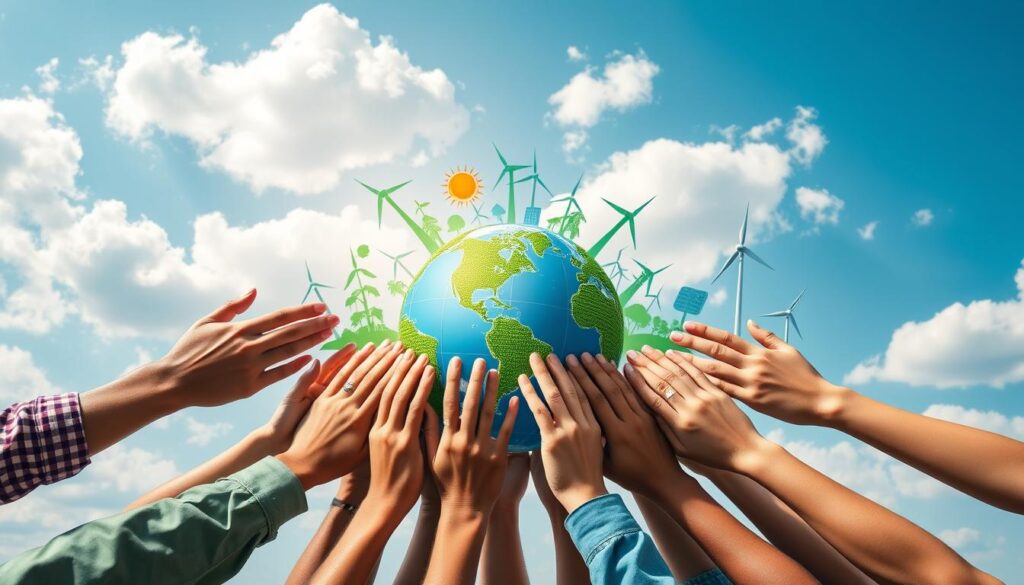
Climate change is a global problem that hits every country hard. It causes wildfires in Canada and floods in Pakistan. No single country can fight it alone, showing we need to work together1. Our atmosphere, oceans, and ecosystems are all connected, making teamwork key to solving climate issues1.
Africa, for example, only makes up 3.8% of global emissions but faces big problems like droughts and floods1. Big polluters like China, the United States, and the European Union must join forces to fight climate change1.
Climate change brings us global problems like rising sea levels and more intense storms2. If we keep burning fossil fuels, global temperatures could soar to dangerous levels2. This shows we need a global effort to tackle climate change2.
Developing countries need help from the world to deal with climate change1. They need technology, money, and knowledge to fight its effects. This highlights the need for fair and inclusive global partnerships1.
Key Takeaways
- Global cooperation is essential to address the global climate crisis.
- International collaboration and cross-border partnership are necessary to combat climate change.
- The largest emitters of greenhouse gases need to coordinate efforts to meaningfully combat climate change.
- Developing countries require technology transfers, financial support, and knowledge sharing from global cooperation.
- Global cooperation can help reduce greenhouse gas emissions and address climate impacts.
Understanding the Global Climate Crisis
The global climate crisis is a big problem, affecting both nature and people. If we keep using fossil fuels, Earth’s temperature could rise by 3 to 8 degrees Celsius. This could cause big changes like different weather patterns, melting glaciers, and higher sea levels3.
Overview of Climate Change
Climate change means big changes in the Earth’s temperature and weather over time. Right now, Earth’s temperature is going up fast because of human actions. If we don’t act soon, the effects could be very bad3.
Key Drivers of Climate Change
Things like pollution from industries, cutting down trees, and using synthetic refrigerants are big problems. They make the Earth trap more heat, making it warmer34.
The Role of Human Activity
Humans are making climate change worse. Things like factories, cars, and power plants release a lot of greenhouse gases. But if we work together and use green practices, we can make a difference5.
| Statistic | Details | Source |
|---|---|---|
| Global Temperature Rise | 3 to 8°C increase by 2100 | 3 |
| U.S. Emission Reduction | 50-52% below 2005 levels by 2030 | 5 |
| EU Emissions Share | 7% and declining | 4 |
Benefits of Global Cooperation
Global cooperation is key in fighting climate change. It helps nations understand each other better and build stronger relationships. Together, countries can use their strengths to find and use effective climate solutions.
Shared Resources and Technologies
Sharing resources and technologies speeds up the creation and use of green solutions. Through teamwork, big advances have been made in clean energy and saving energy. For example, the Paris Agreement has helped share technology for cleaner energy6.
Policy Coordination and Agreements
Agreements like the Paris Agreement help countries work together on climate issues. They make sure everyone is working towards the same goals. This way, countries can help keep the global temperature from rising too high6.
Economic Opportunities in Sustainability
Working together on sustainability can help economies grow. It creates jobs in clean energy and green industries. Moving to a low-carbon economy also helps the environment and brings economic benefits.
It reduces our need for fossil fuels and makes energy more secure. Plus, it opens up new markets for green technologies and services. This drives innovation and makes countries more competitive worldwide.
Challenges to Global Cooperation
Fighting climate change globally is hard. We face many obstacles. We need to work together to overcome these challenges.
Political Barriers and National Interests
National interests often come first, not global goals. Out of 193 countries, 60 leaders want to change how decisions are made7. They want to limit vetoes and give more voice to all regions7.
Misinformation and Public Perception
False information affects how people see climate issues. It makes it hard to get everyone on the same page7. We must fight misinformation to keep global efforts strong.
The Need for Effective Communication Strategies
Good communication is key to working together. Groups like the European Union are working on this8. Better communication helps us move towards unity.
FAQ
Why is global cooperation essential in combating climate change?
Climate change is a borderless issue that affects every nation, regardless of their individual contributions to greenhouse gas emissions. The interconnectedness of our planet’s systems means that isolated efforts are insufficient. Global cooperation fosters worldwide unity and global solidarity, enabling nations to share resources, technologies, and strategies to effectively address this global threat.
How does climate change affect nations differently?
The impacts of climate change, such as rising sea levels, intensified storms, and altered weather patterns, are felt globally but affect nations in diverse ways. Developing countries may face more severe consequences due to limited resources for adaptation, while developed nations might experience economic disruptions. Mutual understanding and international collaboration are key to ensure all countries can support each other in mitigating and adapting to these varied effects.
What are the key drivers of climate change?
The primary factors contributing to climate change include greenhouse gas emissions from industrial processes, deforestation, and the burning of fossil fuels. These activities increase the concentration of greenhouse gases in the atmosphere, leading to the warming of the planet. Addressing these drivers requires a coordinated cross-border partnership and the implementation of sustainable practices worldwide.
How do human activities contribute to climate change?
Human activities, such as deforestation, industrial emissions, and the use of fossil fuels, have significantly accelerated climate change. These actions increase the levels of greenhouse gases in the atmosphere, trapping heat and disrupting natural climate patterns. Recognizing our responsibility is the first step towards mitigating these effects through diplomatic relations and global initiatives.
What are the benefits of international collaboration in developing climate solutions?
International collaboration allows for the pooling of resources and expertise, accelerating the development and implementation of innovative climate solutions. Successful technology transfers and collaborative research initiatives show how nations can work together to achieve global harmony in their climate efforts, leading to more effective and sustainable outcomes.
How do policy coordination and international agreements help in climate action?
Policy coordination through international agreements like the Paris Agreement creates a unified framework for climate action. These agreements foster mutual accountability and align national policies with global objectives, ensuring that all countries work towards shared climate goals and support each other in achieving them.
What economic opportunities arise from global sustainability efforts?
Global sustainability efforts open up numerous economic opportunities, including the growth of green industries and job creation in renewable energy sectors. Transitioning to a low-carbon economy not only helps mitigate climate change but also offers long-term economic benefits by fostering innovation and creating a more resilient global economy.
What political barriers hinder international collaboration on climate change?
Political barriers such as conflicting national interests, economic concerns, and sovereignty issues often impede international agreements and collaborative efforts. Balancing short-term national priorities with long-term global needs requires effective diplomatic relations and a commitment to global solidarity to overcome these challenges.
How does misinformation impact global climate initiatives?
Misinformation and climate change skepticism can undermine cooperative efforts by distorting public perception and influencing policy-making. Addressing false information is essential to maintain public support for international collaborations and to ensure that climate initiatives are based on accurate, scientific evidence.
Why is effective communication important for global cooperation on climate change?
Effective communication is critical for conveying the urgency of climate change, building public support, and bridging cultural and linguistic divides in global discussions. Innovative communication strategies help foster mutual understanding and worldwide unity, enabling nations to collaborate more effectively in addressing this global crisis.
Source Links
- International Cooperation: Key to Combating the Climate Crisis – https://greenly.earth/en-us/blog/ecology-news/international-cooperation-key-to-combating-the-climate-crisis
- Climate Change and International Cooperation — Harvard ALI Social Impact Review – https://www.sir.advancedleadership.harvard.edu/articles/climate-change-and-international-cooperation
- Chapter 14: International cooperation – https://www.ipcc.ch/report/ar6/wg3/chapter/chapter-14/
- Cooperation on climate action with non-EU countries – https://climate.ec.europa.eu/eu-action/international-action-climate-change/eu-engagement-climate-action-non-eu-countries/cooperation-climate-action-non-eu-countries_en
- Climate Crisis – United States Department of State – https://www.state.gov/policy-issues/climate-crisis/
- International Cooperation | United Nations – https://www.un.org/en/water-energy-network/page/international-cooperation
- Today’s Challenges Require More Effective and Inclusive Global Cooperation, Secretary-General Tells Security Council Debate on Multilateralism – https://press.un.org/en/2022/sc15140.doc.htm
- Solving World’s Problems Requires ‘Global Cooperation Based on Agreed Rules’, European Union High Representative Tells Security Council – https://press.un.org/en/2021/sc14547.doc.htm