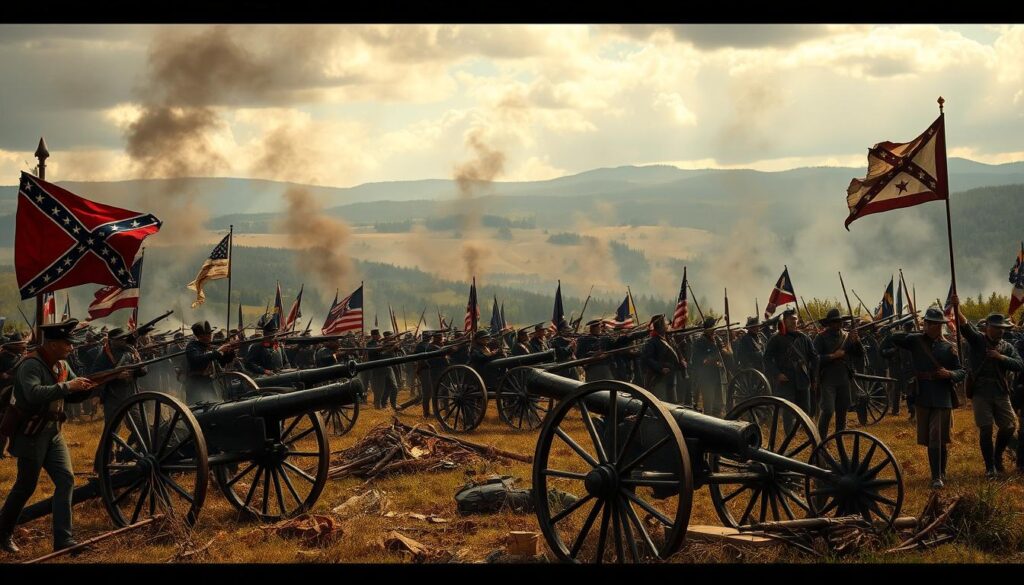
The American Civil War was a major event in U.S. history. It lasted from April 12, 1861, to May 26, 1865, for 4 years, 1 month, and 2 weeks1. This conflict was between the United States (Union) and 11 Southern states that became the Confederate States of America. It led to the deaths of about 620,000 to 750,000 soldiers1.
This war is a key part of American history. Knowing its causes and effects helps us understand today’s American society.
The Civil War was a turning point in U.S. history. It changed the nation’s social, political, and economic landscape. We will look at how the war tested the nation’s strength and changed its core values. This led to a more united America2.
Important figures like Abraham Lincoln, Ulysses S. Grant, and Robert E. Lee played big roles. Major events like the Battle of Gettysburg and the Battle of Antietam also shaped the war2.
Key Takeaways
- The American Civil War lasted from 1861 to 1865 and resulted in significant loss of life1.
- The war was fought between the Union and the Confederacy, with the Union ultimately emerging victorious2.
- The Civil War had a profound impact on American society, leading to the abolition of slavery and a more unified nation1.
- Key figures like Abraham Lincoln and Ulysses S. Grant played important roles in the war2.
- The war’s legacy continues to shape American history and society today1.
- The economic and social consequences of the war were far-reaching, with significant impacts on the nation’s development2.
Overview of the American Civil War
The American Civil War lasted from 1861 to 1865. It was a key moment in U.S. history. The war started when the Confederate army attacked Fort Sumter in April 1861. Almost a million soldiers fought on a huge battlefront3.
Causes of the Conflict
The North and South had big economic differences. These differences led to fights over states’ rights and slavery. These issues made the divide between the two sides grow wider3.
Key Figures and Leaders
Abraham Lincoln led the Union Army. He wanted to keep the country together and end slavery. On the other side, Robert E. Lee led the Confederacy with skill. Ulysses S. Grant became a key Union general, helping to end the war4.
Major Battles and Turning Points
The Battle of Gettysburg was a key moment. The Union Army defeated the Confederate Army, causing many deaths. Battles like Antietam and Vicksburg also changed the war’s path.
| Battle | Date | Outcome |
|---|---|---|
| Battle of Gettysburg | July 1-3, 1863 | Union victory |
| Battle of Antietam | September 17, 1862 | Tactical draw, strategic Union advantage |
| Siege of Vicksburg | May 18 – July 4, 1863 | Union victory |
Social and Economic Impact
The Emancipation Proclamation changed the United States’ social scene. It declared freedom for all slaves in rebellious states5. This move ended slavery and started the Reconstruction era, changing American society.
Slavery and its Role in the War
Slavery was key in the Southern economy. By 1860, the South made three-quarters of the world’s cotton6. The South’s economy was weak after the war because of its reliance on slave labor7. Ending slavery caused big changes in society.
Changes in Society and Culture
After the war, America changed a lot. Freed slaves wanted to learn and vote, changing society5. African Americans also joined the workforce, making society more diverse and fair.
Economic Consequences
The North grew stronger, thanks to its industry and government help5. But the South was hit hard, facing food shortages and less cotton sales6. The war ended, and the North became the economic leader.
| Region | Economic Impact | Social Changes |
|---|---|---|
| North | Industrial growth, increased government spending5 | Urbanization, immigration influx6 |
| South | Economic devastation, decline in cotton exports6 | Abolition of slavery, social restructuring5 |
Aftermath and Legacy
The end of the American Civil War started a new chapter in American history. The nation had to rebuild and find a new identity.
Reconstruction Era
The Reconstruction era aimed to bring Southern states back into the fold. It also worked to make sure African Americans had equal rights. The government spent about $1 billion8 to help make these changes happen.
The 13th, 14th, and 15th Amendments were key. They ended slavery and gave African Americans citizenship and the right to vote. These changes changed the U.S. Constitution8.
Long-term Effects on American Society
The war made the federal government stronger, lessening the power of states. The Southern economy lost 60% of its farm values, showing big economic gaps8. Also, 3,000 to 20,000 former Confederates moved to Brazil, looking for a fresh start9.
These changes led to ongoing debates about race and power between states and the federal government.
Lessons Learned from the Civil War
The Civil War was very costly, with about 750,000 soldiers dying10. This loss showed the high price of division and the value of unity. The war taught us the importance of coming together and fighting for equality and justice.
FAQ
What were the primary causes of the American Civil War?
The American Civil War was sparked by many factors. These included economic differences between the North and South, debates over states’ rights, and the issue of slavery expansion. These issues created a lot of tension, leading to the start of the war.
Who were the key figures in the Civil War?
Important leaders like Abraham Lincoln and Jefferson Davis played big roles. Lincoln was the President of the Union Army, and Davis was the President of the Confederate Army. Military leaders like Ulysses S. Grant and Robert E. Lee also had a big impact on the war.
What was the significance of the Battle of Gettysburg?
The Battle of Gettysburg was a turning point in the war. It happened in July 1863 and was the bloodiest battle. It was the first big defeat for Robert E. Lee’s Confederate Army in the North. This victory boosted Northern morale and helped lead to the Confederate surrender.
What was the Emancipation Proclamation?
Abraham Lincoln issued the Emancipation Proclamation in 1863. It declared freedom for all slaves in Confederate territory. This document changed the war’s purpose, adding a moral reason for the Union. It helped pave the way for the end of slavery in the United States.
What roles did the Union Army and Confederate Army play in the war?
The Union Army fought to keep the United States together and end slavery. The Confederate Army defended the South’s right to keep their social and economic systems, including slavery. Both armies played key roles in the many battles and strategies of the war.
How did the Reconstruction era impact American society after the Civil War?
The Reconstruction era aimed to bring the South back into the Union and ensure equality for freed African Americans. Despite its goals, it faced many challenges, including political resistance and social upheaval. These challenges left a lasting impact on American society and race relations.
What were the long-term effects of the Civil War on the United States?
The Civil War had lasting impacts, including the end of slavery and economic changes. It also strengthened federal authority. The war set the stage for Reconstruction and influenced future policies, shaping the nation’s path into the modern era.
What lessons were learned from the Civil War?
The Civil War showed the importance of national unity and the dangers of sectionalism. It highlighted the human cost of war and the need to address social and economic issues. It also showed the role of leadership and strategy in conflict outcomes.
Source Links
- American Civil War – https://en.wikipedia.org/wiki/American_Civil_War
- American Civil War | History, Summary, Dates, Causes, Map, Timeline, Battles, Significance, & Facts | Britannica – https://www.britannica.com/event/American-Civil-War
- A Brief Overview of the American Civil War – https://www.battlefields.org/learn/articles/brief-overview-american-civil-war
- Civil War ‑ Causes, Dates & Battles | HISTORY – https://www.history.com/topics/american-civil-war/american-civil-war-history
- American Civil War | Causes & Effects | Britannica – https://www.britannica.com/summary/Causes-and-Effects-of-the-American-Civil-War
- The Economic Impact of the American Civil War – https://www.thecollector.com/economic-impact-of-the-american-civil-war/
- Causes, Costs and Consequences: The Economics of the American Civil War – https://www.essentialcivilwarcurriculum.com/the-economics-of-the-civil-war.html
- American Civil War: Aftermath & Legacy (Part 4) – https://podcasts.apple.com/us/podcast/american-civil-war-aftermath-legacy/id1537788786?i=1000568679890
- Milestones in the History of U.S. Foreign Relations – https://history.state.gov/milestones/1861-1865/victory
- Aftermath: War, Memory and History – https://www.harvard.edu/president/speeches-faust/2017/aftermath-war-memory-and-history/