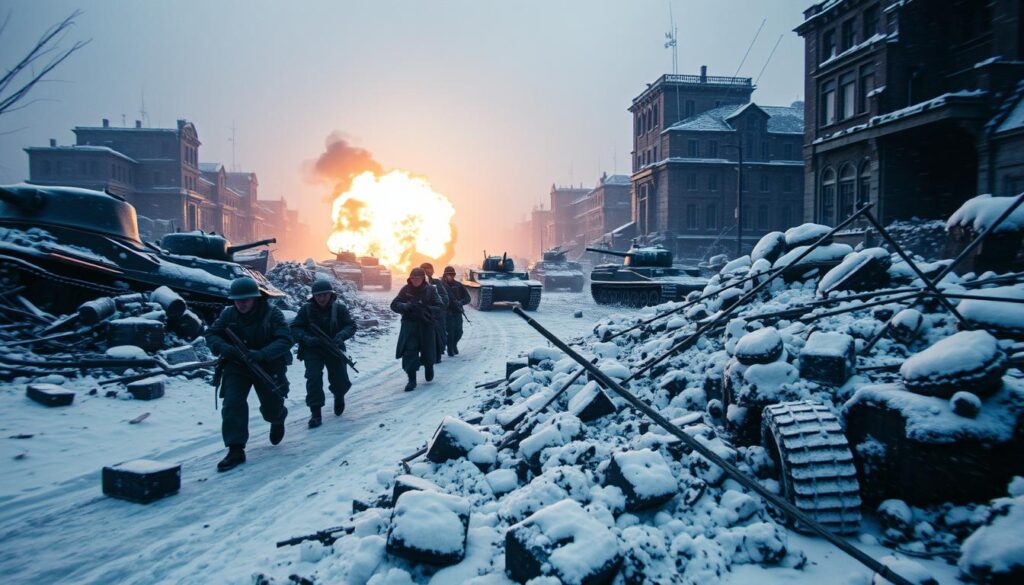
The Battle of Stalingrad was a key event in World War II history. It happened from July 17, 1942, to February 2, 19431. This major fight was between Nazi Germany and the Soviet Union over Stalingrad in southern Russia. It’s a big part of Stalingrad’s history.
Almost 4 million soldiers fought in this battle, making it one of the biggest in history2.
Exploring Stalingrad’s history, we see how important this battle was. It was a turning point in World War II, leading to the Soviet Union’s victory over Nazi Germany2. The battle started with heavy bombing of Stalingrad by Generaloberst von Richthofen’s Luftflotte 4, dropping over 1,000 tons of bombs1.
The Battle of Stalingrad was a major shift in the war’s direction. About 480,000 Red Army soldiers died defending Stalingrad, more than the total American casualties in World War II2. Its outcome had big consequences, making it a key part of Stalingrad’s history and facts.
Key Takeaways
- The Battle of Stalingrad took place from July 17, 1942, to February 2, 19431.
- The battle involved nearly 4 million combatants, making it one of the largest battles in history2.
- Approximately 480,000 Red Army soldiers lost their lives in the defense of Stalingrad2.
- The battle marked a turning point in World War II, leading to the eventual defeat of Nazi Germany2.
- The Battle of Stalingrad is a significant part of Stalingrad history and Stalingrad facts.
Overview of the Battle of Stalingrad
The Battle of Stalingrad was a key fight in World War II. It changed the war’s path on the Eastern Front. The city’s location on the Volga River made it vital for Soviet production and transport.
Significance of Stalingrad in WWII
Stalingrad was a big industrial city that made weapons and tractors. Taking it would cut off Soviet transport to southern Russia. It would also help the Germans reach the Caucasus oil fields3.
The city was very important to both Hitler and Stalin. They fought hard to control it.
Timeline of Events
The battle started on June 28, 1942, with Operation Blue4. By September, the Luftwaffe controlled the skies over Stalingrad3. This led to tough fighting in the city.
The battle’s peak was in February 1943. Nearly 100,000 German soldiers surrendered34.
Key Military Strategies
Both sides had different plans that shaped the battle:
- German Blitzkrieg: Quick, coordinated attacks to overwhelm Soviet defenses.
- Soviet Defense-in-Depth: Defensive layers to absorb and counter enemy advances.
These strategies made the battle long and hard. It had big effects on the war.
| Aspect | Details |
|---|---|
| Duration | August 22, 1942 – February 2, 19434 |
| Participants | Germany, Soviet Union4 |
| German Troops | 330,000 under Gen. Friedrich Paulus4 |
| Axis Casualties | Over 800,000 dead, wounded, missing, or captured4 |
| Soviet Losses | 1,100,000 dead, wounded, missing, or captured4 |
| German Surrender | Nearly 100,000 soldiers34 |
| Memorials |
|
Key Players in the Battle
The Battle of Stalingrad was shaped by remarkable leaders. Their decisions greatly influenced the battle’s outcome. Understanding these key figures gives us a deeper look into the battle’s dynamics.
Soviet Forces and Leadership
Marshal Georgy Zhukov was the most successful Soviet commander in World War II. His strategic brilliance was seen in “Operation Uranus,” a counterattack in early November. This turned the tide in favor of the Soviets5.
General Vasily Chuikov led the 62nd Army. He showed relentless defense under Stalin’s “Not One Step Back” order. This boosted troop morale, even in dire circumstances6.
German Forces and Command Structure
Field Marshal Friedrich Paulus commanded the 6th Army. He led about 250,000 soldiers, 7,000 mortars and firearms, 25,000 horses, and 500 tanks into the battle5. Despite initial successes, Paulus’ forces were trapped, controlling over 80% of the city at their peak5.
Adolf Hitler’s refusal to authorize a retreat trapped the German forces. This led to Paulus’ surrender on February 2, 19435. The decision resulted in huge losses, with Axis casualties estimated between 750,000 to 1,500,00067.
Allies and Support
Allied support was key to the Soviet defense. The United States and the United Kingdom provided vital equipment and resources. This support was essential in keeping the Soviet forces going during the siege of Stalingrad6.
| Category | German Forces | Soviet Forces |
|---|---|---|
| Personnel | 250,000 soldiers5 | 600,000–1,011,000 personnel6 |
| Tanks | 500 tanks5 | Over 640 tanks6 |
| Artillery | 7,000 mortars and firearms5 | 3,000 artillery pieces6 |
| Aircraft | 500 tanks5 | 732 operational aircraft6 |
| Casualties | 750,000 dead7 | 1,000,000 dead6 |
| Captured | Approximately 91,000 soldiers7 | N/A |
Consequences of the Battle
The Battle of Stalingrad was a turning point in World War II. It stopped the German advance and weakened the Axis forces. This victory was a major win for the Soviet Union.
Impact on the Eastern Front
The battle was very intense. It led to nearly 300,000 German casualties. This included 35,000 wounded, 100,000 captured, and 150,000 killed8.
Also, the German Army Groups A, B, and Don lost another 300,000 soldiers8. This loss hurt the Axis command and reduced their power8.
Long-term Effects on WWII
Stalingrad’s victory boosted Allied morale everywhere. The long siege used up German resources. It helped the Soviet Union move into Eastern Europe, leading to Nazi Germany’s downfall8.
Human Cost and Casualties
The battle was very costly in human lives. Soviet forces lost over 1,100,000 soldiers. Axis forces lost about 850,0008.
These numbers show the huge sacrifices made by both military and civilians. They highlight the harshness of urban warfare back then9.
Lessons Learned from Stalingrad
The Battle of Stalingrad changed how we think about war. It left a lasting mark in history.
Tactical Innovations
Stalingrad showed us new ways to fight in cities. The Soviet “hugging” strategy was key. It made German airpower less important10. This method of close combat has shaped military strategies ever after.
Psychological Warfare
Stalingrad was a battle of minds as much as guns. Soviet propaganda kept soldiers and civilians strong. But German confidence faltered against the Soviet resistance10.
Urban Warfare Dynamics
Stalingrad taught us about the challenges of fighting in cities. It led to changes in military plans around the world. The battle’s intense street fights gave us valuable lessons for future wars.
Today, Volgograd remembers this important battle. The Stalingrad museum and memorial honor the sacrifices and strategies of that time. They ensure we learn from history.
FAQ
What was the significance of the Battle of Stalingrad in World War II?
The Battle of Stalingrad was a key moment in World War II. It was the first big win for the Soviet Union against the German Wehrmacht. This victory helped shift the war’s direction, leading to the Allies’ ultimate success.
When and where did the Battle of Stalingrad take place?
The battle happened from August 23, 1942, to February 2, 1943. It took place in and around Stalingrad (now Volgograd), in southwestern Russia, along the Volga River.
Why was Stalingrad strategically important to both Hitler and Stalin?
A: Stalingrad was vital because of its factories and its spot on the Volga River. The river was a key route for supplies. Whoever controlled Stalingrad had a big advantage in resources and logistics.
What were the key military strategies employed during the Battle of Stalingrad?
The Germans used a blitzkrieg strategy, aiming for quick wins. The Soviets, on the other hand, had a defense-in-depth plan. They built layers of defense to slowly wear down the Germans.
Who were the main leaders involved in the Battle of Stalingrad?
Important leaders were Adolf Hitler and Joseph Stalin. General Friedrich Paulus led the German Sixth Army, while General Vasily Chuikov commanded the Soviet 62nd Army.
What were the immediate and long-term consequences of the Battle of Stalingrad?
The Soviet win at Stalingrad stopped the German push into the Soviet Union. It also lifted Allied spirits. In the long run, it weakened the German army and paved the way for the Soviet Union’s push to Berlin.
What was the human cost of the Battle of Stalingrad?
The battle was very costly, with about 2 million soldiers and civilians lost. The huge loss of life shows the battle’s tragic impact on both soldiers and civilians.
How did the Battle of Stalingrad influence future military strategies?
The battle led to new tactics, like the Soviet “hugging” method to counter German air power. It also showed the value of psychological warfare and strong defense strategies in cities.
How is the Battle of Stalingrad commemorated today?
The Battle of Stalingrad‘s legacy is kept alive through memorials and museums in Volgograd. These places remember the fallen and highlight the battle’s importance and lasting impact.
Source Links
- The Battle of Stalingrad – https://www.jewishvirtuallibrary.org/the-battle-of-stalingrad
- How Germany’s Defeat in the Battle of Stalingrad Turned WWII Around | HISTORY – https://www.history.com/news/battle-stalingrad-turning-point
- Battle of Stalingrad ‑ Definition, Dates & Significance – https://www.history.com/topics/world-war-ii/battle-of-stalingrad
- Battle of Stalingrad | History, Summary, Location, Deaths, & Facts | Britannica – https://www.britannica.com/event/Battle-of-Stalingrad
- Key Figures – https://thebattleofstalingradperiodone.weebly.com/key-figures.html
- Battle of Stalingrad – https://en.wikipedia.org/wiki/Battle_of_Stalingrad
- Battle of Stalingrad for Kids – https://www.ducksters.com/history/world_war_ii/battle_of_stalingrad.php
- Stalingrad 1942: The Aftermath – The History Reader : The History Reader – https://www.thehistoryreader.com/military-history/stalingrad-1942-aftermath/
- Stalingrad: Understanding the Global Impact of the Eastern Front in WWII | Teaching with the Library – https://blogs.loc.gov/teachers/2018/03/stalingrad-understanding-the-global-impact-of-the-eastern-front-in-wwii/
- What We Can Learn from The Battle of Stalingrad – https://www.linkedin.com/pulse/what-we-can-learn-from-battle-stalingrad-kevin-kurnia