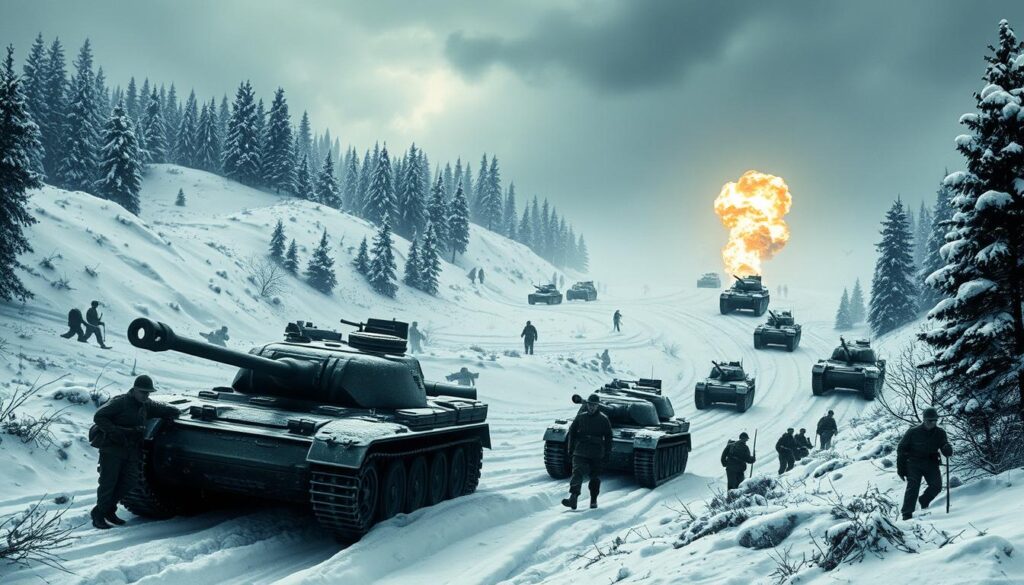
The Battle of the Bulge was a major German attack from 16 December 1944 to 25 January 1945. It involved a large number of troops and caused significant casualties1. This battle, also known as the Bulge, was a bulging pocket in the Allied front lines.
The German army’s surprise attack happened in the densely forested Ardennes region between Belgium and Luxembourg. The term “Bulge” refers to the bulging shape of the battlefield. The German forces tried to push through the Allied lines, creating a bulge in the process.
The Battle of the Bulge was the largest and bloodiest battle fought by the United States in World War II. Allied forces had more than 700,000 men, with casualties ranging from 77,000 to over 83,000, including at least 8,600 killed1. The German forces had over 410,000 men, 1,400 tanks, 2,600 artillery pieces, and over 1,000 combat aircraft1.
The battle was a significant turning point in the war. It was Germany’s last major offensive on the Western Front. The battle resulted in a substantial bulge in the Allied lines.
Key Takeaways
- The Battle of the Bulge took place from 16 December 1944 to 25 January 19451.
- The German forces committed over 410,000 men and a significant amount of military equipment1.
- The Allied forces amounted to more than 700,000 men, with casualties ranging from 77,000 to over 83,0001.
- The battle was the largest and bloodiest single battle fought by the United States in World War II1.
- The term “Bulge” refers to the bulging shape of the battlefield, where the German forces attempted to push through the Allied lines.
- The battle resulted in a substantial bulge in the Allied lines, but ultimately ended in defeat for the German army.
- The German offensive utilized around 2,100 tanks and assault guns, and had approximately 1,900 artillery pieces at their disposal2.
Overview of the Battle of the Bulge
The Battle of the Bulge was a key moment in World War II. It was filled with intense fighting and clever strategies.
Historical Context of World War II
After the D-Day landings, the Allies pushed the Germans back. This was a critical time for the Allies as they moved towards Germany. They wanted to end the war quickly.
Key Players in the Battle
- General Dwight D. Eisenhower: Led the Allied forces.
- General George S. Patton: Commanded the Third Army, key in the counterattacks.
- Field Marshal Gerd von Rundstedt: Led the German forces in the offensive.
Significance of the Battle
The Battle of the Bulge was the biggest and bloodiest battle for the U.S. in World War II. Over 600,000 American soldiers were involved3. This battle was very tough for both sides, testing their strength and strategy. It weakened Nazi Germany, helping to end the war sooner.
| Statistic | Detail |
|---|---|
| Dates | December 16, 1944 – January 28, 19454 |
| Location | Ardennes, Belgium, Meuse River4 |
| Participants | Germany, United Kingdom, United States4 |
| Total Allied Casualties | 75,0004 |
| Total German Casualties | 120,0004 |
| Duration of Offensive | Started before dawn on December 16, 19444 |
| Miles Advanced by Fifth Panzer Army by December 24 | Within 4 miles (6 km) of the Meuse River4 |
Major Events During the Battle
The Battle of the Bulge lasted five weeks, from December 16, 1944, to January 25, 1945. It was filled with unexpected moves and intense battles5.
The German Offensive Begins
On December 16, 1944, German forces launched a surprise attack through the Ardennes Forest. They aimed to split the Allied armies and disrupt their supply lines5.
Allied Responses and Counterattacks
American troops, like those around Bastogne and Elsenborn Ridge, quickly responded to the German attack. General Patton’s Fourth Armored Division made a 150-mile advance in just 19 hours. This helped relieve forces trapped by the enemy56.
Life in the Trenches: Soldier Experiences
Soldiers faced harsh winter conditions, similar to dealing with a bulging disc. The extreme cold and constant fighting were huge physical and mental challenges6.
“The nights were freezing, and every day felt like lifting a heavy burden,” shared a veteran who survived the trenches.
- Extreme cold leading to frostbite
- Pneumonia from harsh weather
- Constant fear and stress of combat
| Event | Date | Casualties |
|---|---|---|
| German Offensive Begins | December 16, 1944 | 19,000 killed, 47,500 wounded56 |
| Patton’s Relief of Bastogne | December 27, 1944 | Significant strategic advantage gained5 |
| End of Battle | January 25, 1945 | Over 100,000 German casualties56 |
Strategic Implications After the Battle
The Battle of the Bulge changed military strategies for both sides. Commanders adjusted their plans, like fixing bulge clothing, to cover weaknesses shown in the battle.
Shifts in Military Strategy
Allied forces learned to value mobility and flexibility. They saw how German rigidity caused problems. This change is like bulge repair, where small fixes make a big difference7.
Impact on Allied Forces
The Allies worked hard to fix and strengthen their lines. They aimed to quickly fix any weak spots. This effort is similar to bulge repair, focusing on detailed work to restore power and function8.
Consequences for Nazi Germany
The failed attack hurt Nazi Germany’s military a lot. Their forces, once strong, now needed fixing, struggling to regain power. They were forced to retreat78.
Commemoration and Legacy
The Battle of the Bulge is honored through memorials and events. These keep its memory alive for future generations.
Significant Memorials and Sites
In the United States, 46 monuments remember the Battle of the Bulge. They were built by local chapters9. Places like Winchenden, MA, Jefferson Barracks, MO, and Arlington, VA, are for reflection and learning.
Remembering the Soldiers
Efforts to honor veterans include a 60-page Christmas stories booklet. It features Bulge veterans for $15, including shipping9. Annual ceremonies, like the 80th anniversary in Bastogne, involve U.S. Army Garrison Benelux and the 101st Airborne Division10.
Surviving soldiers take part in wreath-laying and other activities. This ensures their stories are kept alive10.
The Battle in Popular Culture
The Battle of the Bulge has inspired many books, films, and documentaries. A 1965 documentary on American veterans was nominated for an Academy Award9. Music and reenactments also keep its legacy alive, like Fred Faulkner’s Ardennes March by the Florida Orchestra9.
Organizations like BOBA host events and talks. They include a three-part program at the WWII American Experience museum in Gettysburg9.
FAQ
Why is the Battle of the Bulge referred to as a “bulge”?
The term “bulge” comes from the German Ardennes offensive. It created a bulge in the Allied lines. This disruption was like a bulge in pants, changing how the Allies defended.
What strategic advantages did the Germans seek with their offensive, often compared to bulge removal?
The Germans wanted to split the Allied forces and take Antwerp. This would remove the “bulge” in the lines, giving them an advantage. They aimed to weaken the Allies’ supply chain and push for peace.
How did the harsh winter conditions during the Battle of the Bulge affect the soldiers, similar to dealing with a bulging disc?
The cold weather was very hard on soldiers, like a bulging disc is on the back. They faced freezing temps, limited supplies, and tough terrain. They needed to stay strong and adapt to keep fighting.
In what ways did the Allied forces engage in “bulge exercises” to counter the German offensive?
The Allies did lots of military exercises to fight back. They moved troops, strengthened Bastogne, and launched counterattacks. These efforts aimed to push back the German bulge and secure their lines.
What were the long-term “bulge repairs” necessary for the Allied forces after the battle?
After the battle, the Allies had to fix their military setup. They worked on their supply lines and troop positions. This ensured they could defend against future attacks and move forward in Europe.
How is the legacy of the Battle of the Bulge preserved in modern “bulge clothing” or military attire?
The battle’s legacy lives on in special military clothes and uniforms. These items remember the battle’s bravery and strategic value. They keep the World War II history alive.
What memorials and historical sites serve as “bulge removals” of the past, preserving the history of the Battle of the Bulge?
Many memorials and sites keep the Battle of the Bulge’s memory alive. Places like the Bastogne War Museum and the Bois Jacques Memorial teach about the battle. They ensure its importance is remembered.
How have popular culture representations of the Battle of the Bulge contributed to its “bulge repair” in public memory?
Movies, documentaries, and games have helped keep the Battle of the Bulge in the public eye. They share its story with more people. This keeps its lessons and heroism alive for future generations.
Source Links
- Battle of the Bulge – https://en.wikipedia.org/wiki/Battle_of_the_Bulge
- What You Need To Know About The Battle Of The Bulge – https://www.iwm.org.uk/history/what-you-need-to-know-about-the-battle-of-the-bulge
- Battle of the Bulge | The United States Army – http://www.army.mil/botb/
- Battle of the Bulge | Summary, Commanders, & Significance | Britannica – https://www.britannica.com/event/Battle-of-the-Bulge
- Battle of the Bulge: A Timeline of Key Events — Team Red, White & Blue – https://teamrwb.org/blog/battle-of-the-bulge-timeline-of-key-events
- Battle of the Bulge ‑ Definition, Dates & Who Won – https://www.history.com/topics/world-war-ii/battle-of-the-bulge
- Remembering the Battle of the Bulge: 80 Years Later – https://news.syr.edu/blog/2024/12/10/remembering-the-battle-of-the-bulge-80-years-later/
- Chapter 4-THE ARDENNES: BATTLE OF THE BULGE – https://www.history.army.mil/books/wwii/7-8/7-8_4.htm
- Battle of the Bulge Association® – https://battleofthebulge.org/
- Heroes welcomed in Belgium for Battle of the Bulge 80th commemoration – https://www.army.mil/article/282056/heroes_welcomed_in_belgium_for_battle_of_the_bulge_80th_commemoration