The Crimean War was a major event in history, fought from October 1853 to February 1856. It involved the Russian Empire and an alliance of the Ottoman Empire, France, the United Kingdom, and Sardinia-Piedmont1. This war was a turning point in European power dynamics.
It introduced modern warfare, marking a significant chapter in military history. We will explore the complex reasons behind this war. Key players and their goals are essential to understanding this period.
The Crimean War was a key moment in 19th-century Europe. It lasted about 2 years, 5 months, and 2 weeks1. Russia lost the Danube Delta and Southern Bessarabia as a result1.
Major powers like France, the Ottoman Empire, Sardinia, the United Kingdom, and Russia were involved2. The British and French joined on March 28, 18542. The war also led to improvements in battlefield medicine, thanks to Florence Nightingale2. Emperor Alexander II rose to power after the war2.
Key Takeaways
- The Crimean War was a significant event in European history, lasting from October 1853 to February 1856.
- The war involved major participants, including France, Ottoman Empire, Sardinia, United Kingdom, and Russian Empire2.
- The war saw the introduction of modern warfare elements and had a profound impact on the balance of power in Europe.
- The war resulted in significant territorial changes, including Russia losing the Danube Delta and Southern Bessarabia1.
- The war had a significant impact on battlefield medicine, with improvements by Florence Nightingale2.
- The war is an essential part of the Crimean War timeline and Crimean War history.
Overview of the Crimean War
The Crimean War lasted from 1853 to 18563. It was a major conflict that changed how power was distributed in Europe. This section will explore the Crimean War causes, introduce the main Crimean War participants, and highlight key events that shaped the war.
Causes of the War
Russia wanted to protect Orthodox Christians in the Ottoman Empire3. Disputes over religious rights in Palestine with France added to the tension3. The weakening Ottoman Empire and Russia’s desire for more land threatened European stability4.
Major Participants
Many countries were key players in the Crimean War:
- Russia: Wanted to grow its influence and protect Orthodox Christians.
- Ottoman Empire: Tried to keep its territory intact.
- Great Britain: Acted to stop Russian growth and protect its trade routes.
- France: Teamed up with Britain to balance Russian power.
- Sardinia-Piedmont: Joined the Allies to boost its standing in Europe.
Timeline of Events
| Year | Event | Significance |
|---|---|---|
| 1853 | Battle of Sinop | Ottoman defeat with nearly 2,000 sailors lost3 |
| 1854 | Battle of Alma | Allied forces lost 962 men; over 5,700 Russian soldiers killed3 |
| 1854 | Battle of Balaclava | Thin red line held against Russian cavalry; Light Brigade suffered heavy losses3 |
| 1854 | Battle of Inkerman | Allied forces lost 2,500 British and 1,700 French soldiers3 |
| 1856 | Treaty of Paris | War ended; Russia returned seized territories and demilitarized the Black Sea3 |
Key Battles and Military Strategies
The Crimean War history is filled with key battles that changed the war’s outcome. These fights showed the military skills of the nations involved. They also showed how warfare was changing back then.
Siege of Sebastopol
The Siege of Sebastopol lasted a year and tested both sides’ endurance and engineering. It weakened the Russian defenses and was a turning point in the war5.
Battle of Balaclava
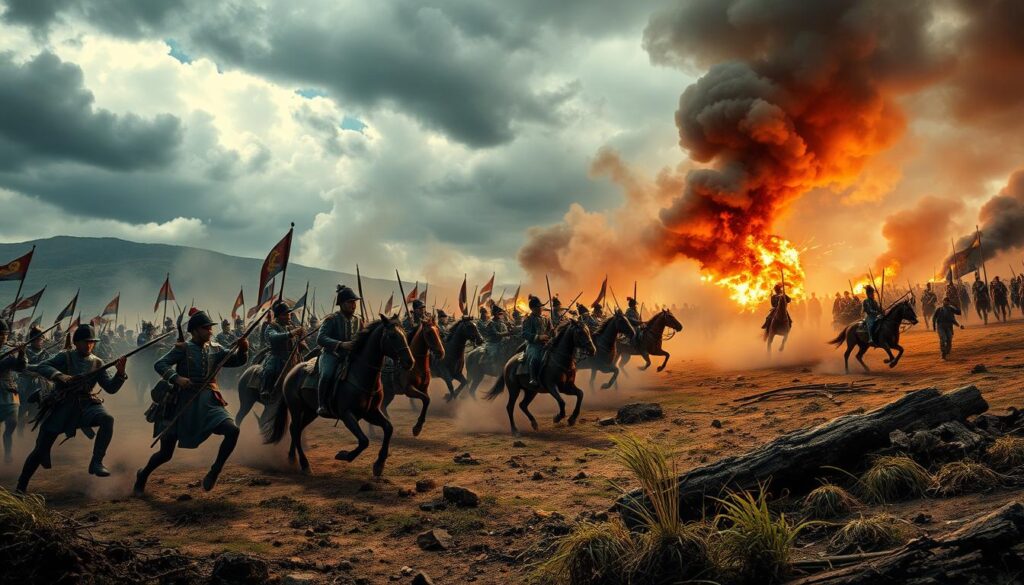
The Battle of Balaclava is well-known in the Crimean War timeline. It’s famous for Alfred Lord Tennyson’s poem, “The Charge of the Light Brigade.” The battle showed bravery and mistakes by the British. It ended in a stalemate, with Balaclava staying in Allied hands, making Russian supply lines harder6.
Innovations in Warfare
- Introduction of explosive naval shells
- Use of railways for military logistics
- Implementation of telegraphs for rapid communication
- Deployment of new artillery technologies
The Crimean War was the first to use modern technologies, changing military strategies. These new tools influenced the war’s outcome and paved the way for future military advancements57.
| Battle | Date | Outcome |
|---|---|---|
| Alma River | September 20, 1854 | Allied Victory |
| Balaclava | October 25, 1854 | Strategic Stalemate |
| Inkerman | November 5, 1854 | Allied Victory |
Consequences and Legacy of the War
The Crimean War had a lasting impact on Europe. It changed political alliances, society, and military tactics. It also shaped the course of future wars and modernized the involved nations.
Political Implications
The Treaty of Paris in 1856 changed Europe’s power balance. It reduced Russia’s power and helped the Ottoman Empire, France, and Britain8. Austria lost Russian support, leading to losing territory within a decade8.
This change helped Italy and Germany unite. Weakened Austria could no longer control these areas8.
Social Changes in Europe
The war led to big social reforms, like Russia ending serfdom. Tsar Alexander II did this to keep up with Europe8. It was a step towards modernizing Russia.
Because of high death rates from disease, military medicine improved. The Royal Sanitary Commission and Army Medical School were created9. Florence Nightingale’s work at Sebastopol changed nursing forever9.
Influence on Future Conflicts
The Crimean War brought new weapons like rifled muskets and the Minie ball. These made guns more accurate and far-reaching810. These changes affected military strategies in later wars, like the American Civil War and World War I10.
The war also showed the importance of good logistics and medical care. These lessons were key for future military operations9.
FAQ
What were the primary causes of the Crimean War?
The Crimean War was caused by many factors. The Ottoman Empire’s decline led to a power vacuum. Russia wanted to control the Black Sea and warm-water ports. Western powers wanted to keep the balance of power in Europe.
Disputes over holy sites in Palestine also played a big role. This led to a complex web of alliances and rivalries. These factors ultimately sparked the war.
Who were the major participants in the Crimean War?
The main players in the Crimean War were Russia, the Ottoman Empire, Britain, France, and Sardinia-Piedmont. Russia wanted to expand its influence and control strategic territories. The Ottoman Empire wanted to keep its territories.
Britain and France intervened to stop Russia’s dominance. They wanted to protect their interests. Sardinia-Piedmont joined to support the balance of power in Europe and boost its standing.
Can you provide a timeline of key events during the Crimean War?
Sure! The Crimean War started in 1853 over holy sites in Palestine. In 1854, the allies launched the Siege of Sebastopol, a key campaign lasting until 1855.
The Battle of Balaclava took place in October 1854, known for the Charge of the Light Brigade. Battles and diplomatic moves shaped the war in 1855. The war ended with the Treaty of Paris in 1856, changing Europe’s balance of power.
What were the key battles and military strategies employed in the Crimean War?
The Crimean War saw many important battles and new military strategies. The Siege of Sebastopol lasted a year, testing military engineering and endurance.
The Battle of Balaclava is famous for the Charge of the Light Brigade. The war also saw the introduction of modern warfare, like railways and telegraphs. These innovations changed how wars were fought.
What was the outcome of the Crimean War and its impact on European power dynamics?
The Crimean War ended with the Treaty of Paris in 1856. This treaty changed the European balance of power. Russia’s expansion was stopped, weakening its influence.
Britain and France gained more power. The war also led to reforms in Russia, like the end of serfdom. It influenced Italy and Germany’s unification. The war solidified Western powers’ dominance and changed European diplomacy.
How did the Crimean War influence future conflicts and military technology?
The Crimean War had a big impact on future wars and technology. It introduced railways and telegraphs for better troop and supply transport and communication.
Advances in artillery and medical care, like Florence Nightingale’s work, set new standards. These changes influenced wars like the American Civil War and World War I, showing the importance of technology and communication.
What social changes in Europe were sparked by the Crimean War?
The Crimean War led to many social changes in Europe. It improved medical care, thanks to figures like Florence Nightingale.
It also brought war reporting and photography to the public, raising awareness of war. The war made public opinion more important in shaping policies and strategies, leading to a more informed citizenry.
Why is the Crimean War considered significant in European history?
The Crimean War is important in European history for many reasons. It shifted the balance of power, stopping Russian expansion and strengthening Western powers like Britain and France.
The war introduced modern warfare elements, like technology and new strategies. It had big political and social effects, including reforms in Russia and changes in how people viewed war. Its detailed documentation through reports and photography gave valuable insights into 19th-century warfare.
Source Links
- Crimean War – https://en.wikipedia.org/wiki/Crimean_War
- Crimean War | Map, Summary, Combatants, Causes, & Facts | Britannica – https://www.britannica.com/event/Crimean-War
- Crimean War ‑ Summary, Facts & Causes | HISTORY – https://www.history.com/topics/european-history/crimean-war
- The Crimean War (U.S. National Park Service) – https://www.nps.gov/places/the-crimean-war.htm
- No title found – https://www.oxfordbibliographies.com/abstract/document/obo-9780199791279/obo-9780199791279-0228.xml
- Battle of Balaklava | National Army Museum – https://www.nam.ac.uk/explore/battle-balaklava
- The Anglo-French Crimean War Coalition, 1854–1856 – https://www.rusi.org/explore-our-research/publications/commentary/anglo-french-crimean-war-coalition-1854-1856
- BBC – History – The Crimean War – https://www.bbc.co.uk/history/british/victorians/crimea_01.shtml
- The Crimean War and the Birth of Modern Military Medicine – https://www.ibms.org/resources/news/the-crimean-war-and-the-birth-of-modern-military-medicine/
- The Crimean War: A pivotal conflict in world history – https://www.ourhistory.org.uk/the-crimean-war-a-pivotal-conflict-in-world-history/