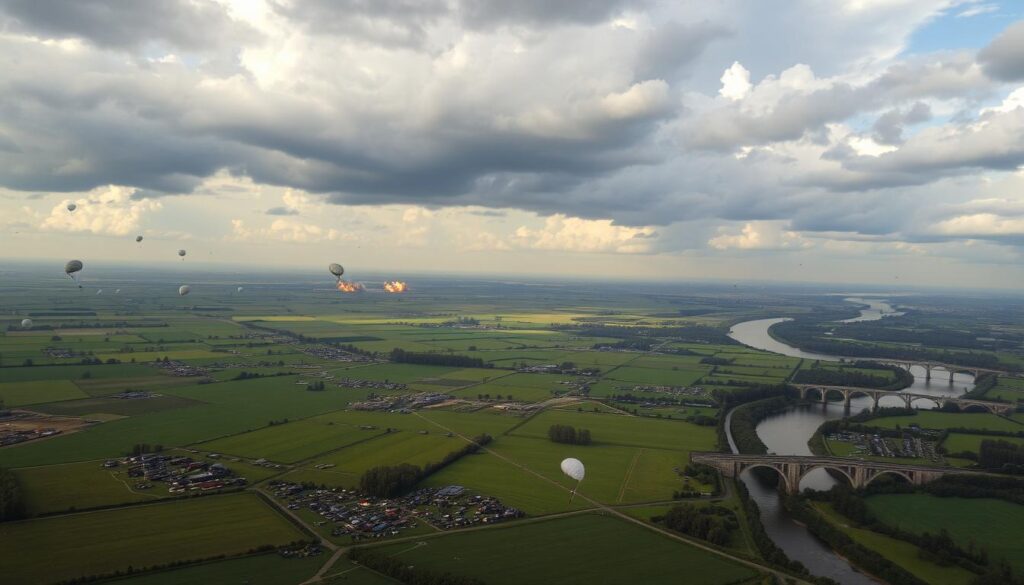
Operation Market Garden was a big Allied move in World War II. It happened in the German-occupied Netherlands from 17 to 25 September 1944. The goal was to make a 64 mi (103 km) gap into German land with a bridge over the Nederrijn (Lower Rhine River). This would open a path into northern Germany1.
This airborne attack, with 20,000 troops at first, was part of a plan to end the war by Christmas 19442. It was the biggest airborne attack of World War II. The aim was to drop troops along an eighty-mile path in Holland, securing key bridges and water barriers3.
Three divisions and one independent brigade, with 63,759 troops, took part in the airborne forces1. It was part of a bigger plan to expand control in Europe. The main goal was to get Allied troops across the Rhine River3.
The Allies, including the United Kingdom, United States, and others, launched this bold move across the Netherlands. Places like Arnhem, Eindhoven, and Nijmegen were involved2.
Key Takeaways
- Operation Market Garden was an Allied military operation during World War II, fought in the Netherlands from 17 to 25 September 1944.
- The operation involved 20,000 initial parachute and glider troops, with the objective of creating a bridgehead over the Nederrijn (Lower Rhine River)2.
- The operation was the largest airborne attack during World War II, aiming to secure bridges and major water barriers3.
- The Allies involved in the operation included the United Kingdom, United States, and other participants, with the principal objective of getting Allied troops across the Rhine River3.
- The operation involved approximately 100,000 German soldiers opposing the Allied offensive1.
- The casualties and losses during Operation Market Garden ranged from 15,326 to 17,200 killed, wounded, and captured, with 88 tanks destroyed and 377 aircraft and gliders lost1.
The Objectives of Operation Market Garden
Operation Market Garden aimed to quickly change the war’s direction by opening a key path through the Netherlands. The main goal was to cross the Rhine River. This would help the Allied advance into Germany.
Aims to Secure Strategic Crossings
The mission focused on taking control of important bridges for the Allied advance. These bridges were key for moving troops and supplies quickly. This was vital for keeping the momentum on the front lines4.
Expanding Allied Control in Europe
The Allies wanted to gain control over key areas in Europe. This was essential for weakening German defenses. It also helped pave the way for more attacks into occupied lands5.
Coordinated Land and Air Assault
The operation combined airborne divisions and ground forces in a complex plan. The airborne divisions were to capture and hold bridges. At the same time, ground units would push forward in an armored thrust to connect and secure the path6.
The plan was to merge airborne divisions with armored units for a smooth advance. This was to avoid delays and make the operation’s impact stronger. Yet, the presence of about 100,000 German soldiers made the task very challenging4.
The Challenges Faced
Operation Market Garden faced many obstacles that made it hard to succeed. These challenges tested the strength and flexibility of the Allied forces.
Logistical Issues
The operation was hit hard by supply shortages. This was mainly because there were not enough transport planes7. Airborne troops were dropped in three waves, which weakened their initial power. This gave German forces time to react7.
Adverse Weather Conditions
Bad weather was a big problem. Fog in England delayed help, and low clouds over the battle area made it hard to get supplies and reinforcements by air7. These issues caused delays in important missions, making coordination tough.
Resistance from German Forces
The Allies didn’t think the Germans in the Netherlands would fight so hard. The 9th and 10th SS Panzer divisions, even though they were not full strength, launched strong German counter-attacks. The airborne troops were not ready for this8.
Communication Breakdowns
The dense woods in Arnhem made wireless communication hard. This led to a lot of radio failures and problems coordinating between units7. These issues made it hard to ask for help and made decision-making slow.
| Challenge | Impact | Details |
|---|---|---|
| Supply Shortages | Reduced troop strength | Limited transport aircraft necessitated staggered deployments7 |
| Weather Interference | Delayed missions | Fog and low clouds disrupted resupply and reinforcements7 |
| German Counter-Attacks | hindered progress> | Presence of SS Panzer divisions led to fierce resistance8 |
| Radio Failures | Poor coordination | Wooded terrain restricted wireless set range, causing communication breakdowns7 |
The Aftermath and Legacy
Operation Market Garden changed the war’s path, making the Allies rethink their strategy.
Long-Term Implications for WWII
The battle cost the Allies over 17,000 lives, while the Germans lost about 8,0009. The failure to cross the Rhine delayed the push into Germany by six months9. This forced the Allies to change their plans, aiming for a broader victory.
Lessons Learned in Military Strategy
Market Garden showed how vital good intelligence is and the risks of being too optimistic9. It taught the importance of being flexible and ready for surprises on the battlefield.
Influence on Subsequent Operations
The lessons from Market Garden helped in later successes, like Operation Varsity in 19459. The teamwork between airborne and ground troops improved, making future plans more effective.
Despite failing, Market Garden is a key topic in history debates9. It’s studied in books and films. The bravery of the soldiers is remembered, keeping the operation’s legacy alive in World War II history.
FAQ
What was the primary objective of Operation Market Garden?
The main goal of Operation Market Garden was to open a path through the Netherlands. The Allies aimed to cross the Rhine River and reach Germany’s industrial heart. This could have ended World War II in Europe quickly.
Who conceived Operation Market Garden?
A: Field Marshal Bernard Montgomery came up with Operation Market Garden. He wanted to speed up the Allied victory by Christmas 1944. He planned a big airborne and ground attack.
What were the main components of Operation Market Garden?
The plan had two parts: “Market” and “Garden”. “Market” was the airborne assault to capture key bridges. “Garden” was the ground forces advance, like XXX Corps, to help the airborne units.
Why was Operation Market Garden considered ambitious?
A: Operation Market Garden was bold because of its size and complexity. It aimed to quickly move into Germany by securing key points in the Netherlands. The plan needed perfect coordination, making it a daring effort in World War II.
What challenges did Operation Market Garden face?
The operation faced many hurdles. There were logistical issues like not enough planes. Bad weather delayed help and air support. The German resistance was stronger than expected, and communication problems made things worse.
How did weather affect Operation Market Garden?
Bad weather was a big problem. Fog in England slowed down help and supplies. Low clouds over the battle area made air support hard, affecting the Allies’ coordination and success.
What role did German resistance play in the outcome of Operation Market Garden?
The German resistance was much stronger than the Allies thought. Two SS Panzer divisions fought hard against the airborne troops. This made Operation Market Garden fail and delayed the Allied push into Germany.
What were the immediate consequences of the failure of Operation Market Garden?
The failure led to the loss of thousands of Allied troops, including the British 1st Airborne Division at Arnhem. Not getting a bridgehead over the Rhine made the Allies wait months to enter Germany, extending the war into 1945.
How did Operation Market Garden influence subsequent Allied military strategies?
The failure of Operation Market Garden made the Allies rethink their plans. They went back to Eisenhower’s broader approach instead of Montgomery’s narrow strategy. This change helped in planning future operations, like Operation Varsity in 1945.
What lessons were learned from Operation Market Garden?
Key lessons included the importance of good intelligence and not being too optimistic in planning. The need for flexibility and reliable communication in big operations was also learned. These lessons were important for future military strategies.
Why is Operation Market Garden considered a significant event in military history?
A: Operation Market Garden is important because of its scale, complexity, and bold goals. It shows the bravery of the Allies and the challenges of big military operations. It’s studied a lot in history, books, and films, making it a key example in understanding war.
How did logistics impact the success of Operation Market Garden?
A: Logistical issues were a big problem. There weren’t enough planes and supplies for the troops at Arnhem. These problems made it hard to keep the airborne divisions going and let the Germans counter-attack effectively.
What was “Hell’s Highway” in the context of Operation Market Garden?
“Hell’s Highway” was the main road that XXX Corps had to follow. It was exposed and vulnerable to jams and German attacks. This made Operation Market Garden harder to succeed.
Source Links
- Operation Market Garden – https://en.wikipedia.org/wiki/Operation_Market_Garden
- Operation Market Garden (1944) | Summary, Date, & Significance | Britannica – https://www.britannica.com/event/Operation-Market-Garden
- Operation MARKET-GARDEN – https://www.history.army.mil/books/70-7_19.htm
- U.S., Allies Remember Operation Market Garden – https://www.defense.gov/News/Feature-Stories/Story/Article/1963536/us-allies-remember-operation-market-garden/
- Operation Market Garden | ASOMF – https://www.asomf.org/operation-market-garden/
- Operation Market Garden Day 1 – The Tank Museum – https://tankmuseum.org/article/operation-market-garden-day-1
- Operation Market Garden | National Army Museum – https://www.nam.ac.uk/explore/market-garden
- Why did Operation Market Garden fail? – https://www.iwm.org.uk/history/why-did-operation-market-garden-fail
- The Allies Hoped Operation Market Garden Would End WWII. Here’s What Went Wrong | HISTORY – https://www.history.com/news/operation-market-garden-failure-allies