The Battle of Verdun was a key event in World War I. It happened from February 21 to December 18, 1916, in France. It caused an estimated 714,231 casualties1.
This battle showed the strength of human spirit and the horrors of modern war. The German siege of Verdun began in February 19162. It lasted for 10 months, making it the longest battle of World War I3.
Understanding the Battle of Verdun requires knowing its strategic value and the context of the Western Front. The battle resulted in at least 714,000 losses, with 377,000 French and 337,000 Germans affected1. About 1 million German troops faced around 200,000 defenders at Verdun2.
The Battle of Verdun was a turning point in the war. Verdun saw around 100,000 shells fall every hour during the battle2. The French Second Army had 259 infantry regiments defending Verdun2. Over 1,200 German Krupp 38-centimeter long-barreled guns bombarded French forces along a 20-kilometer front stretching across the Meuse River3.
Key Takeaways
- The Battle of Verdun was one of the longest and bloodiest battles of World War I.
- The battle resulted in an estimated 714,231 casualties.
- Verdun was a strategic location on the Western Front.
- The German siege of Verdun started in February 1916.
- The French Second Army had 259 infantry regiments involved in the defense of Verdun.
- The Battle of Verdun was a significant turning point in the war.
Overview of the Battle of Verdun
The Battle of Verdun was a key event in Verdun history. It happened during World War I on the Western Front. This battle showed the strength and strategy of warfare.
Historical Context
German Chief of General Staff Erich von Falkenhayn started the battle. He wanted to take the Verdun fortress and hurt the French army badly. Falkenhayn planned to weaken the French through long battles, a tactic called “bleeding white”.
Key Dates and Timeline
- The battle began on February 21, 1916, with a strong German artillery attack4.
- By June, the Germans took important places like Fort Douaumont5.
- The German attack slowed down on June 24 to help the Somme front5.
- By December 18, 1916, French counterattacks had stabilized the front4.
The Significance of Verdun
Verdun was important because of its strong defenses and its meaning to France. The battle was very intense and had many casualties. It changed military tactics and raised national pride in Verdun France45.
Major Strategies and Tactics
The Verdun battle was a complex fight between French and German forces. Each side tried to outsmart the other in one of World War I’s toughest battles.
French Defensive Strategy
General Philippe Pétain used a defense in depth strategy. He set up a network of strongpoints that supported each other. This kept French troops fresh and their morale high, even under constant German attacks.
German Offensive Tactics
At first, General Falkenhayn aimed to weaken the French army through constant attacks. He involved about 75% of French and one third of German divisions in the Verdun battle6. Later, Crown Prince Wilhelm focused on quick gains, using over 1,400 guns and mortars to break through French defenses7.
Use of Artillery in the Battle
Artillery was key, with Germans using nearly 500 15cm Heavy Field Howitzers. They fired almost 4 million rounds7. This heavy fire not only destroyed the land but also weakened French spirits, affecting their fight in the long Verdun battle6.
| Strategy/Tactic | Description | Reference |
|---|---|---|
| French Defense in Depth | Network of strongpoints with troop rotations to sustain defense | Based on detailed historical accounts |
| German Attrition Strategy | Engaged 1/3 of German divisions to wear down French forces | 6 |
| German Territorial Offensive | Shift to capturing key areas with concentrated artillery | 7 |
| Artillery Usage | Deployment of 500 heavy howitzers firing 4 million rounds | 7 |
Impact on Soldiers and Civilians
The Battle of Verdun had a lasting impact on soldiers and civilians. Over 700,000 casualties and about 300,000 soldiers killed8 were the results. Soldiers faced harsh conditions, including constant artillery fire, disease, and mental trauma9.
Life in the Trenches
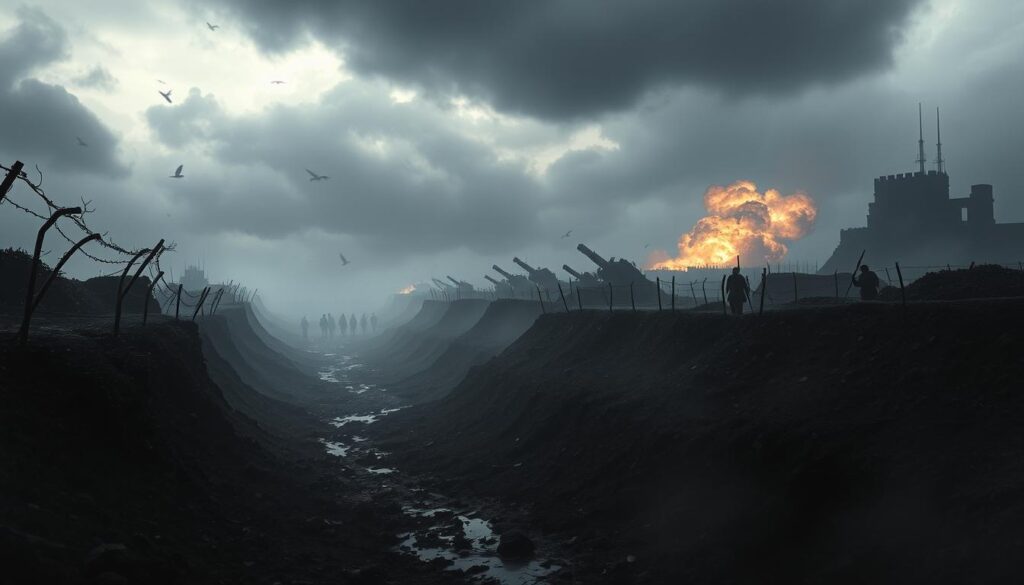
Life in the trenches was a daily fight for survival. Soldiers had to deal with mud, poor supplies, and the danger of enemy attacks. The use of new weapons and intense artillery caused severe physical and mental strain10.
The tough conditions brought soldiers together, but also led to long-lasting mental health issues.
Civilian Displacement and Suffering
Civilians in Verdun suffered greatly as their towns became battlefields. Entire villages, like Beaumont and Douaumont, were destroyed, displacing thousands9. The damage caused long-term economic and social problems, with many never returning home.
Today, the Verdun cemetery is a reminder of the battle’s human cost, drawing visitors for Verdun tourism. The Douaumont Ossuary memorial honors over 150,000 unidentified soldiers8. It’s a place for reflection and remembrance.
Legacy and Historical Interpretation
The Battle of Verdun is a symbol of courage and sacrifice in France. The Douaumont Ossuary and the Verdun Memorial remind us of the 302-day fight11. These places draw many visitors, making Verdun tourism key to keeping this history alive.
Commemoration and Memorials
The Verdun Memorial opened in 1967, marking a new start in Franco-German relations12. The Douaumont Ossuary holds the remains of thousands, a place for quiet reflection. These sites honor the fallen and teach visitors about the battle’s impact.
Lessons Learned from Verdun
The Battle of Verdun changed military tactics, showing the flaws of endless war and the need for teamwork11. Historians see it as a symbol of bravery or a lesson in the futility of war1213. These lessons teach us about war’s costs and the need for smart planning.
Enduring Influence and Modern Relevance
Verdun’s story shapes France’s identity, showing strength and unity. Remembering the battle teaches us about peace and war’s dangers. As Verdun tourism grows, it helps future generations understand the sacrifices made, keeping history alive11.
FAQ
What was the Battle of Verdun and why is it significant in World War I?
The Battle of Verdun was a long and bloody fight in World War I. It showed the harshness of modern war. Fought in 1916 in Verdun, France, it was a key battle that drained both French and German forces.
Who were the key military leaders involved in the Battle of Verdun?
Important leaders included German Chief of General Staff Erich von Falkenhayn and French General Philippe Pétain. Falkenhayn led the German attack. Pétain, on the other hand, came up with the French defense that stopped the Germans.
What strategies did the French and German forces employ during the Battle of Verdun?
General Pétain led the French with a defensive plan. They used a deep defense and rotated troops to keep morale up. The Germans first tried to weaken the French with Falkenhayn’s strategy. Later, they aimed to take land under Crown Prince Wilhelm.
How did the use of artillery influence the Battle of Verdun?
Artillery was key in Verdun, with both sides using many guns and shells. This heavy fire turned the battlefield into a desolate area. It greatly affected the strategies and results of the battle.
What was life like for soldiers and civilians during the Battle of Verdun?
Soldiers faced harsh conditions in the trenches. They dealt with constant enemy fire, disease, mud, and mental stress. New weapons and tactics, like artillery barrages and poison gas, caused severe harm. Civilians were displaced and saw Verdun change from a quiet town to a symbol of French resistance.
What is the legacy of the Battle of Verdun today?
Verdun’s legacy lives on through memorials and sites like the Douaumont Ossuary and the Verdun Memorial. These places remember the battle and its impact on military strategy. Verdun also attracts tourists who want to learn about its history.
Why was Verdun chosen as the focal point for this major conflict?
Verdun was picked for its strong position on the Western Front and its importance to France. Holding Verdun was vital for both sides, making it a key goal in their strategies.
How did the Battle of Verdun impact French national identity?
The bravery and sacrifice of French forces during Verdun boosted national pride and unity. The battle’s outcome showed French determination. It has become a key moment in France’s history, symbolizing resistance and endurance.
Source Links
- Memories of Verdun by Francois Wikart – https://www.westernfrontassociation.com/world-war-i-articles/memories-of-verdun-by-francois-wikart/
- First World War.com – Battles – https://www.firstworldwar.com/battles/verdun.htm
- Battle of Verdun begins | February 21, 1916 | HISTORY – https://www.history.com/this-day-in-history/battle-of-verdun-begins
- Battle of Verdun | Map, Casualties, Significance, Summary, & Facts | Britannica – https://www.britannica.com/event/Battle-of-Verdun
- What Was The Battle Of Verdun? – https://www.iwm.org.uk/history/what-was-the-battle-of-verdun
- The Battle of Verdun and German Strategy in 1916 – https://defenceindepth.co/2016/02/15/the-battle-of-verdun-and-german-strategy-in-1916/
- The Battle of Verdun and German Offensive Tactics in 1916 – https://defenceindepth.co/2016/02/26/the-battle-of-verdun-and-german-offensive-tactics-in-1916/
- Battle of Verdun – WWI, French, German | Britannica – https://www.britannica.com/event/Battle-of-Verdun/The-tide-turns-at-Verdun
- 10 Things You May Not Know About the Battle of Verdun | HISTORY – https://www.history.com/news/10-things-you-may-not-know-about-the-battle-of-verdun
- Battle of Verdun: Date, Outcome & Casualties – https://www.vaia.com/en-us/explanations/history/world-wars/battle-of-verdun/
- Battle of Verdun – https://en.wikipedia.org/wiki/Battle_of_Verdun
- Historiography of Verdun – https://www.johndclare.net/wwi6b.htm
- Why Was the Battle of Verdun so Significant? – https://www.historyhit.com/1916-battle-verdun/