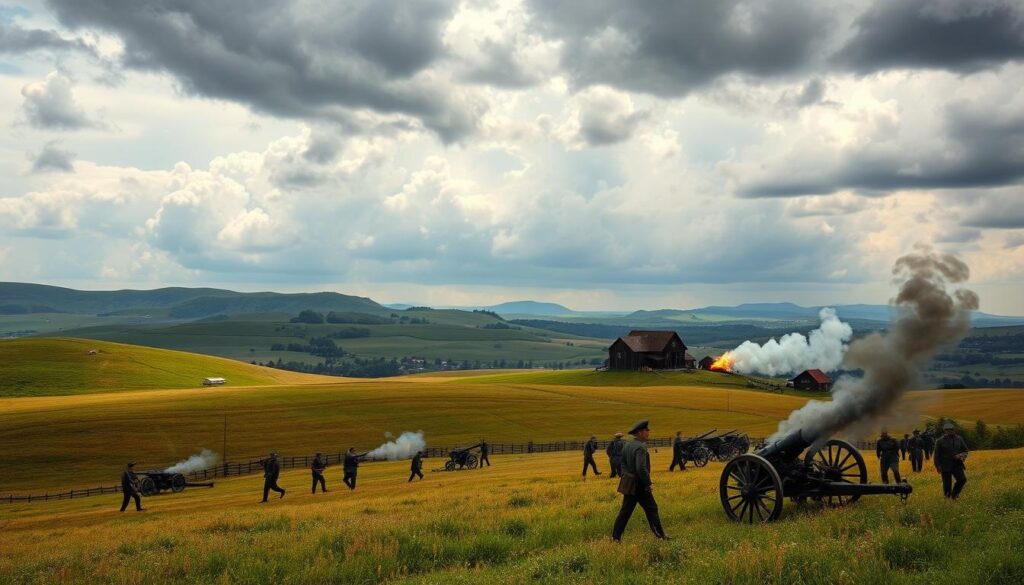
The Battle of Antietam happened on September 17, 1862, near Sharpsburg, Maryland, and Antietam Creek. It was the first major battle on Union soil in the American Civil War1. The battle saw 22,727 soldiers killed, wounded, or missing, making it the bloodiest day in American history1. It’s seen as a key moment in the Civil War1.
The Antietam battle was a turning point for the Union in the American Civil War. It remains the bloodiest single-day battle in American history1.
The Battle of Antietam is the bloodiest day in the American Civil War, with about 23,000 casualties2. Gen. Robert E. Lee led around 40,000 men of the Army of Northern Virginia during the Battle of Antietam in 18623. The battle was a major conflict in the Civil War, with the Union forces having 53,632 engaged soldiers and 275 artillery units. The Confederate forces had 30,646 engaged soldiers and 194 artillery units1.
The Civil War was a significant event in American history, and the Battle of Antietam was a key part of it. The Union victory at the Battle of Antietam was a major turning point1. The battle took place in Maryland, United States, with the Confederate States of America and the United States as participants2. Around 23,000 men from both sides were killed, wounded, or missing during the Battle of Antietam, making it the bloodiest single day in American military history3.
Key Takeaways
- The Battle of Antietam was the bloodiest single-day battle in American history, with 22,727 dead, wounded, or missing soldiers1.
- The battle took place on September 17, 1862, near Sharpsburg, Maryland, and Antietam Creek1.
- Gen. Robert E. Lee led around 40,000 men of the Army of Northern Virginia during the Battle of Antietam in 18623.
- The Union forces had 53,632 engaged soldiers with 275 artillery units, and the Confederate forces had 30,646 engaged soldiers with 194 artillery units1.
- The Battle of Antietam is considered a tactical draw, but President Abraham Lincoln claimed a strategic victory, leading to the delivery of the Emancipation Proclamation3.
- The battle was a major turning point in the favor of the Union during the American Civil War1.
Historical Context of the Battle of Antietam
The Battle of Antietam was a key moment in American history. It was part of the complex Civil War. Knowing why it happened helps us understand its importance and lasting effects.
Causes of Tension Leading to the Battle
Many things made the Union and Confederate armies tense. Confederate General Robert E. Lee wanted to invade Maryland. He hoped to get supplies and sway Northern elections4.
Overview of the Civil War Situation
In 1862, the Civil War was a tough fight. The Union Army, led by Major General George B. McClellan, had about eighty-seven thousand soldiers. They faced Lee’s Army of Northern Virginia, with around forty thousand soldiers5.
The Importance of Maryland
Maryland was key because it was a border state. It was important for both sides. Whoever controlled Maryland could get to vital resources and routes4. It was also a path to the North.
When Union troops found Lee’s Special Order 191, it gave them a big advantage. Despite being outnumbered, the Union Army had a chance because of this secret4. This discovery was a big factor in the battle.
Key Events during the Battle of Antietam
The Battle of Antietam was a turning point in the Civil War. Soldiers from the Union Army and the Confederate Army faced each other near Sharpsburg. They were ready for intense combat.
Initial Engagements on September 16
Early skirmishes started as reconnaissance units clashed. This set the stage for the big battle ahead. The tension was high, showing the clash between the two armies was coming.
The Bloody Encounter at Miller’s Cornfield
Miller’s Cornfield turned into a bloody battlefield. The fighting was relentless, affecting both armies’ morale and plans6.
The Crucial Moment at Burnside Bridge
Crossing Burnside Bridge over Antietam Creek was a key challenge. The Union Army fought hard to cross, a moment that changed the battle’s outcome6.
| Event | Date | Casualties |
|---|---|---|
| Initial Assault by Union Corps | September 16 | 10,000 killed or wounded6 |
| Combat at Bloody Lane | September 17 | 5,500 killed or wounded6 |
| Burnside Bridge Assault | September 17 | 6,000 initiated vs. 2,000 reached Confederate line6 |
| Total Casualties | September 16-17 | 23,000 killed, wounded, or missing6 |
Aftermath and Impact of Antietam
The Battle of Antietam had a deep impact on the Civil War. It left a lasting mark, both immediately and for years to come. The Antietam National Battlefield saw over 26,000 soldiers lost in one day78. This showed the brutal nature of the conflict.
Casualties and Immediate Effects
The Union Army lost 12,410 soldiers, with 2,108 of them dying7. The Confederate Army lost 13,724 soldiers7. These losses showed the fierce determination of both sides.
Strategic Outcomes for Both Armies
Though the battle was tactically a draw, it was a strategic win for the Union. General McClellan stopped General Lee’s invasion of the North7. This gave the Union time to regroup and strengthen their defenses, changing future military plans.
Lasting Legacy of the Battle in American History
The outcome of Antietam gave President Abraham Lincoln the confidence to issue the Emancipation Proclamation7. This changed the war’s purpose. It also stopped European powers from supporting the Confederate Army. Today, Antietam National Battlefield honors bravery and sacrifices, educating and inspiring future generations78.
FAQ
What makes the Battle of Antietam known as the Bloodiest Day in American History?
The Battle of Antietam happened on September 17, 1862. It saw over 22,000 casualties, making it the bloodiest day in U.S. history. The intense fighting at Miller’s Cornfield and Burnside Bridge shows the battle’s extreme brutality.
Why was Maryland a strategic location during the Civil War?
Maryland was key for both the Union and Confederacy. It controlled a vital path to the North for the Confederacy and protected the Union capital. The state’s loyalty was critical, leading to the Battle of Antietam.
How did the Battle of Antietam influence President Lincoln’s policies?
The Union’s win at Antietam gave President Lincoln the chance to issue the Emancipation Proclamation. This move changed the war’s goals, linking it to ending slavery. It also won international support for the Union.
What were the key events that took place during the Battle of Antietam?
The battle started with small fights on September 16. Then, the intense battle in Miller’s Cornfield happened. A key moment was at Burnside Bridge, where Union troops faced heavy fire. These events made the battle significant.
What is the legacy of the Battle of Antietam in American history?
The Battle of Antietam is remembered for its huge loss of life and as a turning point in the Civil War. It changed military tactics and led to the Emancipation Proclamation. Today, it’s a key site for remembering the nation’s history.
How did the outcome of the Battle of Antietam affect the Civil War’s progression?
The Union’s win gave them a strategic advantage, stopping the Confederate Army’s push into the North. This victory helped the Union grow stronger. It also boosted support for President Lincoln’s plans, shaping the war’s future.
Where is the Battle of Antietam National Battlefield located, and why is it important?
The Antietam National Battlefield is near Sharpsburg, Maryland. It keeps the Battle of Antietam site alive, teaching us about the Civil War’s biggest battle. The site reminds us of the war’s severity and its lasting impact on America.
Source Links
- Battle of Antietam – https://en.wikipedia.org/wiki/Battle_of_Antietam
- Battle of Antietam | Summary & Significance | Britannica – https://www.britannica.com/event/Battle-of-Antietam
- Antietam – https://www.battlefields.org/learn/articles/antietam
- Battle of Antietam ‑ Winner, Date & Civil War | HISTORY – https://www.history.com/topics/american-civil-war/battle-of-antietam
- Antietam – https://ahec.armywarcollege.edu/exhibits/CivilWarImagery/edwards_antietam.cfm
- A Short Overview of the Battle of Antietam (U.S. National Park Service) – https://www.nps.gov/articles/a-short-overview-of-the-battle-of-antietam.htm
- Battle of Antietam: Chronology and Aftermath – The History Reader : The History Reader – https://www.thehistoryreader.com/military-history/battle-antietam-chronology-aftermath/
- Antietam’s Gory Aftermath: How the Union Army’s Post-Battle Occupation Devastated Sharpsburg’s Civilians – https://www.historynet.com/sharpsburg-grim-aftermath/