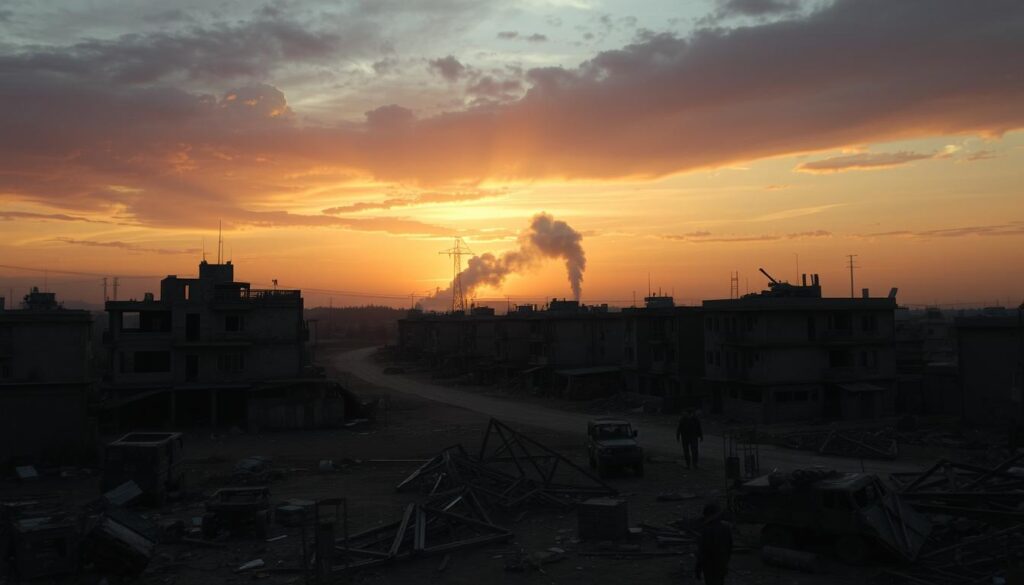
The War in Iraq started in 2003 with the US invasion, leading to Saddam Hussein’s fall1. It’s also known as the Second Gulf War, lasting from 2003 to 20111. Forces from the US, UK, Australia, Poland, and Kurdistan Region fought together, with numbers ranging from 309,000 to 584,799 in 20032.
The War in Iraq deeply affected the region. Iraq Body Count reported 103,160–113,728 civilian deaths. The Associated Press found 110,600 Iraqi deaths from March 2003 to April 20092. Insurgents like Sunni groups, the Mahdi Army, and the Islamic State of Iraq were also involved2.
Key Takeaways
- The War in Iraq lasted from 2003 to 20111.
- The US invasion in 2003 led to Saddam Hussein’s regime fall1.
- Coalition forces had 309,000 to 584,799 personnel in 20032.
- Over 4,400 Americans and nearly 100,000 Iraqis died in the conflict1.
- The War in Iraq had a lasting impact on the region3.
- Key events included Saddam Hussein’s capture and execution13.
Overview of the War in Iraq
The War in Iraq started in March 2003. It changed the Middle East’s politics a lot. The main reason was the belief that Saddam Hussein‘s Iraq had Weapons of Mass Destruction4.
A group of international forces, called Coalition forces, led by the U.S. wanted to stop Hussein’s rule. They aimed to get rid of the WMD threats54.
Causes of the War
The war was sparked by fears of Iraq’s WMDs and the region’s instability. President Bush called Iraq part of the “axis of evil.” This made the U.S. think military action was needed4.
Major Players Involved
- United States: Led the coalition forces pushing for Hussein’s removal.
- United Kingdom: A key ally in the coalition efforts.
- Saddam Hussein: The Iraqi dictator whose regime was the main target.
Timeline of Key Events
The war started on March 19, 2003. By April 14, coalition forces controlled major cities4. Key moments include Baghdad’s fall, the rise of insurgency, and U.S. troop withdrawal.
| Date | Event | Reference |
|---|---|---|
| March 19, 2003 | Invasion of Iraq begins | 4 |
| April 14, 2003 | All major population centers under U.S. control | 4 |
| September 2004 | Battle of Fallujah | 5 |
| July 2006 | Peak in civilian deaths | 5 |
Understanding this war means looking at the fight against WMDs and the challenges in a volatile area.
Consequences of the War in Iraq
The Iraq War aftermath has deeply affected the region and the world. It has changed lives and politics in ways we never expected.
Humanitarian Impact
Over 4,700 U.S. and allied troops lost their lives. More than one hundred thousand Iraqi civilians were killed too6. The Baghdad bombings hurt civilians a lot, causing many to lose their homes.
Many soldiers from the coalition are fighting Gulf War Syndrome. This is a long-term illness from the war.
Economic Effects
The Iraq War cost a lot of money. It put a big strain on national budgets and took away from important programs at home. It also made oil prices go up and down, causing uncertainty in the economy.
Political Landscape Changes
The war made Iraq very unstable7. It took away the country’s power and let groups like the Islamic State grow. This has affected not just the Middle East but the world.
The War’s Legacy and Ongoing Issues
The Iraq War has left a lasting impact on the world. It has shaped global politics and society in many ways. These effects are seen today.
Refugee Crisis
Millions of Iraqis were forced to leave their homes. This created a big refugee crisis. It affected nearby countries and used up international resources.
Many families can’t go back home. They face uncertain futures.
Rise of Extremism
The war’s end led to a power vacuum. This allowed extremist groups to grow. They have made the region even more unstable.
This rise in terrorism is tied to the Global War on Terror. It shows the long-term security problems.
Current U.S. Involvement
Even after leaving in 2011, the U.S. stays involved in Iraq. They work on counterterrorism and help the Iraqi government. This shows the complex legacy of the Iraq War8.
FAQ
What were the primary causes of the War in Iraq?
The main reasons for the War in Iraq were the belief that Iraq had Weapons of Mass Destruction (WMDs). This belief made many think Iraq was a big threat to the world. Also, the war was sparked by tensions after the first Gulf War, worries about peace in the Middle East, and the need to stop Saddam Hussein’s rule.
Who were the major players involved in the Iraq War?
Key figures in the Iraq War were Saddam Hussein, the leader of Iraq; George W. Bush, the U.S. President; and Tony Blair, the U.K. Prime Minister. They led a group of countries, including the U.S., U.K., Australia, and others, in the war.
What role did Weapons of Mass Destruction (WMDs) play in the invasion of Iraq?
The belief in Iraq’s WMDs was a big reason for the 2003 U.S. invasion. Reports said Saddam Hussein was making WMDs, which scared the world. Even though no WMDs were found, the threat was used to get support for the war.
How did coalition forces contribute to the Iraq War effort?
Coalition forces, led by the U.S. and U.K., played a big role in the Iraq War. They fought battles, took control of areas, and helped rebuild Iraq after Saddam Hussein was overthrown.
What was the timeline of key events during the War in Iraq?
The Iraq War started with the U.S. invasion in March 2003. Baghdad fell quickly in April 2003. The war then turned into an insurgency with big events like the Baghdad bombing and sectarian violence. The war ended in December 2011, but its effects lasted for years.
What were the humanitarian impacts of the Iraq War?
The Iraq War had a huge impact on civilians, causing many deaths, displacement, and health problems. The destruction of buildings and lack of services made life hard for Iraqis.
How did the Iraq War affect the global economy and oil markets?
The Iraq War cost trillions of dollars and disrupted oil markets. This led to price changes and affected the world economy. The war also changed economic policies, mainly in the U.S.
What changes occurred in the political landscape as a result of the Iraq War?
The Iraq War changed politics in Iraq and worldwide. In Iraq, Saddam Hussein’s removal led to a power vacuum and sectarian divisions. Globally, the war changed international relations, made people question intelligence agencies, and changed major powers’ strategies in the Global War on Terror.
What is the legacy of the Iraq War in the context of the Global War on Terror?
The Iraq War led to the rise of extremist groups like ISIS due to the conflict’s instability. It also changed U.S. foreign policy, military strategy, and counterterrorism efforts. The war’s effects are felt in regional and global security today.
How has U.S. involvement in Iraq evolved after the formal withdrawal of troops?
After troops left in December 2011, the U.S. stayed involved through advisors, training, and support for Iraqi forces. The U.S. also worked diplomatically to help Iraq, fight extremist groups, and support rebuilding and politics.
What was the impact of the Iraq War on the refugee crisis?
The Iraq War led to millions of Iraqis fleeing violence and instability. Countries like Syria, Turkey, and Jordan took in many refugees. This displacement had big humanitarian, social, and political effects on both refugees and host countries.
How did the Iraq War contribute to the rise of extremist groups?
The Iraq War’s instability and power vacuum helped extremist groups like ISIS grow. The war’s end led to sectarian violence and weak governance, allowing these groups to spread and attack.
What were the long-term health effects of the Iraq War on coalition forces?
Soldiers from the Iraq War suffered from Gulf War Syndrome, causing chronic symptoms like fatigue and headaches. These health issues have affected veterans’ lives and medical needs for years.
Did the Iraq War lead to the discovery of Weapons of Mass Destruction?
No Weapons of Mass Destruction were found in Iraq after the 2003 invasion. This raised doubts about the war’s justification and has been a topic of debate.
What were the economic costs of the Iraq War for the United States?
The Iraq War cost the U.S. over trillion, including military expenses, veteran care, and interest. These costs have had lasting effects on the U.S. economy, affecting budget priorities and national debt.
Source Links
- The Iraq War | George W. Bush Library – https://www.georgewbushlibrary.gov/research/topic-guides/the-iraq-war
- Iraq War – https://en.wikipedia.org/wiki/Iraq_War
- Iraq War | Summary, Causes, Dates, Combatants, Casualties, & Facts | Britannica – https://www.britannica.com/event/Iraq-War
- Iraq War: Background and Issues Overview – https://www.everycrsreport.com/reports/RL31715.html
- A timeline of the Iraq War – https://www.pbs.org/newshour/world/a-timeline-of-the-iraq-war
- A Look Back at How Fear and False Beliefs Bolstered U.S. Public Support for War in Iraq – https://www.pewresearch.org/politics/2023/03/14/a-look-back-at-how-fear-and-false-beliefs-bolstered-u-s-public-support-for-war-in-iraq/
- How the war in Iraq changed the world—and what change could come next – https://www.atlanticcouncil.org/blogs/menasource/how-the-war-in-iraq-changed-the-world-and-what-change-could-come-next/
- Roundtable: Generation Iraq: The Iraq War’s Legacy of Harm – https://tcf.org/content/report/roundtable-generation-iraq-the-iraq-wars-legacy-of-harm/