
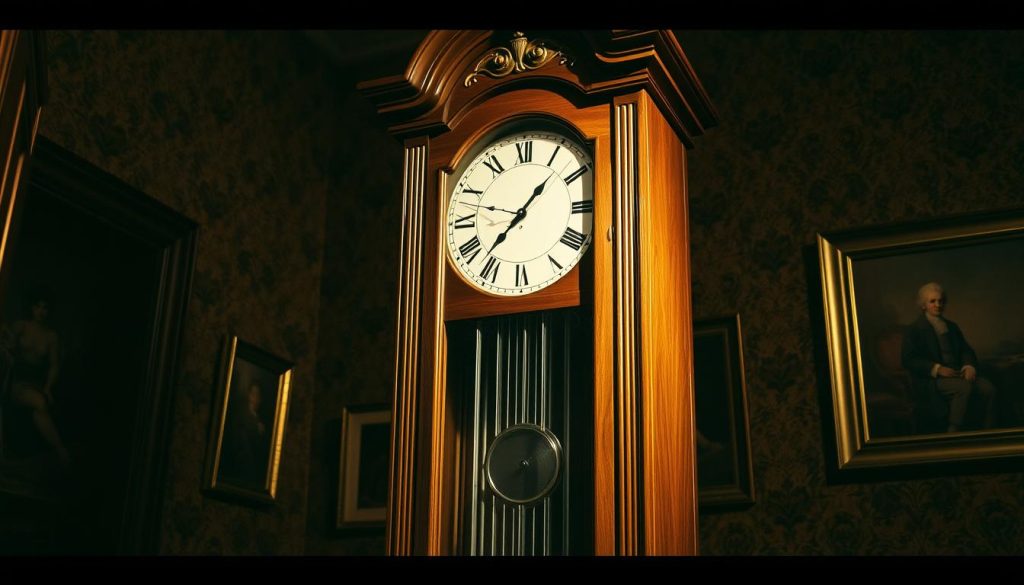
Reading a clock is a key skill that connects us to daily life rhythms. People have tracked time for thousands of years. This skill helps us organize our world and remains crucial today.
Time literacy involves mastering both digital and analog clock reading skills1. Analog clocks have moving hands that track hours, minutes, and seconds2. They show time’s continuous movement visually.
The hour hand on an analog clock makes two full rotations in 24 hours3. This helps us understand the passage of time throughout the day.
Clock reading is more than just practical. It’s a gateway to understanding time management and scheduling. Kids usually start learning this skill between ages six and eight3.
They begin with basic time vocabulary. Then, they progress to more complex time-telling techniques. This gradual learning process helps build a strong foundation.
Key Takeaways
- Time-telling is a critical life skill developed from childhood
- Clocks come in two primary types: digital and analog
- Understanding clock reading helps improve time management
- Time-telling involves multiple mathematical skills
- Clocks represent a fundamental way of organizing human activities
Understanding Different Types of Clocks
Clocks have been vital for measuring time throughout history4. There are two main types: digital and analog. Knowing both helps develop strong clock reading skills5.
Time measurement has come a long way over thousands of years. Humans have improved their methods, from ancient sundials to modern devices4.
Digital Clock Characteristics
Digital clocks show time using four numbers with a colon. They offer two main display formats:
Digital clocks give precise time readings, often including seconds. Some advanced models sync automatically with atomic clock signals6.
Analog Clock Components
Analog clocks have a circular dial marked from 1 to 125. These classic timepieces usually have:
- An hour hand indicating the current hour
- A minute hand showing precise minutes4
- Optional second hand for exact time tracking5
The spaces between numbers on an analog clock show five-minute intervals. This makes reading minutes easier5.
| Clock Type | Display Format | Key Features |
|---|---|---|
| Digital Clock | 12 or 24-hour | Precise numeric display |
| Analog Clock | Circular dial | Hands indicating hours and minutes |
Learning both digital and analog clock formats improves time understanding. It also boosts clock reading skills4.
How to Read a Clock Step by Step
Reading clocks is a vital skill for kids. It helps them manage time and boosts their thinking skills. Let’s explore how to master clock reading with easy steps.
Analog clocks have three hands that show time. Each hand has a specific job. Let’s break down how to read them.
- Identify the hour hand: This is the shortest hand that moves slowly across the clock face7.
- Locate the minute hand: The longer hand that moves more quickly7.
- Notice the second hand: The thinnest hand that moves continuously7.
The hour hand points to the current hour. The minute hand shows exact minutes. Each number represents a 5-minute interval.
Digital clocks show time in numbers. They use either 12-hour or 24-hour formats. You can find helpful clock reading techniques here.
Kids usually start learning to tell time around age 6 to 8. Practice is key to getting better. Try using fun tools like demo clocks to make learning enjoyable.
Conclusion
Time literacy goes beyond clock reading. It’s a vital skill for managing daily schedules effectively. Students with strong clock-reading skills show improved time management abilities.
Clocks hold cultural significance, representing order and precision. Understanding different clock formats connects us to a broader time system. Mastering time comprehension is crucial in our 24-hour day structure8.
Despite technological advances, clock reading remains valuable. The growing use of wristwatches highlights its importance9. Practice and patience are key to mastering both analog and digital clocks.
Time is a universal language. Strong timekeeping skills unlock a powerful tool for success. They enable confident navigation of time in any situation8.
FAQ
Why is learning to read a clock important in today’s digital world?
Reading clocks is vital for time management and punctuality. It helps you navigate various situations and develop strong time literacy. Understanding both analog and digital displays is useful in many settings.
What’s the difference between 12-hour and 24-hour time formats?
The 12-hour format uses AM and PM, running from 1-12 twice daily. The 24-hour format runs from 00:00 to 23:59, without AM/PM indicators. This system is useful in professional and international settings.
How do I read the minute hand on an analog clock?
Count by fives around the clock face. The numbers represent five-minute increments. Observe where the minute hand points between numbers to estimate the exact minute.
Practice and visual estimation will improve your accuracy over time.
Is it harder to read an analog or digital clock?
Digital clocks offer straightforward number reading. Analog clocks require understanding hand positions and movement. Most find digital clocks easier at first, but mastering both is beneficial.
How can I help children learn to tell time?
Start with analog clocks, using visual aids and games. Teach them to recognize hand positions and count by fives. Use real-world examples and clock-based games to make learning fun.
What are some common mistakes when reading clocks?
Common errors include confusing hour and minute hands and misreading between-number positions. Misunderstanding AM/PM and struggling with 24-hour format are also frequent issues. Regular practice helps overcome these challenges.
Do smartphones make traditional clock-reading skills less important?
Traditional clock-reading skills remain valuable despite smartphones. They develop spatial awareness and mathematical understanding. These skills are useful when digital devices are unavailable or battery-depleted.
How quickly can someone typically learn to read a clock?
Children usually learn basic clock reading in 1-2 weeks of consistent practice. Adults often grasp the skills within a few days. Mastery comes with continued practice and real-world application.
Source Links
- How to Read a Clock to Know Time (Tell Time on a Watch) – BYJUS – https://byjus.com/us/math/reading-the-clock/
- How To Tell Time | Read An Analog Clock (Video) – https://tutors.com/lesson/how-to-tell-time-read-an-analog-clock
- How to Tell Time: Helping Your Child Learn to Read a Clock – Begin Learning – https://www.beginlearning.com/parent-resources/how-to-tell-time/
- How to Read a Clock (Digital & Analog) – https://www.dreambox.com/math/skills/measurement/how-to-read-a-clock
- How to Read a Clock – https://www.premierclocks.com/blogs/clock-blog/how-to-read-a-clock?srsltid=AfmBOopauSOImaj-xHv-3ZoJzaMAaVQe4bDPhAdRBo20gN8NH-iROqnH
- What Are the Main Types of Clocks? – https://www.premierclocks.com/blogs/clock-blog/types-of-clocks?srsltid=AfmBOopXOFF4H1ksM5nXY1CoTqUZheBNoiVjVm9ALcKE2lcPGeVKZp_-
- Clock Time Reading | Learn and Solve Questions – https://www.vedantu.com/maths/clock-time-reading
- How to Tell Time: Activity, Ways to Express Time & Conclusion – https://www.vedantu.com/maths/learn-to-tell-the-time
- Mastering How To Read a Clock: Unleash Your Time-Telling Potential! – https://medium.com/@benedict-rumisha/mastering-how-to-read-a-clock-unleash-your-time-telling-potential-48bbf747c289

