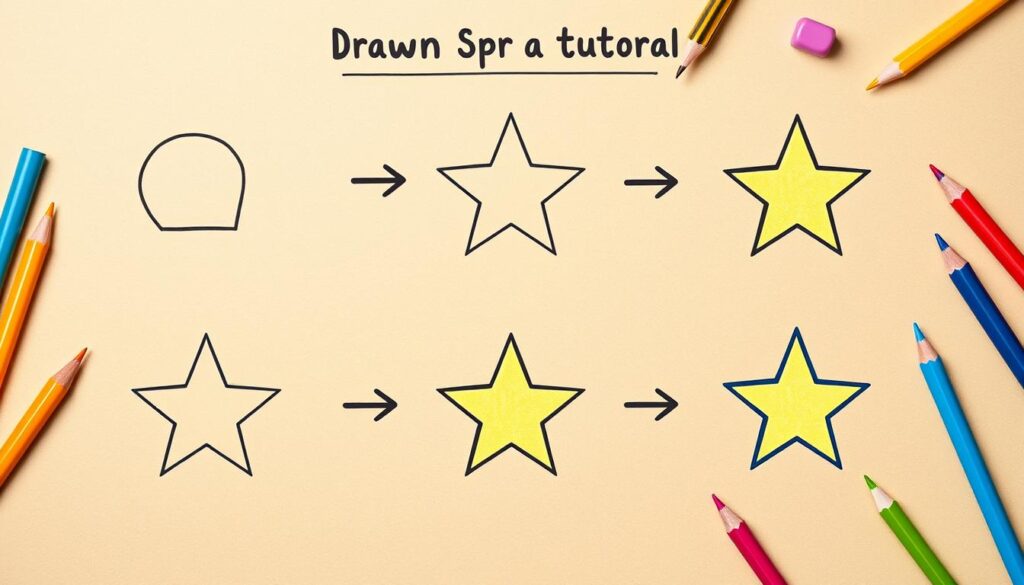
Drawing stars can boost your geometric art skills. It may seem tough, but the right methods make it easy1. Learning star drawing basics will improve your precision and artistic confidence1.
Star drawing lets you explore visual patterns and geometric art. A step-by-step approach and regular practice are key. Freehand stars often look uneven without guidance1.
Repeated practice builds muscle memory for perfect star shapes. Pros suggest specific ways to learn the star’s structure1. With time, drawing stars becomes more natural and fun.
Key Takeaways
- Star drawing requires systematic practice and patience
- Geometric principles are crucial for creating symmetrical stars
- Muscle memory develops through consistent drawing
- Rulers and guides can help achieve precise star shapes
- Multiple techniques exist for drawing different star styles
Understanding the Basics of Star Shapes
Star shapes are captivating geometric designs with symmetrical patterns. They inspire creativity in drawing, origami, and art. Exploring star shapes unlocks endless creative possibilities2.
Different Types of Star Shapes
Stars come in various fascinating forms, each with unique characteristics:
- Five-pointed stars: The most common design, with a perfect 36-degree angle2
- Six-pointed stars: Symmetrical and often used in geometric art
- Seven-pointed stars: More complex and less frequently drawn
Common Mistakes to Avoid
When creating star shapes, watch out for these potential pitfalls:
- Asymmetrical points that disrupt the star’s visual balance
- Uneven line lengths
- Inconsistent angles between star points
Essential Tools for Star Drawing
To create precise star shapes, gather these tools:
- Pencils for initial sketching
- Erasers for corrections
- Rulers for straight lines
- Compasses for perfect circles
- Protractors for accurate angles3
Pro tip: Practice origami folding to boost your understanding of symmetrical star shapes. This will help improve your geometric precision2.
The art of drawing stars is about patience, precision, and creative exploration.
Step-by-Step Tutorial to Draw a Simple Star
Star drawing is an exciting paper craft that sparks creativity. It’s fun and rewarding for beginners and aspiring artists alike. Let’s explore how to draw a star step by step.
First, gather your drawing materials. You’ll need these tools to create a perfect star4:
- HB pencil
- 2B pencil
- 4B pencil
- 1.0 Copic Multiliner pen
- Eraser
- Drawing paper
Starting with Basic Shapes
Understand the fundamental geometry of a star. A perfect five-pointed star needs precise angles and symmetry2. Use a 36-degree angle between points for a balanced shape2.
Draw a central dot on your paper. Create 5 evenly spaced lines from this center point4. Make each branch about 4 inches long4.
Creating the Star Outline
Connect the points to form your star’s basic shape. You’ll see two pentagon shapes emerge4. A large outer pentagon and a medium inner one will appear.
A small pentagon will form at the center. This adds intricate detail to your drawing.
Adding Details and Shading
Shading turns your flat drawing into 3D artwork. Use different pencil grades to create depth4. Add dark gradations in 3 overlapping areas for dimensionality4.
“Practice makes perfect in star drawing. Don’t be afraid to experiment with different techniques!”
Finally, add hard shadows for a realistic, 3D look4. With practice, you’ll soon master creating stunning star designs.
| Pencil Grade | Shading Purpose |
|---|---|
| HB | Light base shading |
| 2B | Medium tone depth |
| 4B | Dark shadow emphasis |
Advanced Techniques for Drawing Stars
Mastering star drawing involves more than basic outlines. Advanced techniques transform simple shapes into captivating geometric art. Professional artists use these methods to create stunning star designs.
Perspective can dramatically enhance your star drawings. Try adding depth and dimension to bring symmetrical designs to life. Understanding light and shadow interaction with geometric forms is crucial.
Mastering Perspective in Star Drawing
Three-dimensional star illustrations require specific techniques. Here are some key strategies to consider:
- Vary line thickness to suggest depth
- Use shading techniques to create volume
- Experiment with vanishing points
Venus’s path creates a fascinating 5-point star pattern in the sky5. This celestial inspiration can inform your approach to geometric art5.
Incorporating Patterns and Textures
Art therapists often suggest exploring intricate patterns within star shapes. Here are some creative approaches to try:
- Zentangle-inspired interior designs
- Geometric pattern filling
- Radial symmetry techniques
Color Addition Strategies
Color turns simple sketches into emotional expressions. The angle between star points can guide your color placement6. Consider these factors when choosing colors:
| Color Type | Emotional Impact | Recommended Medium |
|---|---|---|
| Warm Tones | Energetic | Colored Pencils |
| Cool Tones | Calming | Watercolors |
| Complementary Colors | Dramatic | Markers |
Handcrafted stars often have imperfections that add unique charm5. Embrace your creative journey and let each star tell its story. Your artistic expression will shine through in every design.
Your Creative Star Drawing Projects
Star drawing can transform into exciting art therapy and mindfulness activities. It sparks creativity and offers versatile artistic potential. Your artistic journey begins with exploring diverse ways to incorporate star designs into various projects7.
Experiment with different star techniques for paper crafts. Create intricate designs that reflect cultural symbolism or personal meaning. The star drawing methods can inspire unique artwork that tells your creative story7.
Share your star-inspired creations on social media and online art communities. This can connect you with fellow artists and provide valuable feedback. Seek inspiration from architecture, nature, and global design traditions8.
Develop distinctive star drawing styles that reflect your personal artistic vision. Practice enhances your skills in star drawing. Each sketch brings you closer to mastering this timeless artistic technique7.
FAQ
What are the different types of star shapes I can draw?
Star shapes come in various forms, including five, six, and seven-pointed stars. Each type has its own unique construction method. The five-pointed star is the most common and easiest to create.
What tools do I need to draw a star?
Basic tools for star drawing include a pencil, eraser, ruler, and compass. For advanced techniques, you might need a protractor and drawing templates. These tools help create precise, symmetrical stars with clean lines.
How can I avoid common mistakes when drawing stars?
Common mistakes include creating asymmetrical shapes and uneven points. Use a compass or measured guide for even spacing. Start with light guidelines, then refine your star shape gradually.
Take your time and use light pencil strokes. This allows for easy erasing and adjustments as you work.
What are some advanced techniques for drawing stars?
Advanced techniques include creating 3D effects through perspective drawing. You can also add intricate patterns like zentangle designs. Experiment with shading and line thickness for more visual interest.
Can I use star drawings in other art projects?
Stars are versatile design elements for various projects. They work well in greeting cards, paintings, and digital art. Stars can be central motifs or background elements in your artwork.
Share your star creations on social media and art communities. This can provide valuable feedback and inspiration from fellow artists.
How can I improve my star drawing skills?
Regular practice is crucial for improving your star drawing skills. Begin with simple five-pointed stars and progress to more complex shapes. Study geometric principles and draw inspiration from nature and architecture.
Are there any tips for adding color to my star drawings?
Consider color theory when adding hues to your star drawings. Think about the emotional impact of different color combinations. Try various mediums like colored pencils, markers, or watercolors.
Create depth by using shading techniques. Choose complementary or contrasting colors to make your star designs pop.
Source Links
- How to draw a star freehand – https://tatyanadeniz.com/how-to-draw-star/
- How to Draw a Star: The Easy and the Fun Way – https://letsdrawthat.com/how-to-draw-a-star/
- How to Draw a Star – https://howtodrawforkids.com/how-to-draw-a-star/
- How To Draw An Impossible Star – https://mydrawingtutorials.com/how-to-draw-an-impossible-star-step-by-step/
- Five Pointed Star in One Cut: How to Fold, Cut, Draw, Thread or Plot. – The Smart Happy Project – https://thesmarthappyproject.com/five-pointed-star-in-one-cut/
- Stars | NRICH – https://nrich.maths.org/problems/stars
- How to Draw a Star – https://www.emilydrawing.com/how-to-draw/how-to-draw-a-star/
- 4 Ways to Draw a Star – wikiHow – https://www.wikihow.com/Draw-a-Star