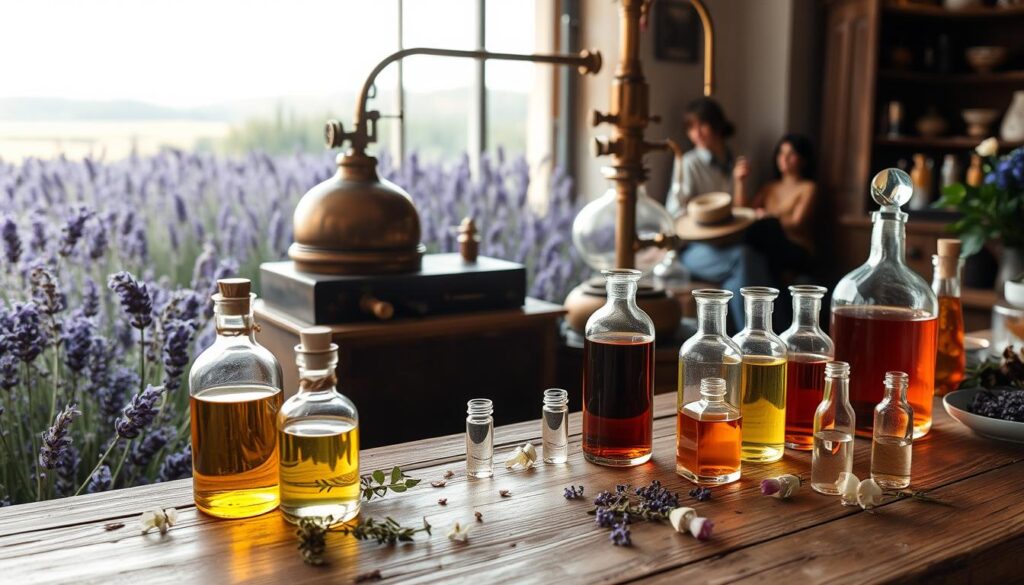
Dive into the captivating realm of French perfume crafting. France reigns as the global hub of fragrance innovation. Here, scent transforms into an exquisite art form1.
Your aromatic adventure begins in Grasse, the legendary perfume capital. This charming town nestles in the picturesque Provence region1.
French perfume making transcends mere craft. It’s a cherished cultural heritage, passed down through generations. Iconic perfumeries like Fragonard, Galimard, and Molinard have created extraordinary fragrances for centuries2.
Galimard perfumery, founded in 1747 by Jean de Galimard, exemplifies this enduring legacy. It stands as a testament to France’s unparalleled perfume craftsmanship2.
Master perfumers, known as “Nez” (Noses), blend natural and synthetic ingredients. They create magical scents using sophisticated techniques and specialized tools1.
The perfume organ is a key tool in their arsenal. This impressive collection of essences allows for infinite creative possibilities2.
Key Takeaways
- France is the global leader in perfume creation and innovation
- Grasse is recognized as the world’s perfume capital
- Perfume making combines artistic creativity with scientific precision
- Historical perfumeries continue to preserve traditional craftsmanship
- Master perfumers undergo extensive training to develop their unique skills
The Rich History of French Perfume Crafting
French perfumery has captivated the world for centuries. It transformed simple essential oils into sophisticated fragrances. This magical journey of artistry and innovation continues to enchant us today.
The 18th century marked the Golden Age of French Perfumery. Grasse became the global perfume capital. Its fertile lands produced aromatic ingredients like jasmine, rose, and lavender.
Origins of Perfume Making in France
Houbigant, the world’s first recorded perfume house, was established in Paris. This solidified the city’s reputation as a fragrance hub. French perfumers developed unique techniques for creating complex, layered scents.
Evolution Through the Centuries
- 18th Century: Emergence of specialized perfume techniques
- 19th Century: Expansion of fragrance production methods
- 20th Century: Fusion of traditional craftsmanship with modern innovation3
Key Historical Figures in Perfume
Ernest Beaux revolutionized the industry by creating iconic fragrances like Chanel No. 5. He demonstrated the artistic potential of perfume making. These masters saw each bottle as more than a scent.
“Perfume is the art that makes memory speak.” – Anonymous
French perfumers still draw inspiration from global sources. They maintain their commitment to crafting exceptional fragrances. These scents serve as personal signatures for many4.
Essential Ingredients in Traditional Perfumes
Crafting the perfect parfum blends natural and synthetic ingredients. It’s an art form that captivates the senses. Fragrances tell unique stories through scent, revealing a complex landscape.
Natural vs. Synthetic Fragrances
Perfume making balances natural and synthetic ingredients. Traditional methods use pure essential oils from plants. Modern techniques add synthetic molecules to capture rare botanical scents5.
Synthetic ingredients offer consistency in perfumes. They help recreate scents that are hard to obtain naturally5.
Popular Floral and Herbal Notes
- Bergamot: A sweet light orange peel oil with delightful floral notes6
- Basil Sweet: Considered exceptional for aromatherapy with high linalool content6
- Cardamom: A warm, spicy scent that uplifts moods6
- Black Pepper: Known as the ‘King of Spices’ with warming properties6
The Role of Base, Heart, and Top Notes
Perfume composition involves three crucial layers:
- Top Notes: The initial impression that first greets your senses
- Heart Notes: The core character of the fragrance
- Base Notes: Long-lasting scents that provide depth and longevity7
Ancient perfumers understood that fragrance layering is key to creating memorable scents that evolve beautifully over time.
Knowing these ingredients helps you appreciate fragrance creation. It’s useful in both traditional parfum techniques and modern aromatherapy practices6.
Source: Statistical data on essential oil properties5Source: Perfume extraction techniques7Source: Ancient perfume composition methods
The Art of Perfume Creation
Perfume creation blends science and art to make captivating fragrances. It’s a complex process that needs great skill and creativity8.
The craft goes beyond simple mixing. It transforms raw ingredients into alluring scents that enchant the senses.
The Scent Composition Process
Perfumers blend essential oils and aromatic compounds with care. They use precise measurements to create harmonious scents8.
Understanding how different notes interact is key. This knowledge helps craft unique eau de parfum.
- Select base notes for depth and longevity
- Choose middle notes for character
- Add top notes for initial impression
Techniques Used by Master Perfumers
Master perfumers use advanced methods to capture ingredient essences. These techniques include:
- Steam distillation
- Solvent extraction
- Enfleurage
- Expression
Creating a fragrance is like composing a musical symphony – each note must complement the others perfectly.
Personalization in Perfume Making
You can now create a personalized aroma that matches your unique style. Many perfumeries offer workshops to blend your signature scent9.
Expert guidance helps you craft a fragrance that’s truly yours. It’s a fun way to explore the world of scents.
| Fragrance Type | Concentration Level |
|---|---|
| Eau de Cologne | 2-5% |
| Eau de Parfum | 10-20% |
| Parfum | 20-30% |
Modern perfumers keep pushing boundaries in scent creation. They explore new sensory experiences to delight fragrance lovers.
Discover more about this fascinating art at Perfumers World. Here, tradition meets innovation in the world of perfumes.
Experiencing Perfume in France
France offers an incredible journey into the world of fragrances. Perfume workshops in Grasse provide an immersive experience in parfum creation. Grasse has been the perfume capital since the 1700s, with fragrance factories throughout the region10.
Renowned perfumeries like Molinard let you dive into aromatherapy and fragrance crafting. Their workshops offer a chance to create your own signature scent. You can choose from over 90 unique essences to blend your perfect parfum10.
The experience typically takes a couple of hours. You’ll learn the art of perfume making and create a 50ML bottle of custom fragrance10.
When choosing your scent, think about your style and where you’ll wear it. Iconic French perfumes like Chanel No. 5 show the rich history of French fragrance design11.
France offers an unmatched perfume experience. You can explore and express your personality through scent.
Most workshops cost around $80 per person10. It’s an affordable way to create a personal memento of your French adventure. Your custom parfum becomes a cherished memory of French perfumery.
FAQ
What makes Grasse so special in the world of perfume?
Grasse, nestled in the French Riviera, is the world’s perfume capital. It’s home to famous perfumeries like Fragonard, Galimard, and Molinard. The town is known for growing key fragrance ingredients such as centifolia rose and jasmine.
Grasse has a rich history of perfume production dating back centuries. Traditional methods of extracting essential oils are still respected today in this fragrant town.
How do perfumers create a unique fragrance?
Master perfumers use a perfume organ with over 200 different essences to compose fragrances. They blend base notes, heart notes, and top notes to create unique scents.
This process requires incredible sensory expertise. Perfumers are trained to recognize thousands of different scents, honing their craft over years.
What are the main methods of extracting fragrance ingredients?
Extraction methods include steam distillation, enfleurage, volatile solvent extraction, and supercritical carbon dioxide extraction. These techniques preserve the delicate qualities of natural ingredients like flowers and herbs.
The goal is to ensure the highest quality essential oils for perfume creation. Each method has its own unique benefits for different ingredients.
Can tourists actually create their own perfume in France?
Yes! Many French perfumeries offer personalized perfume workshops for tourists. You can create your own unique fragrance with guidance from expert perfumers.
These experiences typically include access to numerous essences. You’ll get to bottle and archive your personal scent, taking home a truly unique souvenir.
What are the most important natural ingredients in French perfumes?
Traditional French perfumes rely on several key natural ingredients. These include centifolia rose, jasmine, orange blossom, and lavender.
Other important scents are musk, iris, sandalwood, and vanilla. These ingredients are often grown around Grasse using time-honored methods.
How do I choose the right perfume for myself?
Choosing a signature scent is a personal journey. Consider your preferences, skin chemistry, and the occasions you’ll wear the fragrance.
Visit multiple perfumeries and sample different scents. Pay attention to how they react with your skin over time.
Don’t rush the process. A great perfume should feel like an extension of your personality.
Source Links
- Exploring French Perfume Making Techniques – Talkpal – https://talkpal.ai/culture/exploring-french-perfume-making-techniques/
- CREATE YOUR OWN PERFUME IN GRASSE | Côte d’Azur France / French Riviera – https://cotedazurfrance.com/to-do/flowers-and-perfumes/create-your-own-perfume-in-grasse/
- Unveiling the Elegance: A Journey into the World of French Perfume – https://strommeninc.com/unveiling-the-elegance-a-journey-into-the-world-of-french-perfume/
- The History of Love and Perfume in France – https://michelgermain.com/blogs/the-history-of-love-and-perfume-in-france/the-history-of-love-and-perfume-in-france
- The Different Types of Perfumery Ingredients And How They Are Extracted From Plants – Experimental Perfume Club – https://experimentalperfumeclub.com/how-to-extract-perfume-oil/
- Common Perfume Ingredients – https://www.scentopia-singapore.com/common-perfume-ingredients.html
- The Scent of Love: Ancient Perfumes – https://blogs.getty.edu/iris/the-scent-of-love-ancient-perfumes/
- The Art Of Perfume Making A Comprehensive Guide | Authenteque – https://authenteque.com/the-art-of-perfume-making-a-comprehensive-guide/
- The Intimate Art of Perfume Creation: Crafting Sensations Through Scents – https://amiroud.com/blog/the-intimate-art-of-perfume-creation-crafting-sensations-through-scents?srsltid=AfmBOoqs4rkzRlUMqr5CUAedHASpigEMl6As65CzyUekiuouLHMfF0vY
- Perfume Making in Nice, France — Traveling Tessie – https://www.travelingtessie.com/allposts/perfume-making-in-nice-france
- France and perfume – Perfume Capital of the World – https://parisbyemy.com/france-and-perfume/