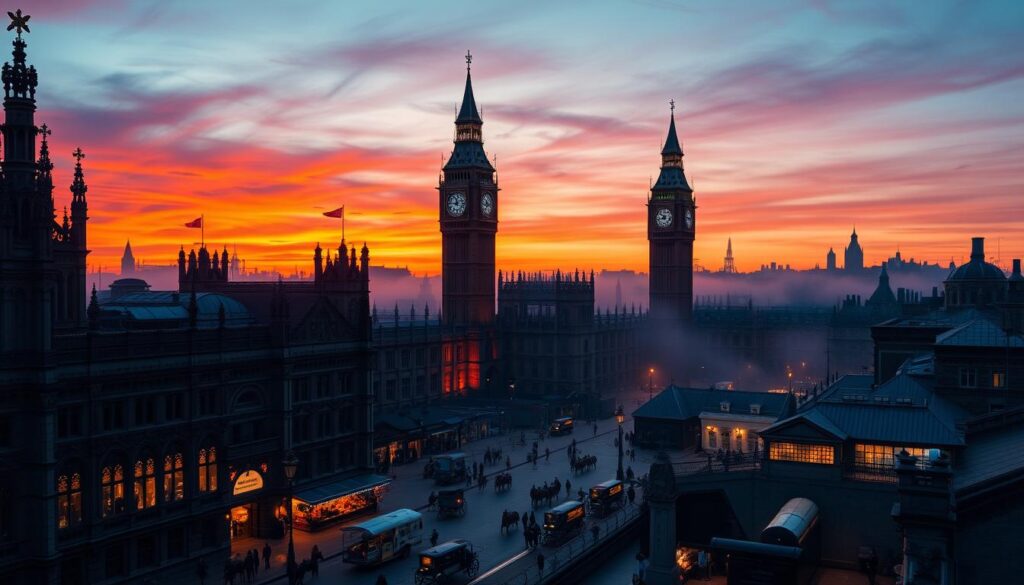
Victorian London was a bustling metropolis of incredible diversity and innovation. The city transformed dramatically in the 19th century. It was a place where extreme wealth coexisted with profound poverty1.
London’s population grew from one million to over five million by 19001. The city became a melting pot of cultures. People from Africa, Ireland, Italy, Germany, and Jewish backgrounds flocked to London1.
Even the food scene reflected this diversity. The first Indian restaurant opened in 18101. This marked the beginning of London’s rich culinary landscape.
Museums capture the essence of Victorian life2. The Ragged School Museum and Dennis Severs’ House offer unique glimpses into 19th-century London. Iconic landmarks like the Houses of Parliament showcase the era’s architectural grandeur2.
Key Takeaways
- Victorian London was a city of dramatic population growth and cultural diversity
- The 19th century saw massive urban transformation
- Museums and landmarks provide authentic insights into Victorian life
- London became a global city during this remarkable period
- The era was marked by significant social and technological changes
Exploring the Heart of Victorian London
Victorian London transformed into a vibrant metropolis during the Industrial Revolution. The city’s growth and architectural innovation created a fascinating landscape. Visitors today still marvel at its unique charm3.
London’s streets showcase remarkable Victorian architectural masterpieces. The urban landscape tells a compelling story of progress and creativity. These structures continue to captivate visitors with their distinctive style.
Iconic Landmarks You Must Visit
Your Victorian London journey should include these must-see locations:
- Houses of Parliament: A stunning example of Gothic Revival architecture
- Tower Bridge: Symbolizing London’s engineering prowess
- Trafalgar Square: A central gathering point of Victorian social life
- Royal Courts of Justice: Representing legal architectural grandeur
The Charm of Victorian Architecture
Victorian architecture reflects the era’s complex social dynamics. Buildings from this period blend functionality with aesthetic beauty. Charles Dickens often described these architectural marvels in his novels3.
| Landmark | Year Established | Significance |
|---|---|---|
| Natural History Museum | 1881 | Scientific education center |
| Royal Albert Hall | 1871 | Cultural performance venue |
| Victoria and Albert Museum | 1852 | Art and design collection |
London’s population expanded dramatically during the Victorian era. The city became a hub of commercial and cultural innovation. Historic markets and prestigious department stores emerged, shaping the urban landscape4.
Daily Life in Victorian Times
Victorian Britain was a world of stark contrasts. Social classes and living conditions varied greatly. Your economic status determined your chances of survival in 19th century society5.
The social structure was rigid with clear class distinctions. Your daily experience depended on your class: upper, middle, or working5.
A Typical Victorian Day
Life expectancy was low, averaging around 42 years6. Children faced tough times. More than 25% didn’t live past their fifth birthday6.
- Working-class families struggled with poverty
- Children often worked in mines and factories
- Urban areas were overcrowded and unsanitary
Social Etiquette and Customs
Victorian society valued strict social norms. The growing middle class eagerly adopted these principles5.
| Social Class | Key Characteristics |
|---|---|
| Upper Class | Wealth, privilege, strict social rules |
| Middle Class | Growing economic opportunities, emphasis on moral conduct |
| Working Class | Limited resources, challenging work conditions |
“The most important of all Victorian values was respectability.” – Unknown Victorian Philosopher
Child labor was prevalent. Young workers endured long hours in tough conditions across various industries5. By century’s end, about one-third of the population lived in poverty6.
Victorian daily life reveals a fascinating era. It was a time of great social changes and new cultural norms.
Victorian Entertainment and Leisure
The Victorian era offered diverse entertainment and leisure activities. These pursuits reflected the social dynamics of the period. They ranged from vibrant public performances to peaceful outdoor relaxation.
Music Halls and Theatrical Performances
Victorian entertainment thrived in lively music halls. These venues became popular social spaces for performers to showcase their talents7. Audiences enjoyed various acts, from comedians to singers.
- Theatrical performances featuring dramatic works
- Comedy sketches and musical numbers
- Variety shows with multiple performers
Outdoor Recreational Activities
Physical activities gained popularity during the late Victorian era. Women began participating in outdoor sports, challenging traditional social norms8. Popular recreational pursuits included:
| Sport | Popularity |
|---|---|
| Cycling | Major craze in the 1890s |
| Tennis | Increasing female participation |
| Cricket | Growing acceptance for women |
Leisure and Social Dynamics
Social class heavily influenced leisure activities during the Victorian era. Upper-class individuals enjoyed extended holidays on country estates7. Working-class people had more limited recreational opportunities.
Charles Dickens often highlighted these social disparities in his literary works.
“The greatest pleasure in life is the art of doing nothing.” – Charles Dickens
Victorian leisure blended traditional customs with new forms of entertainment. This mix shaped modern recreational practices. Music halls and emerging sports reflected a society in transition.
The Influence of Victorian Culture
Victorian literature and art underwent remarkable changes that still fascinate readers today. It became a powerful tool for exploring society and human experiences. Authors like Charles Dickens revolutionized storytelling, reflecting the complexities of 19th-century life.
The Industrial Revolution greatly influenced Victorian creativity. It inspired writers to explore new literary genres. The novel became the main form of writing, with styles like realism and social commentary emerging.
Victorian poets like Robert Browning and Alfred, Lord Tennyson created new techniques. They developed the dramatic monologue, adding depth to their work9.
Literature and Notable Authors
Charles Dickens is a giant in Victorian literature. He captured urban life through compelling characters and intricate plots. His works shone a light on social inequalities, making him a key voice of the era.
Writers explored various themes during this time. They wrote about Britain’s expanding empire and the struggles of the working class. These topics resonated with readers across society Victorian literary landscape.
Art and Innovations from the Era
Victorian culture blended literature with technological innovation. The shift from rural to urban life drove creative expression. New inventions like railroads and steam printing presses changed communication.
These advancements unified British populations in unexpected ways. They allowed for wider distribution of artistic and literary works. This period saw a transformation in cultural understanding and creativity9.
FAQ
What was the population of London during the Victorian era?
London’s population skyrocketed from 1 million in 1800 to over 5 million by 1900. The city became incredibly diverse, with people from various communities settling in.
These included African, Irish, Italian, German, French, Jewish, and Muslim groups. This rapid growth transformed London into a bustling metropolis.
What were living conditions like for the poor in Victorian London?
Life was tough for the poor in Victorian London. Slums were overcrowded with little water or sanitation. Many rented cots in dosshouses for a penny a night.
Unsafe water led people to drink alcohol instead. By 1840, Londoners were consuming 10 liters of gin per person yearly.
What significant landmarks were built during the Victorian era?
Queen Victoria’s reign saw the construction of many iconic London landmarks. These included the Houses of Parliament, Tower Bridge, and Trafalgar Square.
Other notable additions were Nelson’s Column, the Royal Courts of Justice, and the National Portrait Gallery. These structures still define London’s skyline today.
How did entertainment look in Victorian London?
Music halls were popular escape spots for Londoners. These rowdy venues sometimes needed stage cages to protect performers from flying rotten vegetables.
Victoria Park, created in 1845, became the first public park for common people. It offered a new form of outdoor entertainment.
What was the state of education during the Victorian era?
Education wasn’t mandatory until 1880, leading to high illiteracy rates. The Poor Laws of 1834 created major social problems.
These laws freed fathers from responsibility for illegitimate children. This led to the rise of “Baby Farms,” a tragic consequence of the era.
How did technology change during this period?
The Victorian era saw big tech advances during the Industrial Revolution. The London Underground, the world’s first subway, was built then.
This new transport system changed how people moved around the city. It marked a major leap in urban development.
What was the Thames River like during this time?
The Thames River became heavily polluted, causing the infamous “Great Stink” of 1858. This environmental crisis alarmed Londoners and officials alike.
It pushed the government to invest in a proper sewage system. This upgrade greatly improved urban sanitation and public health.
How did literature capture Victorian London?
Charles Dickens brilliantly portrayed Victorian society in his works. He called London his “magic lantern,” using it to inspire his stories.
His books like “Oliver Twist” and “Little Dorrit” vividly showed the era’s stark social contrasts. Dickens’ writing painted a vivid picture of Victorian London.
Source Links
- 10 Things you never knew about Victorian London – https://dickensmuseum.com/blogs/charles-dickens-museum/10-surprising-facts-about-victorian-london?srsltid=AfmBOoq6jSvNGw5-VHjNRrzD_3371WBcaEx6829kAdtjKvrAVweMzMGG
- How To Experience Victorian London – https://theculturetrip.com/europe/united-kingdom/england/london/articles/how-to-experience-victorian-london
- Victorians – https://www.english-heritage.org.uk/learn/story-of-england/victorian/
- 10 Things you never knew about Victorian London – https://dickensmuseum.com/blogs/charles-dickens-museum/10-surprising-facts-about-victorian-london?srsltid=AfmBOoqnUE6e5qNtKZ_g077jv00MJNebZUC87JMoeoFbHbYXdUgMbjMD
- Social Life in Victorian England – https://sites.udel.edu/britlitwiki/social-life-in-victorian-england/
- Victorian daily life: what was it like for ‘ordinary’ Victorians? – https://www.historyextra.com/period/victorian/victorian-daily-life-working-class-what-like/
- Leisure and holidays in Victorian Scotland – BBC Bitesize – https://www.bbc.co.uk/bitesize/articles/z4rcf4j
- VictorianVoices.net: Victorian Pastimes & Recreations – https://www.victorianvoices.net/topics/recreation/index.shtml
- The Victorian Period – https://www.easternct.edu/speichera/understanding-literary-history-all/the-victorian-period.html