
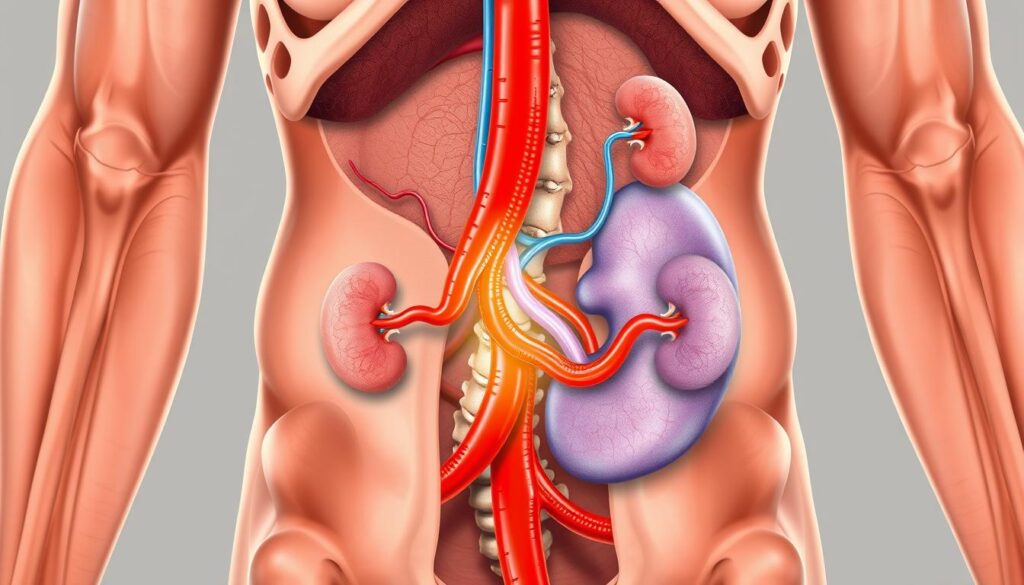
Abdominal aortic aneurysm (AAA) is a silent threat to your body’s main artery. It happens when the lower aorta swells, creating a potential health crisis1. Certain factors can increase your risk of developing this serious condition2.
Men face a higher risk, being 4 to 5 times more likely to develop AAA1. Smoking is the biggest risk factor, greatly increasing the chances of aortic problems2.
About 75% of AAA cases go unnoticed due to lack of symptoms1. If you’re 65-75 years old with a smoking history, doctors suggest a one-time ultrasound screening2.
Key Takeaways
- Abdominal aortic aneurysms are most common in older adults
- Smoking significantly increases AAA risk
- Men are more prone to developing AAA
- Many AAA cases are asymptomatic
- Regular screenings can help early detection
Understanding Abdominal Aortic Aneurysm: A Silent Threat
Abdominal aortic aneurysm (AAA) is a dangerous condition that often goes unnoticed. It can put your health at risk without any warning signs3.
What Happens During Aortic Dilation
Aortic dilation occurs when your aorta walls weaken and expand. This creates a risky bulge that can lead to rupture4.
The expansion happens slowly over time. Early screening is vital for catching this problem.
- The aorta weakens under internal blood pressure
- Blood vessel walls gradually stretch
- Potential for dangerous expansion increases with time
Common Symptoms and Warning Signs
Most people with AAA don’t feel any symptoms at first. Abdominal pain may appear when the aneurysm grows large.
Key warning signs include:
- Deep, constant pain in the abdomen or side
- Persistent back discomfort
- Pulsating sensation near the bellybutton
When to Seek Emergency Care
Get medical help right away if you have severe, constant belly or back pain with pulsing3. About 85% of people with a ruptured AAA die before getting medical care3.
“Early detection can save your life” – Vascular Health Specialists
| Risk Factor | Impact on AAA |
|---|---|
| Age over 65 | Significantly increased risk4 |
| Smoking | Up to 4 times higher chance of developing AAA4 |
| Family History | 12 times more likely to develop AAA3 |
Regular screening is your best defense, especially if you’re at high risk. Talk to your doctor about how often you should be checked3.
Key Risk Factors That Increase Your Chances
Knowing AAA risk factors helps protect your health. Not all factors are controllable. But awareness is key for prevention and early detection.
Age and Gender Considerations
AAA affects certain groups more. Men face AAA four to six times more often than women56. The risk rises sharply after age 65.
Regular check-ups are vital for this age group7.
Lifestyle and Health-Related Risks
Your choices greatly affect AAA risk. Smoking is the biggest changeable risk factor. Current smokers face higher risks:
- 15 times higher risk for women
- 7 times higher risk for men6
Other health risks include:
- High blood pressure (22% increased risk per 12.9 mmHg rise)6
- Obesity (14% higher risk per 4.0 kg/m2 increase)6
- Cardiovascular diseases
Genetic and Family History Factors
Your family history can greatly impact your AAA risk. Having a close relative with AAA increases your chances6.
“Knowing your family medical history is as important as understanding your own health risks.”
Regular screening is crucial for those with multiple risk factors. The US Preventive Service Task Force suggests one-time AAA screening for male smokers aged 65-755.
Treatment Options and Medical Interventions
Understanding your treatment options for an abdominal aortic aneurysm (AAA) is vital. Your doctor will suggest the best approach based on the aneurysm’s size and your health8.
- Endovascular repair: A minimally invasive technique where doctors insert a catheter through the groin to place a metal mesh tube (graft) that strengthens the weakened aorta8.
- Open surgery: A traditional method involving direct surgical removal of the damaged aorta section and replacing it with a sewn-in graft8.
Doctors usually recommend surgery when the aneurysm is 1.9 to 2.2 inches wide or growing fast8. Both repair types have similar long-term survival rates8.
“The choice of treatment depends on individual patient factors and aneurysm characteristics.”
Special medical centers with expert teams can offer thorough evaluations and custom treatment plans9. Your doctor will look at your age, health, and specific body details to suggest the best approach.
Talking to medical experts is crucial for managing AAA effectively. They can provide personalized advice for your situation.
Conclusion
Preventing abdominal aortic aneurysm (AAA) requires a proactive approach to heart health. Your lifestyle choices play a key role in managing this silent threat10. Quitting smoking is crucial, as it’s the most linked risk factor for AAA10.
Regular screenings are vital as you age, especially for high-risk groups. Medical research stresses the importance of early detection. Men over 55 should be extra careful, as aneurysms become more common with age10.
Your family history can greatly affect AAA risk10. AAA in close relatives may increase your risk by four times10. A heart-healthy lifestyle can slow aneurysm growth and protect your cardiovascular system11.
Knowing your risk factors and being proactive about prevention is key. Regular check-ups and ultrasound screenings are important. Open talks with doctors will help you manage your heart health well.
FAQ
What is an Abdominal Aortic Aneurysm (AAA)?
An Abdominal Aortic Aneurysm is a swollen area in the aorta’s lower part. It happens when the aorta’s wall gets weak and bulges out. This can grow slowly without any noticeable signs.
What are the primary risk factors for developing an AAA?
Main risk factors include being over 65, male, and white. Smoking, high cholesterol, diabetes, and high blood pressure also increase risk. Family history and genetics play a role too. Men are 4 to 6 times more likely to get AAAs than women.
What symptoms should I watch out for?
Most people with AAA don’t feel any symptoms. But some signs can include deep, constant belly or side pain. Back pain or a pulsing feeling near the bellybutton may also occur.
Severe, non-stop stomach or back pain with a pulse could mean a dangerous rupture. This needs immediate medical help.
How is an Abdominal Aortic Aneurysm diagnosed?
Doctors often use abdominal ultrasound to screen for AAA. This is especially true for high-risk people. Regular check-ups are key for those with risk factors or small aneurysms.
What treatment options are available for AAA?
Treatment depends on the aneurysm’s size and how fast it grows. Options range from careful watching to surgery. The two main surgical methods are open repair and endovascular aneurysm repair (EVAR).
Open repair uses a large cut. EVAR is less invasive and uses a stent graft.
Can I prevent an Abdominal Aortic Aneurysm?
You can’t totally prevent AAA, but you can lower your risk. Quit smoking, eat healthy, control blood pressure and cholesterol. Regular exercise helps too.
Try to do at least 150 minutes of moderate aerobic activity each week.
What is the rupture risk of an untreated AAA?
Rupture risk goes up as the aneurysm gets bigger and grows faster. Sadly, 85% of people with a ruptured AAA die before getting help. Early detection and monitoring are crucial.
Who should be screened for AAA?
Screening is usually suggested for people over 65 with extra risk factors. These include smoking history, being male, and family history of AAA. Those with other blood vessel problems should also get checked.
Ask your doctor if you should be screened for AAA.
Source Links
- Abdominal Aortic Aneurysm – https://www.hopkinsmedicine.org/health/conditions-and-diseases/abdominal-aortic-aneurysm
- Abdominal aortic aneurysm – Symptoms and causes – https://www.mayoclinic.org/diseases-conditions/abdominal-aortic-aneurysm/symptoms-causes/syc-20350688
- The “Silent Killer” – https://www.froedtert.com/stories/silent-killer-know-your-risks-abdominal-aortic-aneurysm
- Abdominal Aortic Aneurysm: Understanding the Silent Threat – https://vocal.media/geeks/abdominal-aortic-aneurysm-understanding-the-silent-threat
- Risk Factors for Abdominal Aortic Aneurysm in Population-Based Studies: A Systematic Review and Meta-Analysis – https://pmc.ncbi.nlm.nih.gov/articles/PMC6313801/
- The abdominal aortic artery aneurysm and cardiovascular risk factors – https://www.escardio.org/Journals/E-Journal-of-Cardiology-Practice/Volume-18/the-abdominal-aortic-artery-aneurysm-and-cardiovascular-risk-factors
- Abdominal aortic aneurysm: MedlinePlus Medical Encyclopedia – https://medlineplus.gov/ency/article/000162.htm
- Abdominal aortic aneurysm – Diagnosis and treatment – https://www.mayoclinic.org/diseases-conditions/abdominal-aortic-aneurysm/diagnosis-treatment/drc-20350693
- Approach Considerations, Treatment of Unruptured Aneurysms, Initial Management – https://emedicine.medscape.com/article/1979501-treatment
- Abdominal aortic aneurysm: A comprehensive review – https://pmc.ncbi.nlm.nih.gov/articles/PMC3076160/
- Abdominal Aortic Aneurysm – StatPearls – https://www.ncbi.nlm.nih.gov/books/NBK470237/

