
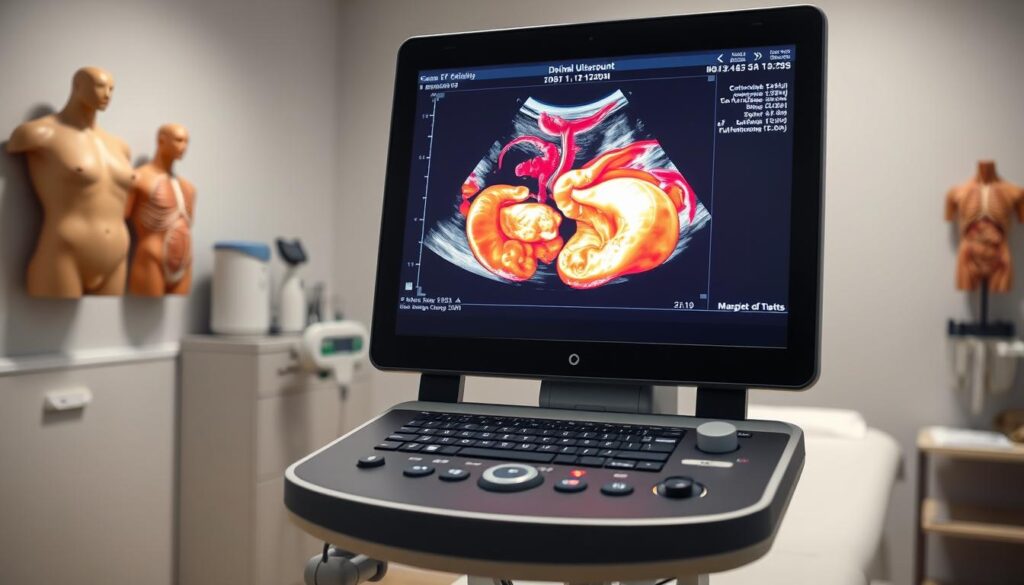
Abdominal ultrasound offers a deep look into your body without surgery. It uses sound waves to create detailed pictures of your organs1. This method helps doctors examine your liver, kidneys, pancreas, and gallbladder clearly1.
This scan can spot many health issues. It can find gallstones, kidney stones, liver tumors, and aortic aneurysms1. Some men need this test more than others.
Men aged 65-75 who’ve smoked over 100 cigarettes should get screened2. This helps catch potential health risks early.
Abdominal ultrasound is very safe. It doesn’t use harmful radiation1. Most scans take less than 30 minutes to complete.
The process is simple. A clear gel is applied to your abdomen. This gel helps transmit sound waves for better images1.
Key Takeaways
- Abdominal ultrasound is a non-invasive diagnostic imaging technique
- The procedure is radiation-free and typically takes less than 30 minutes
- Useful for detecting multiple health conditions in various organs
- Recommended for specific patient groups, especially men with smoking history
- Provides detailed internal imaging without surgical intervention
Understanding Abdominal Ultrasound and Its Purpose
Abdominal diagnostic imaging is vital in modern medical diagnostics. Ultrasound technology has transformed how doctors examine internal organs. It helps detect potential health issues without invasive procedures3.
What Is an Abdominal Sonogram
An abdominal sonogram uses high-frequency sound waves to create detailed pictures of internal organs3. This non-invasive technique allows doctors to visualize abdominal structures quickly. It provides valuable insights without exposing patients to radiation4.
Common Reasons for Getting an Abdomen Scan
- Investigating unexplained abdominal pain4
- Detecting kidney or gallbladder stones5
- Checking for potential tumors or abnormal growths5
- Examining blood flow to abdominal organs3
Benefits of Diagnostic Sonography
Abdominal ultrasound examination offers several advantages. The procedure is painless and typically takes less than 30 minutes4. It provides real-time imaging without harmful radiation exposure3.
| Diagnostic Capabilities | Specific Conditions Detected |
|---|---|
| Organ Assessment | Liver diseases, kidney issues |
| Blood Flow Evaluation | Vascular blockages, aneurysms |
| Structural Examination | Tumors, cysts, stones |
Abdomen ultrasonography provides a window into your internal health without invasive procedures.
Doctors recommend abdominal ultrasounds for various diagnostic purposes. This ensures comprehensive health monitoring and early detection of potential issues5.
How to Prepare for Your Abdominal Diagnostic Imaging
Careful preparation is key for accurate Abdominal Diagnostic Radiology results. Following important steps will help you have a smooth imaging experience6.
Pre-Exam Preparation Requirements
Abdominal ultrasound preparation involves specific guidelines to optimize image quality. Follow these key steps for the best results:
- Fast for 8 to 12 hours before the exam7
- Wear comfortable, loose-fitting clothing6
- Remove jewelry before the procedure
- Be prepared to change into a hospital gown
What to Expect During the Procedure
A technician will apply clear, water-based gel to your abdomen. This gel helps the transducer move smoothly and transmit sound waves effectively7.
You might need to change positions or hold your breath briefly. These actions help capture precise images of your abdomen.
| Preparation Step | Purpose |
|---|---|
| Fasting | Reduces gas and improves image clarity |
| Gel Application | Enables sound wave transmission |
| Positioning | Ensures comprehensive organ visualization |
The Abdominal Diagnostic Radiology procedure usually takes less than 30 minutes7. You can return to your regular activities right after the exam6.
“Proper preparation ensures the most accurate and helpful diagnostic imaging results.”
The gel used during the ultrasound wipes off easily after the procedure6. Your radiologist will review the images and provide a detailed report to your doctor7.
Conclusion
Abdominal ultrasound is a powerful tool for internal health insights. It boasts accuracy rates up to 88.6% for various conditions. This non-invasive method provides detailed organ visuals without radiation exposure.
Ultrasound reveals critical health information with impressive precision. It detects pneumoperitoneum with 95.5% accuracy. Doctors use this advanced imaging to spot issues early and act quickly.
Abdominal sonography works well in many medical situations. It identifies acute appendicitis with 77.2% sensitivity. For septic peritonitis, it finds underlying causes in 79.3% of cases.
Ultrasound offers a safe, reliable approach to diagnostics. It empowers your healthcare choices with comprehensive information. Senior physicians interpret images, ensuring accurate results.
Your proactive use of advanced imaging can make a big difference. It aids in early detection and treatment of potential health issues. Choosing ultrasound is a smart step for your well-being8910.
FAQ
What is an abdominal ultrasound?
An abdominal ultrasound creates detailed images of internal organs using sound waves. It’s a non-invasive test that examines your liver, gallbladder, kidneys, pancreas, and spleen. This method doesn’t use radiation, making it safe for all patients.
Is an abdominal ultrasound painful?
The procedure is completely painless. A technician applies gel to your abdomen and moves a probe over it. You might need to change positions or hold your breath briefly during the exam.
How long does an abdominal ultrasound take?
An abdominal ultrasound typically takes less than 30 minutes. You can resume your regular activities right after the test. This makes it a quick and convenient diagnostic tool.
How should I prepare for an abdominal ultrasound?
Fast for 8 to 12 hours before the test to prevent gas buildup. You may need to wear a hospital gown and remove jewelry. Follow your healthcare provider’s specific instructions for clear images.
What conditions can an abdominal ultrasound detect?
Abdominal ultrasounds can spot various issues like kidney stones and liver disease. They also help diagnose gallstones, abdominal aortic aneurysms, and tumors. Other detectable conditions include appendicitis, cholecystitis, pancreatitis, and liver cirrhosis.
Is an abdominal ultrasound safe?
Abdominal ultrasounds are extremely safe and non-invasive. They don’t use ionizing radiation, unlike X-rays or CT scans. This makes them ideal for patients of all ages.
Who typically needs an abdominal ultrasound?
Men aged 65 to 75 with a smoking history often need abdominal ultrasounds. People with abdominal pain or bloating may also require this test. Healthcare providers may recommend it to investigate potential internal organ issues.
How quickly will I receive my results?
Results from an abdominal ultrasound are usually available quickly. This allows your healthcare professional to make informed decisions about your care. They can plan further testing or treatment promptly.
Source Links
- Abdominal ultrasound Information | Mount Sinai – https://www.mountsinai.org/health-library/tests/abdominal-ultrasound
- Abdominal ultrasound – Mayo Clinic – https://www.mayoclinic.org/tests-procedures/abdominal-ultrasound/about/pac-20392738
- Abdominal Ultrasound – https://www.hopkinsmedicine.org/health/treatment-tests-and-therapies/abdominal-ultrasound
- Abdominal ultrasound: MedlinePlus Medical Encyclopedia – https://medlineplus.gov/ency/article/003777.htm
- Abdominal Ultrasound: Purpose, Risks and Procedure – https://www.healthline.com/health/abdominal-ultrasound
- How do I prepare for an abdominal ultrasound? How do I prepare for an abdominal ultrasound? – https://www.gatewaydiagnostic.com/how-do-i-prepare-for-an-abdominal-ultrasound/
- Ultrasound – Abdomen – https://www.radiologyinfo.org/en/info/abdominus
- Accuracy of abdominal ultrasound for the diagnosis of pneumoperitoneum in patients with acute abdominal pain: a pilot study – The Ultrasound Journal – https://theultrasoundjournal.springeropen.com/articles/10.1186/s13089-015-0032-6
- Abdominal Ultrasound and Its Diagnostic Accuracy in Diagnosing Acute Appendicitis: A Meta-Analysis – https://pmc.ncbi.nlm.nih.gov/articles/PMC8273278/
- No title found – https://avmajournals.avma.org/view/journals/javma/aop/javma.24.04.0271/javma.24.04.0271.xml

