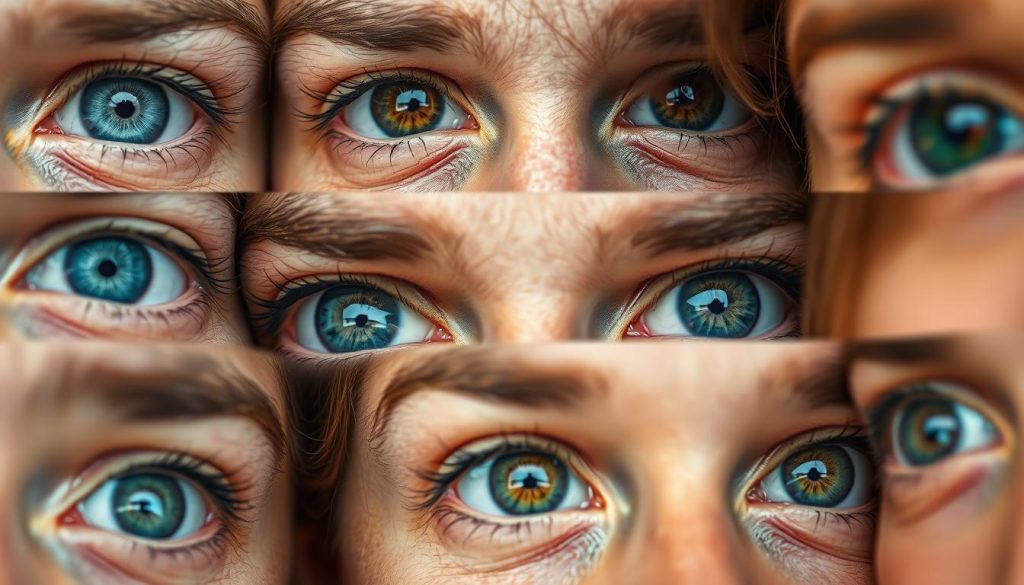
Gray eyes are a fascinating aspect of human diversity. They’re incredibly rare, with less than 1% of people worldwide having this trait1. Gray eyes are mostly found in people of European ancestry, especially from northern and eastern regions1.
Genetic studies show gray eyes aren’t strictly recessive or dominant1. Their appearance can change based on environmental factors, creating a magical visual effect1. This rare eye color is a remarkable example of human genetic variation.
Scientists are still exploring the unique features of gray eyes. About 3% of the world’s population has this exceptional trait2. Gray eyes showcase the amazing complexity of human genetic inheritance.
Key Takeaways
- Gray eyes represent less than 1% of global population
- Primarily found in European ancestral lines
- Eye color can appear to change in different lighting
- Genetic inheritance of gray eyes is complex
- Rare eye color showcases human genetic diversity
Understanding Eye Color Genetics and Melanin
Eye color genetics is a complex world of genetic factors and melanin production. Multiple genes determine the unique pigmentation of our irises. This process goes beyond simple inheritance patterns3.
Melanin is crucial in determining our eye color. It creates the final pigmentation in our irises. People with gray eyes have very low melanin levels in their iris’ front4.
Genetic Factors in Eye Color Determination
Several key genes influence eye color development:
- OCA2 gene: Primary contributor to eye color variations3
- HERC2 gene: Regulates melanin production
- SLC24A4 gene: Impacts pigment distribution
- TYR gene: Influences melanin synthesis
Inheritance Patterns of Eye Color
Eye color inheritance is remarkably complex. Recessive genes play a significant role in determining eye color. Some interesting statistical insights shed light on this process.
| Eye Color | Genetic Characteristics | Population Prevalence |
|---|---|---|
| Brown Eyes | Dominant gene | Over 55% worldwide4 |
| Blue Eyes | Recessive gene | Approximately 8% globally4 |
| Green Eyes | Recessive gene | Around 2% of population4 |
Evolutionary Perspective of Eye Color
Genetic diversity in eye color reflects fascinating evolutionary adaptations. A groundbreaking genome scan identified significant genetic markers associated with eye color variations3.
Twin studies have shown high genetic concordance in eye color. Identical twins often display nearly identical eye colors3.
Eye color is not just a simple genetic trait but a complex interplay of multiple genetic and environmental factors.
Grey Eyes Rarity: Statistics and Global Distribution
Eye color diversity is fascinating, with gray eyes being a unique genetic trait. They’re among the rarest, found in about 3% of people worldwide5. This rarity makes gray eyes an intriguing genetic curiosity.
Eye color distribution varies across regions. Northern and Eastern European populations have the highest number of gray-eyed individuals. In Asian and African regions, gray eyes are much less common6.
Genetics play a crucial role in determining iris pigmentation. The ethnic variations in eye color show this clearly.
| Region | Gray Eye Prevalence | Dominant Eye Colors |
|---|---|---|
| Northern Europe | Highest | Blue, Gray |
| Eastern Europe | High | Blue, Gray, Intermediate |
| Asia | Very Low | Brown |
| Africa | Extremely Rare | Brown |
Gray eyes are uncommon in the United States. Most gray-eyed Americans can trace their roots back to Europe. In the U.S., brown eyes make up 45% of the population.
Blue eyes account for 27%, with other colors making up smaller percentages6. This eye color distribution shows the genetic diversity in America.
Gray eyes are nature’s rare genetic masterpiece, representing a unique intersection of genetic inheritance and geographical ancestry.
The global landscape of eye colors highlights our genetic diversity. Gray eyes, though rare, are an extraordinary genetic expression. They continue to amaze both researchers and the public5.
The Science Behind Gray Eye Color
Gray eyes result from a unique iris structure with minimal eye pigmentation. Specialized collagen fiber arrangements and light interaction create this distinctive appearance. Rare eye colors like gray highlight the complexity of genetic inheritance and optical phenomena7.
The Rayleigh scattering effect is key to creating the gray eye color. This phenomenon occurs when light waves scatter through the iris. It produces a cloudy, silvery look that sets gray eyes apart from other light-colored variations8.
Gray eyes differ from blue eyes through subtle structural variations. Both result from low melanin levels, but gray eyes often have brown specks. They also feature a more complex light-scattering pattern78.
The science behind gray eye pigmentation reveals remarkable genetic diversity. Less than 3% of the global population has this eye color. Gray eyes remain an extraordinary and captivating genetic expression78.
FAQ
How rare are gray eyes?
Gray eyes are incredibly uncommon, affecting less than 1% of people worldwide. They’re most often seen in Northern and Eastern European descendants. This makes gray eyes one of the rarest eye colors globally.
What causes gray eye color?
Gray eyes result from genetic variations in melanin production. Genes like OCA2 and HERC2 play a key role. Low melanin and a unique iris structure create the distinctive gray look.
Can gray eyes change color?
Gray eyes can shift between shades of gray, blue, and even green. This change depends on lighting, clothing, and surrounding colors. The low melanin content allows light to reflect differently off the iris.
Are gray eyes a result of a specific genetic mutation?
Gray eyes stem from complex genetic interactions, not a single mutation. They’re typically a recessive trait influenced by multiple genes. These genes control melanin production and distribution in the iris.
Where are gray eyes most common?
Gray eyes are most common in Northern and Eastern Europe. You’ll find them in Russia, Finland, and parts of Scandinavia. They’re rare in African, Asian, and South American populations.
Do gray eyes have any special characteristics?
Gray eyes have a unique Rayleigh scattering effect, creating their distinct color. They typically contain less melanin than blue eyes. Some people with gray eyes may experience increased light sensitivity.
Can two brown-eyed parents have a child with gray eyes?
It’s rare, but possible if both parents carry recessive genes for light eye colors. Eye color inheritance is complex and can skip generations. The right genetic combination must include specific traits for low melanin production.
Are gray eyes more sensitive to light?
Gray eyes tend to be more light-sensitive than darker eye colors. This is due to their lower melanin content. People with gray eyes might need sunglasses more often to protect their eyes.
Source Links
- What You Should Know About One Of The World’s Rarest Eye Colors – The List – https://www.thelist.com/161384/the-truth-about-gray-eyes/
- How Rare Is Your Eye Colour? SmartBuyGlasses | UK – https://www.smartbuyglasses.co.uk/blog/how-rare-is-your-eye-colour/
- What colour are your eyes? Teaching the genetics of eye colour & colour vision. Edridge Green Lecture RCOphth Annual Congress Glasgow May 2019 – Eye – https://www.nature.com/articles/s41433-021-01749-x
- Unlock the Mysteries of Eye Color Genetics: A Fascinating Deep Dive – https://www.viacord.com/blog/unlock-mysteries-eye-color-genetics-fascinating-deep-dive?srsltid=AfmBOopYc-7u0lyPP4WpQuw8r_AqANU5jkHEdskt5nNe49mY4aBfrZ3P
- Eye Color Percentage by Country 2024 – https://worldpopulationreview.com/country-rankings/eye-color-percentage-by-country
- All About Eye Colors (and What They May Say About Your Health) – https://www.healthline.com/health/eye-health/eye-color-percentages
- Gray Eyes – All About Vision – https://www.allaboutvision.com/eye-care/eye-anatomy/eye-color/gray/
- Gray Eyes (Pictures, Genetics & Facts) – https://www.visioncenter.org/conditions/grey-eyes/