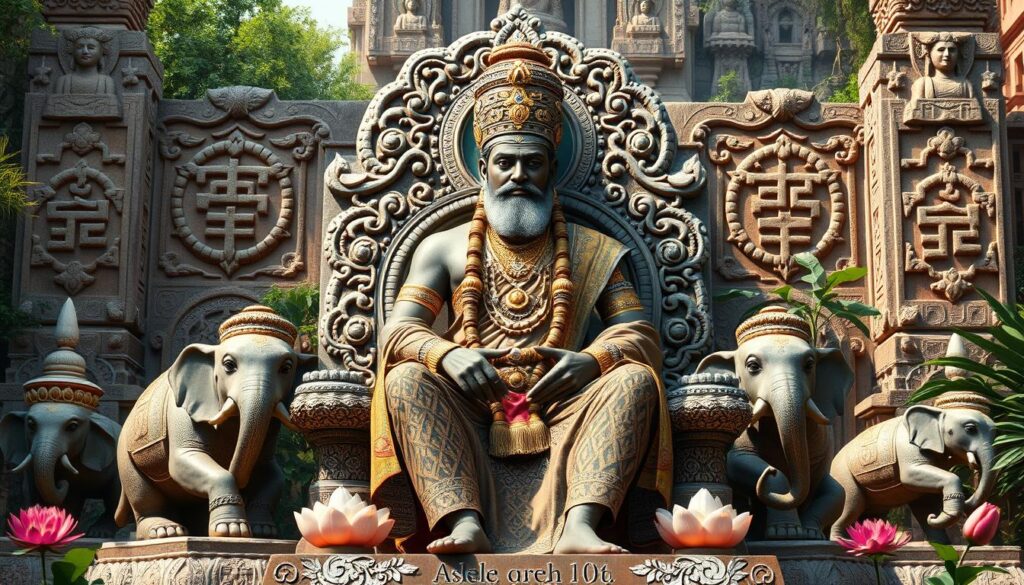
Ashoka, also known as Ashoka the Great, was the third ruler of the Mauryan dynasty. He ruled from about 268 BCE to 232 BCE1. His empire stretched from present-day Afghanistan to Bangladesh, covering a big part of India1.
He is often called Ashoka, Ashoka the Great, and Ashoka Emperor. These names highlight his significant role in shaping India’s history.
Imagine ruling a vast empire and then becoming a compassionate leader. That’s Ashoka’s story. After conquering Kalinga, he adopted Buddhism and supported it strongly2.
Key Takeaways
- Ashoka was the third ruler of the Mauryan dynasty, reigning from approximately 268 BCE to 232 BCE1.
- His empire covered a significant part of the Indian subcontinent, extending from present-day Afghanistan to present-day Bangladesh1.
- Ashoka adopted Buddhism after his conquest of Kalinga and became a vigorous patron of the religion2.
- He founded hospitals for both people and animals, planted roadside trees, dug wells, and constructed watering sheds and rest houses for public welfare2.
- Ashoka’s policies promoted respect for all religious sects and advocated for the increase of inner worthiness among followers of different beliefs2.
The Legacy of Ashoka the Great
The legacy of Ashoka Maurya is a key part of Indian history. It shows how his rule changed governance and culture.
Historical Context
Ashoka took power around 268 BCE. He ruled over a huge Mauryan Empire that covered the Indian subcontinent3. The empire had many people and lands, making it hard to manage4.
Ashoka’s Reign and Achievements
Ashoka ruled for 37 years, showing great strength and change5. His victory in Kalinga in 261 BCE changed him, leading him to follow Buddhism43. He focused on kindness, helping others, and making society better4.
He built many pillars and rock edicts to share his ideas across the empire5.
The Spread of Buddhism
After Kalinga, Ashoka supported Buddhism a lot, building stupas and helping missionaries45. His work helped Buddhism grow beyond India, touching many Asian cultures3. His commitment to peace and fair rule has influenced many systems today.
| Achievement | Description | Reference |
|---|---|---|
| Kalinga War | Led to Ashoka’s conversion to Buddhism | 43 |
| Dhamma Policies | Promoted non-violence, compassion, and social welfare | 4 |
| Edicts and Pillars | Inscribed messages promoting ethical governance | 5 |
| Spread of Buddhism | Established stupas and supported missionary work | 35 |
Ashoka’s Edicts and Inscriptions
Ashoka’s edicts and inscriptions are some of the earliest signs of a ruler’s power in India. They give us a detailed look at
Overview of the Edicts
The Edicts of Ashoka are 33 inscriptions found on pillars, stones, and cave walls. They span across Afghanistan, Bangladesh, India, Nepal, and Pakistan6. These inscriptions are divided into different types, including Minor Rock Edicts and Major Pillar Edicts7.
Only ten Pillar Edicts remain, standing tall at 40 to 50 feet and weighing up to 50 tons6. The pillars are decorated with lion, bull, and horse capitals. The four-facing lion capital is now India’s national emblem6.
Key Messages in the Inscriptions
Ashoka’s inscriptions mainly talk about Dhamma, or doing the right thing. He was committed to good governance7. After the Kalinga War, he gave up violence and became a Buddhist6.
He used his edicts to spread peace and non-violence across his empire6. The inscriptions also share his administrative policies and missionary work. They show how he helped Buddhism grow into a global religion6.
| Type of Edict | Description | Number |
|---|---|---|
| Major Rock Edicts | Focus on governance and moral teachings | 7 |
| Minor Rock Edicts | Detail specific policies and local issues | 14 |
| Major Pillar Edicts | Emphasize Ashoka’s Dhamma and administrative reforms | 10 |
| Minor Pillar Edicts | Contain inscriptions on individual pillars | 2 |
Influence on Modern Governance
Ashoka India’s governance model focuses on moral leadership and ethical practices. These values inspire today’s political landscape.
Principles of Non-Violence
Ashoka’s commitment to non-violence changed his rule. After the Kalinga war, he chose “conquest by dharma.” This meant honesty, compassion, and kindness8.
This change helped create modern ideas of soft power and ethical governance9.
Impact on Contemporary Leaders
Leaders like Mahatma Gandhi and Nelson Mandela were inspired by Ashoka. Gandhi used non-violent resistance, just like Ashoka10. Mandela worked on reconciliation, showing Ashoka’s values of tolerance and care for society9.
Today, India’s governance reflects Ashoka’s legacy. It focuses on public welfare and religious tolerance. This creates a diverse and inclusive society8.
| Ashoka’s Principles | Modern Governance Practices |
|---|---|
| Non-violence and ethical rule | Emphasis on diplomacy and peacebuilding |
| Social welfare initiatives | Public health and education programs |
| Religious tolerance | Policies promoting multiculturalism and diversity |
| Compassion and benevolence | Human rights and humanitarian efforts |
Ashoka in Popular Culture
Ashoka’s legacy inspires many parts of modern culture in India. His story is a big part of India’s history. It also stands for lasting values and principles.
Literary References
Ashoka India is a key figure in many books, from old tales to new stories. Writers dive into his change and how his rule affected others. This gives readers a close look at his life.
Representation in Art and Media
Artists and filmmakers show Ashoka’s life and achievements in different ways. His story is told in movies and documentaries, showing his path from war to Buddhism. Art often shows his ideals, making his story known to more people.
Ashoka’s Symbolism in Modern Times
The State Emblem of India uses Ashoka’s legacy, with the Lion Capital as a symbol. The Ashoka Chakra on India’s flag also shows his impact. These symbols remind us of Ashoka India’s history and values every day111213.
FAQ
Who was Ashoka the Great?
A: Ashoka the Great was a key figure in ancient Indian history. He ruled the Mauryan dynasty in the 3rd century BCE. He is famous for changing from a fierce warrior to a kind ruler who followed Buddhism.
What was the extent of Ashoka’s empire?
Ashoka’s empire covered most of the Indian subcontinent. This includes today’s India, Pakistan, Bangladesh, and parts of Nepal and Afghanistan. His rule was known for good administration and spreading Buddhist teachings.
How did the Kalinga War influence Ashoka’s reign?
The Kalinga War was a turning point for Ashoka. The war’s bloodshed and suffering made him turn to Buddhism. He then focused on peace and fair rule, changing his ways and legacy.
What are Ashoka’s pillars and what is their significance?
A: Ashoka’s pillars are columns across the Indian subcontinent. They have Ashoka’s messages and are the oldest known imperial messages in ancient India. They show his commitment to dhamma (moral law).
What are the key messages in Ashoka’s edicts?
Ashoka’s edicts talk about dhamma. They stress non-violence, respect for all religions, and caring for people. These messages show his aim for a fair and kind society.
How did Ashoka influence the spread of Buddhism?
Ashoka helped spread Buddhism in his empire and beyond. He built stupas, supported monks, and sent missionaries. His efforts helped Buddhism grow.
In what ways has Ashoka’s governance influenced modern political thought?
Ashoka’s ideas on peace, fairness, and helping people have shaped modern politics. Leaders like Mahatma Gandhi and Nelson Mandela were inspired by him. They used his ideas in their own leadership.
How is Ashoka represented in modern popular culture?
Ashoka is seen in many parts of popular culture, like books, movies, and art. His story is told in films and TV shows. This keeps his legend alive and important in today’s India.
What is the significance of the Ashoka Chakra in modern India?
The Ashoka Chakra is a key symbol in India’s flag. It stands for the cycle of law and progress. It shows the values of Ashoka’s rule, like justice and doing what’s right.
How have Ashoka’s principles been integrated into India’s modern political landscape?
Ashoka’s ideas of kindness, tolerance, and helping others are part of India’s politics today. His focus on doing good and being fair influences current policies. It shapes how India looks at human rights and democracy.
Source Links
- https://en.wikipedia.org/wiki/Ashoka – Ashoka
- https://www.britannica.com/biography/Ashoka – Ashoka | Biography, History, Religion, India, & Buddhism | Britannica
- https://sammatey.substack.com/p/unpaywalled-repost-ashoka-the-great – Now Unpaywalled: Ashoka the Great Was, In Fact, Pretty Great
- https://amishanagraj004.medium.com/ashoka-the-great-and-his-enduring-legacy-of-dhamma-bd33cd0f9d98 – Ashoka the Great and His Enduring Legacy of Dhamma
- https://thesocialdigest.com/2024/02/23/the-legacy-of-emperor-ashoka-tracing-the-mauryan-empires-impact-on-indian-history/ – Tracing the Mauryan Empire’s Impact on Indian History – The Social Digest
- https://www.worldhistory.org/Edicts_of_Ashoka/ – The Edicts of Ashoka the Great
- https://en.wikipedia.org/wiki/Edicts_of_Ashoka – Edicts of Ashoka
- https://confucianweeklybulletin.wordpress.com/2020/07/28/ashoka-and-the-politics-of-moral-governance/ – Ashoka and the Politics of Moral Governance
- https://library.fiveable.me/key-terms/ap-world/ashokas-reign – Ashoka’s reign – (AP World History: Modern) – Vocab, Definition, Explanations | Fiveable
- https://www.nationalgeographic.com/culture/article/ashoka – Who was Ashoka?
- https://unacademy.com/content/upsc/study-material/ancient-history/about-ashoka-and-his-culture/ – About Ashoka and His Culture
- https://swarajyamag.com/culture/ashoka-the-not-so-great – Ashoka, The Not So Great
- https://www.worldhistory.org/Ashoka_the_Great/ – Ashoka the Great