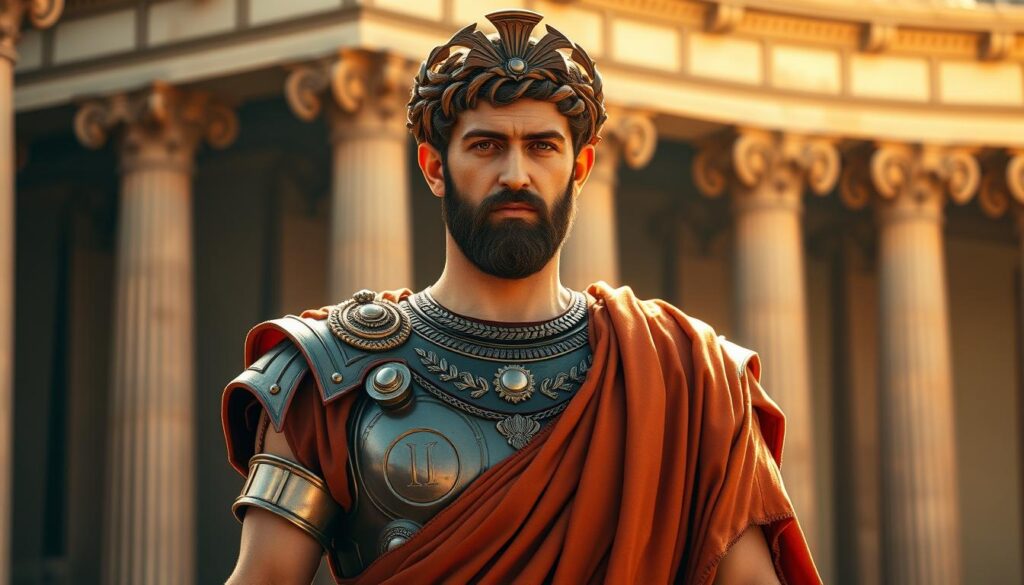
Augustus, the first Roman Emperor, changed the Roman Republic into an empire. He brought stability and prosperity, known as the Pax Romana1. Born Gaius Octavius on 23 September 63 BC in Rome, he was Julius Caesar’s great-nephew and adopted son. He later became known as Gaius Julius Caesar Octavianus2.
As the Roman Emperor, Augustus expanded the empire. He also set up the Principate system of government and changed the Roman tax system1. He was a major figure in Ancient Rome, and his impact is felt today3.
Key Takeaways
- Augustus was the first Roman Emperor, ruling from 27 BC until his death in AD 141.
- He was born Gaius Octavius on 23 September 63 BC in Rome and later became known as Gaius Julius Caesar Octavianus2.
- Augustus expanded the Roman Empire, establishing the Principate system of government and reforming the Roman system of taxation1.
- He played a key role in changing the Roman Republic into an empire, bringing stability and prosperity known as the Pax Romana1.
- Augustus was a major figure in Ancient Rome, and his legacy continues to be felt today3.
- He was succeeded as emperor by his adopted son Tiberius1.
- Augustus adopted the name Gaius Julius Caesar Octavianus after being adopted by Julius Caesar as his son2.
Early Life and Background
Augustus Caesar, the First Roman Emperor, came from a family that greatly influenced Roman History.
Family Heritage and Upbringing
Augustus was born in 63 B.C. in Velletri. His family was wealthy and part of the equestrian class. His father was the first to become a Roman senator4. This set a high standard of political power and respect in their family.
Education and Early Influences
Tragedy hit when Augustus was just four years old5. Yet, he got a great education. He learned a lot about Roman culture and public life. At twelve, he gave a moving speech for his grandmother Julia. This showed his talent in speaking.
Rise of the Roman Republic
When Augustus was young, the Roman Republic was changing a lot. His friendship with Julius Caesar helped him rise. This made him a key player in the shift to the Roman Empire6.
Political Career and Leadership
After the Battle of Actium, Augustus became the clear leader of Ancient Rome. This was a major change in Roman History7.
Assumption of Power
After Julius Caesar’s death, Augustus worked his way through the Second Triumvirate. He formed alliances with Mark Antony and Marcus Agrippa. This helped him defeat his opponents and take full control of Rome8.
Key Policies and Reforms
Augustus created the Principate system, a monarchy that looked like a republic. This system kept Rome stable while seeming democratic8.
He also brought in social and economic changes to support Roman values. He gave money to families with three or more kids to encourage more children7.
Augustus built many roads, aqueducts, and public buildings in Rome. These projects helped the economy grow and made people proud of their city8.
Military Conquests and Expansion
Augustus made the Roman Empire bigger, covering more of the Mediterranean. He secured borders and set up provinces that boosted trade and the military9.
His military wins helped Rome grow stronger. They also brought in new cultures, making Roman History richer and the legacy of Emperor Augustus greater9.
Cultural Impact and Legacy
Augustus, the first Roman Emperor, greatly influenced Ancient Rome
Influence on Roman Art and Architecture
During Augustus’ time, Rome saw a surge in literature and poetry. He backed famous poets like Virgil and Horace, enriching the culture10. He also built the Forum of Augustus and the Temple of Caesar, beautifying the city1011.
His image was everywhere, seen in statues and coins across the empire10.
Changes in Roman Religion and Society
Augustus promoted Roman cults and started the imperial cult. This mix of religion and leadership united the people12. He focused on good citizenship and personal responsibility, creating a strong community12.
His efforts in rebuilding society helped people feel connected and resilient12.
Legacy in Historical Context
Augustus’ impact went beyond his life, shaping Roman society, law, and government. He created a system that lasted for centuries, influencing Rome’s governance10. His rule brought peace and stability, setting a high standard for future generations10.
His book, “Res Gestae Divi Augusti,” gives us a deep look into his rule and the time10.
| Aspect | Contribution |
|---|---|
| Art and Literature | Supported poets like Virgil and Horace, fostering a literary golden age10 |
| Architecture | Constructed the Forum of Augustus and Temple of Caesar1011 |
| Religion | Promoted traditional Roman cults and the imperial cult12 |
| Governance | Established the enduring imperial system and the Pax Romana10 |
| Legacy | Left “Res Gestae Divi Augusti” and set standards for Roman governance10 |
Assessment of Augustus’s Rule
Augustus Caesar changed Roman History by becoming the First Roman Emperor. His rule brought stability after years of chaos. This showed his strong leadership.
Strengths and Achievements
Augustus’s biggest achievement was starting the Pax Romana, a long period of peace13. He also fixed the tax system and improved roads. These actions helped the economy and trade.
Controversies and Criticisms
Augustus was criticized for his strict rule. He took power away from the Roman Republic’s democracy13. His choice to banish the poet Ovid also raised questions about his views on freedom of speech.
Comparison with Successors
Augustus set a high standard for future emperors14. Some followed his ways to keep Rome prosperous. But others found it hard to match his success, showing Augustus’s special leadership skills.
Augustus’s legacy in Roman History is complex. He made big changes and faced criticism. As the First Roman Emperor, his influence lasted for centuries, shaping the Roman Empire and future leaders13.
FAQ
Who was Augustus and why is he considered the first Roman Emperor?
A: Augustus, originally known as Gaius Octavius, was the adopted son of Julius Caesar. After Caesar’s death, Augustus became the sole ruler of Rome. He established the principate system, marking the end of the Roman Republic and the start of the Roman Empire. His leadership brought stability and prosperity to Rome, creating a lasting legacy.
How did Augustus rise to power following Julius Caesar’s assassination?
After Julius Caesar’s death in 44 BCE, Augustus, then Octavian, joined forces with Mark Antony and Lepidus. Together, they defeated Caesar’s assassins. Octavian’s strategic alliances and military victories led to his rise to power. By 27 BCE, he became the sole ruler of Rome, implementing reforms that kept the appearance of a republic.
What were the key policies and reforms introduced by Augustus as emperor?
Augustus introduced significant policies and reforms as the first Roman Emperor. He established the principate system, maintaining authority while preserving traditional structures. He also promoted Roman values, restructured the tax system, and initiated building projects that transformed Rome.
His military reforms strengthened the legions, facilitating expansion and maintaining peace. These reforms reshaped Roman governance and culture.
What is the Pax Romana, and how did Augustus contribute to its establishment?
The Pax Romana, or “Roman Peace,” was a period of peace and stability in the Roman Empire. Augustus played a key role in ending civil wars and securing the empire’s borders. His policies promoted prosperity, infrastructure development, and cultural flourishing, creating a stable environment for trade and cultural exchange.
How did Augustus influence Roman art and architecture during his reign?
Augustus was a patron of the arts and architecture, promoting his image and the empire’s grandeur. He supported renowned artists and poets, such as Virgil and Horace. Architecturally, he initiated a building program that transformed Rome’s urban landscape.
His famous statement, “I found Rome a city of bricks and left it a city of marble,” reflects his commitment to Rome’s magnificence.
What were the religious changes and developments during Augustus’s reign?
During his reign, Augustus promoted traditional Roman cults and religious practices. He revived old temples and sponsored festivals, focusing on piety and moral values. He also laid the groundwork for the imperial cult, deifying emperors and integrating their worship into Roman religion.
What were some of the major achievements and accomplishments of Augustus’s rule?
Augustus’s reign was marked by significant achievements. He ended the era of civil wars, bringing stability and peace. His administrative reforms streamlined governance and reduced corruption. He expanded the empire’s territories, securing its borders and increasing wealth.
His investment in infrastructure improved the quality of life in Rome and facilitated economic growth.
What criticisms and controversies surrounded Augustus’s rule?
Despite his achievements, Augustus faced criticisms and controversies. Some saw his consolidation of power as a move towards authoritarianism, undermining traditional Roman values. His suppression of opponents and use of propaganda were seen as threats to political freedom.
While the Pax Romana brought peace, it relied heavily on military force and strict governance. This laid the groundwork for future imperial excesses.
How did Augustus’s leadership influence his successors and the future of the Roman Empire?
Augustus established a model of imperial governance followed by his successors. He balanced autocratic power with traditional institutions, setting a precedent for future emperors. His emphasis on stability, infrastructure, and cultural patronage influenced the policies and priorities of subsequent rulers.
What was Augustus’s early life like, and how did it prepare him for his role as emperor?
Augustus, born Gaius Octavius, came from a well-connected Roman family. His father was a senator, and his mother was related to Julius Caesar. From a young age, Augustus received a thorough education and was exposed to Roman public life.
At age 12, he delivered the funeral oration for his grandmother, Julia. This showcased his oratory skills and understanding of Roman traditions. His early experiences and connections to influential figures like Caesar prepared him for his rise to power.
Source Links
- https://en.wikipedia.org/wiki/Augustus – Augustus
- https://www.britannica.com/biography/Augustus-Roman-emperor – Augustus | Biography, Accomplishments, Statue, Death, Definition, & Facts | Britannica
- https://en.wikipedia.org/wiki/Augustus_(title) – Augustus (title)
- https://www.history.com/topics/ancient-rome/emperor-augustus – Augustus ‑ Caesar, Emperor & Accomplishments | HISTORY
- https://en.wikipedia.org/wiki/Early_life_of_Augustus – Early life of Augustus
- https://www.ducksters.com/history/ancient_rome/augustus.php – Biography for Kids: Augustus
- https://www.worldhistory.org/article/116/augustus-political-social–moral-reforms/ – Augustus’ Political, Social, & Moral Reforms
- https://the-history-avenue.eu/2024/02/06/unlocking-greatness-the-leadership-legacy-of-octavian-augustus/ – Unlocking Greatness: The Leadership Legacy of Octavian Augustus – THE HISTORY AVENUE
- http://roman-emperors.sites.luc.edu/auggie.htm – Roman Emperors – DIR Augustus
- https://medium.com/@codexaugustorum/the-legacy-of-augustus-the-first-emperor-of-rome-e8ef974ef7b7 – The Legacy of Augustus: The First Emperor of Rome
- https://origins.osu.edu/milestones/august-2014-celebrating-roman-emperor-augustus – Celebrating Roman Emperor Augustus | Origins
- https://sweetinstitute.com/augustus-caesars-legacy-lessons-for-mental-well-being-through-leadership-and-stability/ – Augustus Caesar’s Legacy: Lessons for Mental Well-Being through Leadership and Stability – SWEET INSTITUTE – Continuing Education for Mental Health Professionals
- https://www.worldhistory.org/article/905/reforms-of-augustus/ – Reforms of Augustus
- https://en.wikipedia.org/wiki/Constitutional_reforms_of_Augustus – Constitutional reforms of Augustus