
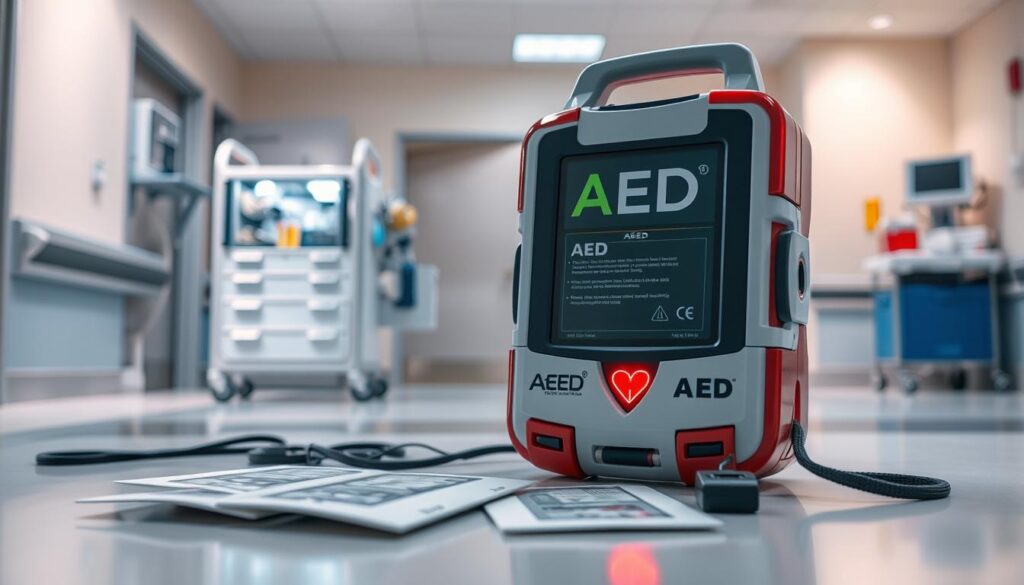
Cardiac arrest requires immediate action. AEDs are vital emergency devices that save lives during sudden heart rhythm problems1. These portable tools offer quick help for people facing life-threatening heart emergencies2.
You can find AEDs in many public places. They’re in government buildings, schools, airports, and community centers1. Police, ambulances, malls, offices, gyms, and planes also have these crucial devices1.
Over 350,000 people have cardiac arrest each year in the US2. First responders take 8-12 minutes to arrive after a 911 call. Having an AED nearby can greatly boost survival chances2.
Every minute without defibrillation lowers survival odds by about 10%2. Modern AEDs like Philips HeartStart and Zoll AED Plus give voice instructions. This makes emergency response easier for untrained people1.
These devices check heart rhythm and give precise electrical shocks when needed. They can potentially save a life within minutes.
Key Takeaways
- AEDs are critical in treating sudden cardiac arrest
- Quick intervention is essential for survival
- AEDs are available in many public spaces
- Proper training enhances effective AED use
- Every minute counts during cardiac emergencies
Understanding Automated External Defibrillators (AEDs)
Automated External Defibrillators (AEDs) are vital life-saving devices. They help during sudden cardiac emergencies. These portable machines offer hope when every second counts3.
Types of AEDs: Public vs Professional Use
AEDs come in two main types: public access and professional models. Public access AEDs are made for untrained individuals. They’re user-friendly and guide users through each rescue step3.
- Public AEDs like Defibtech Lifeline are designed for general use
- Professional AEDs such as Physio-Control LIFEPAK target trained first responders
- Non-medical personnel including police and firefighters can effectively use these devices3
How AEDs Work in Cardiac Emergencies
AEDs are crucial during cardiac arrest. They analyze heart rhythm and deliver a shock if needed. This shock can restart a normal heart pattern4.
Immediate CPR with AED use can greatly increase survival chances3.
Every minute without defibrillation reduces survival odds by approximately 10%4.
Key Components and Features of Modern AEDs
Modern AEDs like Cardiac Science Powerheart have advanced tech. They’re designed to maximize user effectiveness. These devices typically include:
- Voice prompt guidance system
- Visual indicator lights
- Automatic heart rhythm analysis
- Interchangeable adult and child electrode pads3
| AED Model | Primary Use | Key Feature |
|---|---|---|
| Defibtech Lifeline | Public Access | Simple User Interface |
| Physio-Control LIFEPAK | Professional Use | Advanced Diagnostic Capabilities |
| Cardiac Science Powerheart | Versatile | Quick Shock Technology |
Knowing how AEDs work can save lives during cardiac emergencies. These amazing devices provide quick medical help. They continue to save countless lives worldwide4.
Step-by-Step Guide to Using an AED in Emergency Situations
Knowing how to use an Automated External Defibrillator (AED) can save lives during cardiac arrest5. AEDs are easy to use, even without medical training5. They allow anyone to potentially save a life in an emergency.
Here’s a critical guide to using an AED during an emergency response:
- Check Responsiveness: Ensure the person is unresponsive and not breathing normally
- Call emergency services immediately
- Begin CPR while waiting for an AED
- Turn on the AED and follow voice prompts5
- Expose the chest and attach electrode pads correctly
- Ensure no one touches the patient during heart rhythm analysis
- Press the shock button if advised by the device
AEDs are available in many public places like airports, schools, and hospitals5. Some devices have a “Child Mode” for younger patients5.
Remember: Using an AED within the first 3-5 minutes can increase survival rates by up to 70%5.
To be better prepared, take an AED and CPR training course. These courses last a few hours and offer hands-on practice6.
Good Samaritan laws protect those who use AEDs in good faith during emergencies5. Stay calm and follow the device’s instructions. You could help save someone’s life.
Conclusion
AEDs are vital in cardiac arrest situations. They offer great potential, but understanding their performance is crucial. Studies show AEDs were used in 38.6% of cases, with 18.1% survival to hospital discharge7.
Your quick action can be life-changing during emergencies. Bystander CPR rates are low, under 25% in the US8. Hands-only CPR is effective, with a 15.5% hospital discharge rate8.
Learning proper emergency techniques could save a life. Consider your risk factors when thinking about home AED purchase. The FDA offers guidance on AED selection. AED effectiveness varies based on heart rhythm characteristics7.
Your preparedness and quick action greatly impact survival outcomes. Effective emergency response combines proper CPR, swift AED use, and staying calm under pressure.
FAQ
What is an Automated External Defibrillator (AED)?
An AED is a portable device that treats sudden cardiac arrest. It delivers an electrical shock to restore normal heart rhythm. These life-saving tools are found in public spaces and are user-friendly for everyone.
How do AEDs work?
AEDs analyze heart rhythm through pad electrodes. They determine if a shock is needed automatically. The device guides users with voice prompts and visual indicators during emergencies.
AEDs can deliver an electrical shock to stop dangerous heart rhythms. This helps restore normal heart function in critical situations.
Are there different types of AEDs?
Yes, there are two main types of AEDs. Public access AEDs require minimal training. Professional use AEDs are for first responders like EMTs and paramedics.
Popular FDA-approved brands include Philips HeartStart, Zoll AED Plus, and Defibtech Lifeline. Physio-Control LIFEPAK and Cardiac Science Powerheart are also well-known options.
Can anyone use an AED?
Most modern AEDs are designed for people with little or no training. They provide step-by-step audio and visual instructions during cardiac emergencies. Basic training can boost confidence and effectiveness when using an AED.
What are the basic steps to use an AED?
First, check for responsiveness and call emergency services. Turn on the AED and follow its voice prompts. Remove chest clothing and attach pad electrodes correctly.
Ensure no one touches the person during rhythm analysis. If advised, deliver a shock by pressing the indicated button. Begin CPR immediately and follow the AED’s instructions.
How effective are AEDs in saving lives?
AEDs are highly effective when used promptly. CPR and early defibrillation greatly improve survival rates during sudden cardiac arrest. Using an AED within minutes can dramatically increase chances of survival.
Do I need to purchase an AED for my home?
Home AEDs aren’t mandatory but can provide peace of mind for high-risk individuals. Consider your living situation, health risks, and costs before buying. If purchased, ensure proper maintenance and that family members know its location and use.
How do I maintain an AED?
Regular maintenance is crucial for AEDs. Register your device with the manufacturer and check battery levels often. Inspect pad electrodes for expiration and keep the AED easily accessible.
Many AEDs have self-diagnostic features that alert you to maintenance needs. Always follow the manufacturer’s guidelines for your specific model.
Source Links
- Automated external defibrillators: Do you need an AED? – https://www.mayoclinic.org/diseases-conditions/heart-arrhythmia/in-depth/automated-external-defibrillators/art-20043909
- What is AED? | Learn What an AED Is | Red Cross – https://www.redcross.org/take-a-class/aed/using-an-aed/what-is-aed?srsltid=AfmBOopcqL-Frk4A3IRHFvNrN8F6v5P1ikKwCO-dMYFv49miSyMvsbsq
- What Is an Automated External Defibrillator? – https://www.heart.org/-/media/files/health-topics/answers-by-heart/what-is-an-aed.pdf
- What is AED? | Learn What an AED Is | Red Cross – https://www.redcross.org/take-a-class/aed/using-an-aed/what-is-aed?srsltid=AfmBOopmjj2MDuFYv_ka0q449K4b8jLuykOWIk2XmL4V2Mj4LQMs3gcM
- How to use an AED – Victor Chang Cardiac Research Institute – https://www.victorchang.edu.au/aed
- AED Training, information on Automated External Defibrillator use, how to use AED’S – http://www.early-defib.org/03_06_08.html
- Automated External Defibrillators and Survival After In-Hospital Cardiac Arrest – https://pmc.ncbi.nlm.nih.gov/articles/PMC3587791/
- The AED in Resuscitation: It’s Not Just about the Shock – https://pmc.ncbi.nlm.nih.gov/articles/PMC3116356/

