
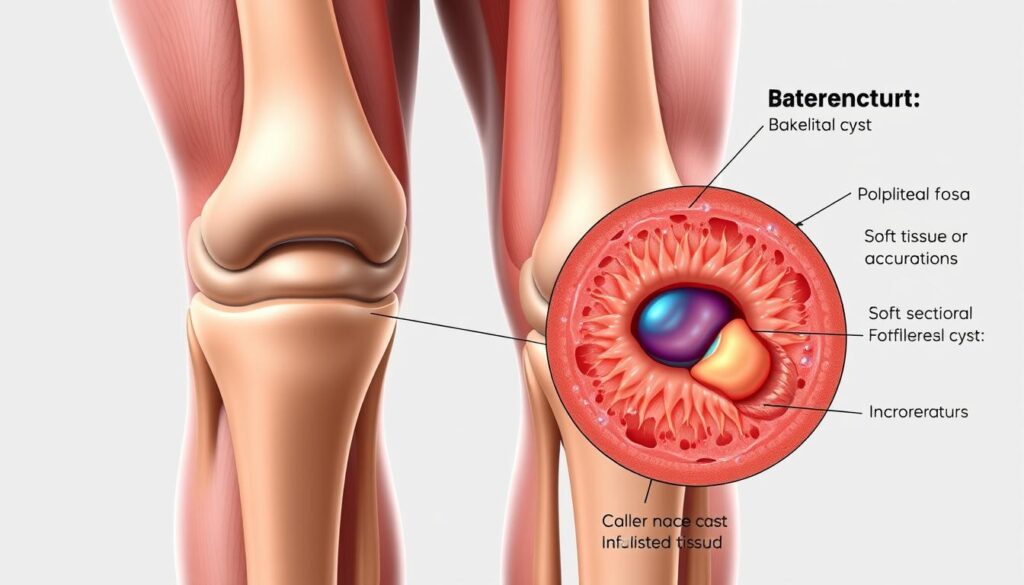
A Baker cyst is a fluid-filled swelling behind your knee joint. It can cause discomfort and affect your mobility. This happens when the knee joint is inflamed or damaged1.
Baker’s cysts form when extra fluid builds up behind the knee. This creates a bulge that can lead to pain and stiffness2.
Knowing about this condition helps you manage symptoms better. Most people with Baker’s cysts feel knee swelling and pain. These issues often link to other knee problems like cartilage tears or arthritis2.
Taking care of your knee joint health is key. It can help prevent and manage these cysts1.
Key Takeaways
- Baker cysts are fluid-filled swellings behind the knee
- Most common in adults between 35 and 70 years old
- Can be caused by various knee joint conditions
- Often treatable with non-surgical methods
- Rarely lead to long-term complications
Understanding Baker Cyst and Its Causes
A Baker cyst is a fluid-filled growth behind the knee. It can cause significant pain and discomfort. This condition impacts joint mobility and overall comfort3.
What Defines a Baker Cyst?
A Baker cyst is a fluid-filled sac in the back of your knee. It’s usually connected to the synovial membrane. Excess synovial fluid creates a bulge, causing tightness and limited movement4.
Common Causes and Risk Factors
Several factors contribute to Baker cyst development:
- Osteoarthritis and rheumatoid arthritis3
- Meniscus or ACL tear
- Cartilage damage
- Chronic knee joint inflammation
Some people may have Baker cysts without knowing the exact cause. This is especially true for younger patients3.
Synovial Fluid and Cyst Formation
The synovial membrane is key in cyst development. Knee joint problems can make this membrane produce excess fluid. This excess fluid leads to Baker cyst formation4.
| Characteristic | Details |
|---|---|
| Prevalence | Common in individuals with underlying knee conditions3 |
| Symptom Variation | Can be asymptomatic or cause significant discomfort4 |
| Treatment Approach | Typically managed with nonsurgical methods3 |
Understanding the nuanced nature of Baker cysts can help you recognize potential symptoms and seek appropriate medical guidance.
Signs, Symptoms and Complications
Baker cysts can cause knee discomfort and limit mobility. Knowing the signs helps manage this condition better.
The primary symptoms of a Baker cyst typically include:
- Pain behind the knee5
- Knee stiffness and reduced flexibility6
- Swelling in the knee and calf area7
- Discomfort during prolonged standing or physical activity5
Severe Baker cysts can cause intense symptoms. In rare cases, the cyst may rupture, leading to sharp pain and significant swelling7.
Some people feel fluid running down their calf. This can be quite alarming5.
| Symptom Severity | Potential Complications |
|---|---|
| Mild | Slight knee discomfort |
| Moderate | Increased calf pain and knee stiffness |
| Severe | Potential cyst rupture, nerve trapping, or artery blockage5 |
“Early recognition of symptoms can prevent potential complications and improve treatment outcomes.”
If you have ongoing knee swelling or calf pain, see an orthopedic specialist. They can find the cause and create a treatment plan7.
Conclusion
Managing a Baker cyst requires a tailored approach to your knee health. Treatment depends on factors like swelling severity and joint conditions8. Your doctor can help create a plan that addresses the cyst’s root cause, which medical research links to meniscal issues or inflammation8.
Most patients find relief through conservative methods. Younger patients may see the cyst resolve on its own9. Ultrasonography helps doctors assess the cyst and determine the best treatment9.
Surgery might be needed for larger cysts or persistent knee problems. Careful monitoring is essential to prevent recurrence9.
Your Baker cyst experience can be manageable. Work closely with your healthcare team to understand your condition. Follow recommended treatments to effectively manage symptoms and maintain knee function.
Remember, each case is unique. What works for one person may not work exactly the same for another.
FAQ
What exactly is a Baker cyst?
A Baker cyst is a fluid-filled swelling behind the knee. It’s often caused by knee joint problems like arthritis or cartilage tears. The cyst forms when excess fluid builds up in a bursa at the back of the knee.
What are the main symptoms of a Baker cyst?
Common symptoms include swelling behind the knee and knee pain. You might also experience stiffness and trouble bending your knee fully. Discomfort may increase after physical activity or standing for long periods.
In rare cases, the cyst may burst. This can cause sharp pain, calf swelling, and a feeling of fluid running down the leg.
Who is most at risk of developing a Baker cyst?
Older adults and those with previous knee injuries are at higher risk. People with joint conditions like arthritis or cartilage damage are also more likely to develop a Baker cyst. Chronic knee joint inflammation increases the chance of cyst formation due to excess fluid production.
How is a Baker cyst typically treated?
Treatment depends on how severe the symptoms are. Self-care methods include rest, ice packs, and over-the-counter pain relievers. More advanced treatments may involve corticosteroid injections or cyst drainage.
In some cases, surgery might be needed to fix underlying knee joint issues. Always talk to a doctor about your treatment options.
Can a Baker cyst be dangerous?
Baker cysts are usually not serious but can cause discomfort. If left untreated, they might lead to complications. In rare cases, they can be mistaken for more serious conditions like blood clots.
Seek medical help if you have ongoing pain or swelling.
How long does a Baker cyst typically last?
The duration varies based on the cause and treatment. Some cysts may go away on their own with rest and basic care. Others might need medical treatment.
Fixing the root cause of knee joint swelling is key to long-term relief.
Can I prevent a Baker cyst from developing?
While not always preventable, you can lower your risk by keeping your joints healthy. Regular exercise and maintaining a healthy weight help. Avoid knee injuries and manage conditions like arthritis.
Warm up before physical activities and use proper protective gear when needed.
Source Links
- Baker’s cyst – https://patient.info/bones-joints-muscles/knee-pain-patellofemoral-pain/bakers-cyst
- Bakers Cyst Removal in Los Angeles: Symptoms & Treatment | Meier Orthopedic Sports Medicine – https://www.mosm.com/bakers-cyst/
- Baker’s Cyst (Popliteal Cyst) – OrthoInfo – AAOS – https://orthoinfo.aaos.org/en/diseases–conditions/bakers-cyst-popliteal-cyst/
- Baker cyst – Symptoms and causes – https://www.mayoclinic.org/diseases-conditions/bakers-cyst/symptoms-causes/syc-20369950
- No title found – https://www.urmc.rochester.edu/encyclopedia/content?contenttypeid=134&contentid=510
- Baker’s cysts – https://www.healthdirect.gov.au/bakers-cysts
- Baker’s Cyst (Popliteal Cyst) – https://www.webmd.com/arthritis/what-is-bakers-cysts
- Determination of the Factors Influencing Rupture of Baker’s Cysts in the Knee on Plain Radiographs and MRI – https://i-mri.org/DOIx.php?id=10.13104/jksmrm.2012.16.3.217
- Baker’s cyst in children: conservative management versus surgical excision according to clinical and imaging criteria – Annals of Pediatric Surgery – https://aops.springeropen.com/articles/10.1186/s43159-021-00071-1

