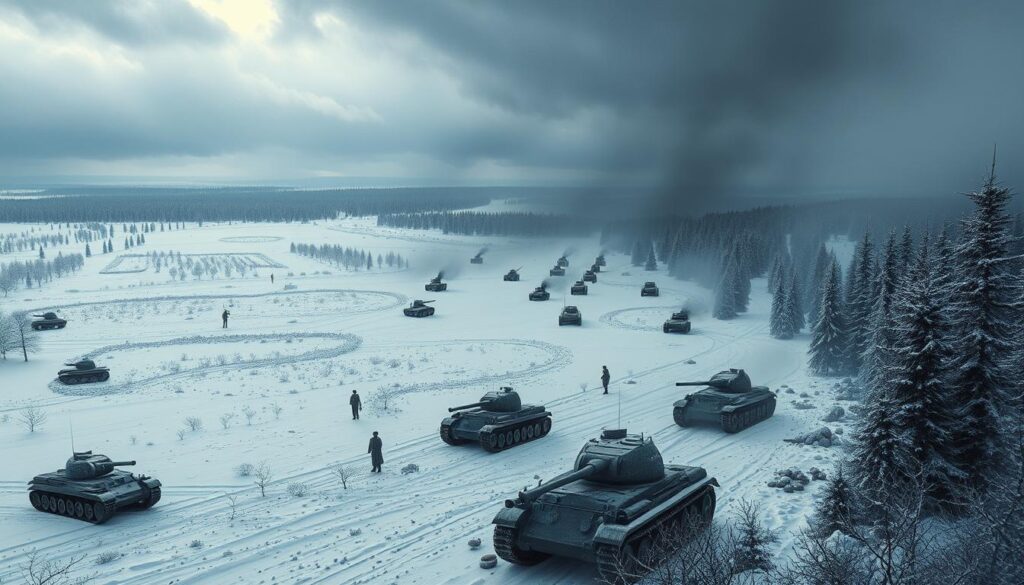
Operation Barbarossa was a key event in World War II. It was the code name for Nazi Germany’s invasion of the Soviet Union. It started on June 22, 1941, with over 3 million soldiers, making it the biggest military operation ever1.
This event was very important in the war. It had a big impact on both Nazi Germany and the Soviet Union. Understanding the scale and stakes of this moment is key to grasping its significance.
The operation was named after Emperor Frederick I Barbarossa. It compared Hitler’s ambitions to the medieval ruler’s legacy. Over 10 million soldiers fought, leading to more than 8 million casualties by the end2.
The Axis forces had over 3.8 million soldiers. This was the largest invasion force in history2.
Key Takeaways
- Operation Barbarossa was the largest military operation in history, involving over 3 million Axis personnel.
- The operation resulted in over 8 million casualties by the end of the operation2.
- The Axis forces invaded the western Soviet Union with over 3.8 million personnel, the largest invasion force in the history of warfare2.
- The operation saw the deliberate starvation or killing of 3.3 million Soviet prisoners of war and millions of civilians by the Germans2.
- Over a million Soviet Jews were murdered as part of the Holocaust during Operation Barbarossa2.
- The failure of Operation Barbarossa reversed the fortunes of Nazi Germany, leading to its eventual defeat in 19452.
Overview of Operation Barbarossa
Operation Barbarossa started on June 22, 1941. It was a key moment in Barbarossa in World War II. The goal was to change Europe to fit Nazi plans.
Objectives of the Axis Powers
The main aim was to get more space, or Lebensraum, by taking the western Soviet Union. The Axis also wanted important resources and to stop Communism3.
Key Strategies Implemented
The plan had three army groups going for Leningrad, Moscow, and Kiev. This was to break down Soviet defenses and stop them from fighting back3.
Significance in World War II
Operation Barbarossa made the war much bigger. It opened the Eastern Front and led to huge battles. It also hurt German supplies and helped lead to their loss4.
| Forces | German Troops | Soviet Troops |
|---|---|---|
| Total Troops | ~3.5 million4 | ~5.5 million4 |
| Divisions | 138 German + 36 allied4 | 304 Soviet4 |
| Casualties | ~1 million4 | ~4 million4 |
The Lead-Up to the Invasion
As tensions in Europe grew, the stage was set for Operation Barbarossa. The political scene was complex, with shifting alliances and mistrust among nations. This created a perfect storm for war.
Political Context in Europe
The German-Soviet Non-Aggression Pact seemed to bring peace, but tensions were always there. As both sides eyed each other’s lands, trust faded. This led to the pact’s breakdown and the start of the invasion.
Military Preparations by Germany
Germany prepared for war on a massive scale. They gathered over 3 million soldiers, 3,000 tanks, and 2,700 aircraft56. The challenge of coordinating such a huge force was huge, showing the enormity of the Barbarossa timeline.
- 3 million soldiers
- 3,000 tanks
- 2,700 aircraft
Initial Reactions from the Soviet Union
The Soviet leaders, led by Stalin, didn’t take the threat seriously. They ignored warnings of an attack5. This made the USSR unready for the invasion’s size.
| Military Asset | Quantity | Source |
|---|---|---|
| Soldiers | 3 million | 6 |
| Tanks | 3,000 | 6 |
| Aircraft | 2,700 | 6 |
The Course of the Operation
Operation Barbarossa started with a quick push, taking down Soviet defenses and grabbing huge areas almost twice as big as France in just a month7. The fast start was filled with big wins in key battles. But, as time went on, the push slowed down5.
Major Battles and Engagements
- The Battle of Moscow involved over four million Axis soldiers along a 1,800-mile front5.
- The Siege of Leningrad led to huge civilian losses, showing the war’s harsh side7.
- Encirclement battles caught hundreds of thousands of Soviet troops early on7.
Tactics and Technology Used
The German army used blitzkrieg tactics, combining fast movement with cars and horses5. They also had advanced communication and coordinated infantry, giving them an edge at first7.
Challenges Faced by German Forces
As the fight went on, the German army faced big problems. They had to deal with long distances and poor roads, making it hard to get supplies7. The cold Russian winters and tough Soviet tactics also slowed them down. By December, they had stopped just before Moscow75.
| Aspect | Details |
|---|---|
| Initial Progress | Rapid advance capturing territories twice the size of France within the first month7 |
| Major Battles | Battle of Moscow, Siege of Leningrad, encirclement battles75, |
| Tactics | Blitzkrieg, motorized units, coordinated infantry5 |
| Challenges | Logistical issues, vast distances, harsh climate, Soviet resistance75, |
Aftermath and Historical Impact
Operation Barbarossa changed the course of World War II. Its effects were felt in the strategies and power balance of the time.
Consequences for Germany and the USSR
Germany’s failure to win quickly led to big losses. The Wehrmacht was weakened, hurting the Nazi regime8. On the other hand, the Soviet Union became a global superpower, despite heavy losses910.
Lessons Learned from the Campaign
Barbarossa showed how key logistics and strategy are in war89. Germany’s mistakes taught the value of realistic planning and not underestimating an enemy’s strength10.
Legacy in Modern Military Strategy
Today, Barbarossa’s lessons are part of military strategies. It highlights the importance of strong supply chains and good intelligence89. Modern leaders learn from Barbarossa to avoid the mistakes of large invasions and overextension10.
FAQ
What was Operation Barbarossa?
A: Operation Barbarossa was a massive invasion by Nazi Germany of the Soviet Union on June 22, 1941. It was a big step in World War II, opening the Eastern Front. It greatly changed the war’s course.
Why was Operation Barbarossa significant in World War II?
A: Operation Barbarossa was huge and changed the war’s strategy. It was the biggest military invasion ever, with millions of troops and thousands of tanks. Its failure hurt Nazi Germany and helped the Soviet Union become a major world power.
What were the main objectives of the Axis powers in Operation Barbarossa?
The Axis powers wanted to take Soviet land for Lebensraum (living space). They aimed to destroy the Soviet military and end communism. They also needed oil and grain to keep fighting.
How did the political landscape in Europe lead to Operation Barbarossa?
Europe was at peace after the German-Soviet Non-Aggression Pact. But, tensions grew, and Hitler broke the pact. He wanted to expand and achieve his goals.
What were the key strategies implemented during Operation Barbarossa?
The main plan was a three-pronged attack on Soviet cities and key spots. The goal was to quickly defeat the Soviets. But, the plan faced big challenges and underestimated Soviet strength.
How did the Soviet Union initially respond to the threat of Operation Barbarossa?
The Soviet Union was slow to react to Operation Barbarossa. Stalin didn’t believe the warnings, and Nazi lies delayed the response. This was the “calm before the storm,” as the Soviets were not ready.
What were the major challenges faced by German forces during Operation Barbarossa?
German troops faced huge distances, supply problems, and the cold. The Soviets were tough, and their defense in key battles slowed the Germans. This led to the operation’s failure.
What were the long-term consequences of Operation Barbarossa for Germany and the Soviet Union?
A: Operation Barbarossa had big effects on both sides. For Germany, it was the start of a decline that ended in defeat in 1945. For the Soviet Union, it made them stronger and a global power after the war.
How has Operation Barbarossa influenced modern military strategy?
A: Operation Barbarossa showed the importance of logistics, intelligence, and flexibility in war. Its lessons have shaped modern military planning. Today, strategies focus on being adaptable and having strong supply chains.
What is the origin and meaning of the name “Barbarossa” in the context of the operation?
“Barbarossa” comes from Emperor Frederick I Barbarossa, a medieval leader. Adolf Hitler chose it to show his ambition, comparing himself to Frederick.
Can you provide a timeline of key events during Operation Barbarossa?
Sure. Operation Barbarossa started on June 22, 1941. Key moments include the push towards Moscow, the Battle of Kiev in August 1941, and the Siege of Leningrad. The operation ended in early 1942, failing to meet its goals.
Source Links
- What Was Operation ‘Barbarossa’? – https://www.iwm.org.uk/history/what-was-operation-barbarossa
- Operation Barbarossa – https://en.wikipedia.org/wiki/Operation_Barbarossa
- Operation Barbarossa – https://www.armyupress.army.mil/Journals/NCO-Journal/Archives/2022/May/Operation-Barbarrosa/
- Operation Barbarossa: The Biggest of All Time | The National WWII Museum | New Orleans – https://www.nationalww2museum.org/war/articles/operation-barbarossa
- Operation Barbarossa | History of Western Civilization II – https://courses.lumenlearning.com/suny-hccc-worldhistory2/chapter/operation-barbarossa/
- Eastern Front | World War II, Definition, Battles, & Casualties | Britannica – https://www.britannica.com/event/Eastern-Front-World-War-II
- The Nazi War Atlas of Operation Barbarossa | Timeless – https://blogs.loc.gov/loc/2019/12/the-nazi-war-atlas-of-operation-barbarossa/
- Operation Barbarossa | History, Summary, Combatants, Casualties, & Facts | Britannica – https://www.britannica.com/event/Operation-Barbarossa
- Operation Barbarossa: Date & Significance ‑ HISTORY – https://www.history.com/topics/world-war-ii/operation-barbarossa
- Operation ‘Barbarossa’ And Germany’s Failure In The Soviet Union – https://www.iwm.org.uk/history/operation-barbarossa-and-germanys-failure-in-the-soviet-union