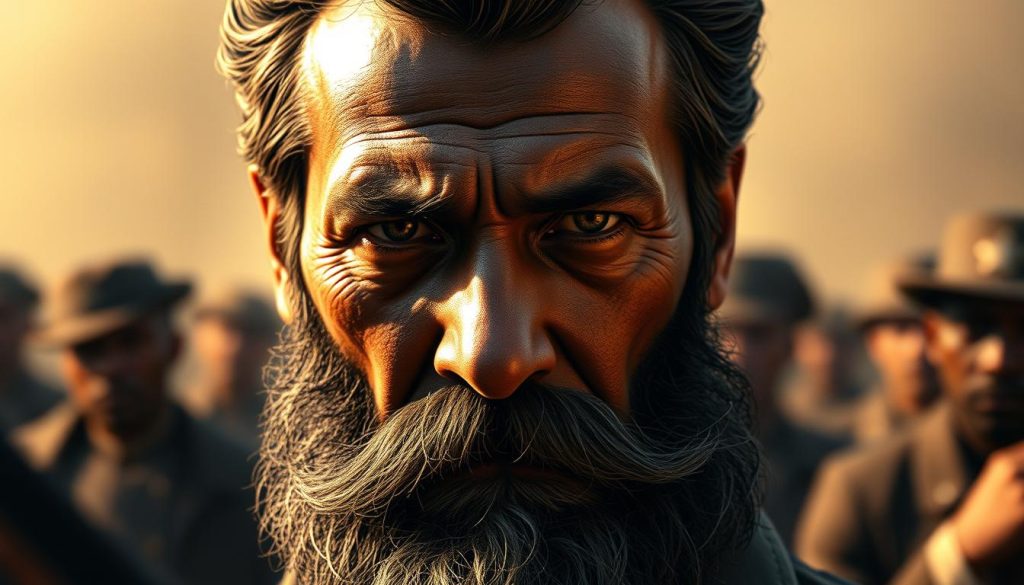
John Brown was a radical American abolitionist in the mid-19th century. He fought tirelessly against slavery, setting himself apart from others. Brown believed that action, not just words, was needed to end slavery.
Born on May 9, 1800, Brown devoted his life to the abolitionist cause. He became a key figure in American history. His approach included using violence to free slaves, unlike other abolitionists.
Brown showed an amazing commitment to justice and equality. He respected the rights of the poorest and weakest people oppressed by slavery. His belief in human dignity was strong and unwavering.
Brown’s powerful words and actions played a big role. They increased tensions between the North and South. This ultimately led to significant changes in the country12.
Key Takeaways
- John Brown was a radical American abolitionist committed to ending slavery
- He believed in direct action over passive resistance
- Brown was willing to sacrifice his life for the cause of justice
- His actions significantly influenced the path to the American Civil War
- Brown viewed slavery as a moral and humanitarian crisis
Most Famous Anti-Slavery Quotes by John Brown
John Brown was a fierce anti-slavery activist in pre-Civil War America. His words and actions challenged slavery’s moral foundations. Brown’s militant abolitionism turned him into a revolutionary figure fighting for human freedom3.
Brown’s fight against slavery went beyond words. His radical approach involved direct confrontation with the institution of slavery. On October 16, 1859, he led a bold raid on Harpers Ferry, Virginia3.
With a group of twenty-one men, Brown showed his readiness to take extreme actions against oppression. This raid demonstrated his commitment to ending slavery at any cost.
Quotes About Freedom and Justice
Brown’s most powerful statements showed his deep belief in human equality. His words revealed a strong moral conviction and unwavering dedication to justice.
“I am yet too young to understand that God is any respecter of persons. I believe that to have interfered as I have done…in behalf of His despised poor, was not wrong, but right.”
- Believed all humans deserved fundamental rights
- Challenged societal norms of racial inequality
- Viewed slavery as a moral and spiritual crime
Quotes from His Trial and Final Days
During his trial, Brown’s resolve remained unbroken. He transformed his legal proceedings into a platform for challenging the systemic injustice of slavery. Despite facing certain execution, he continued to speak truth to power4.
Battlefield and Action-Related Statements
Brown’s militant abolitionism was not just talk, but action3. After his Harpers Ferry raid, US troops led by Colonel Robert E. Lee captured him.
Brown maintained his commitment to liberation even after capture. He was tried, found guilty of treason, and executed on December 2, 1859, at fifty-nine years old3.
“I, John Brown, am now quite certain that the crimes of this guilty land will never be purged away but with blood.”
John Brown’s Impact on American History Through His Words
John Brown’s passionate voice shaped American history before the Civil War. His militant approach to ending slavery challenged the nation’s moral conscience. Brown’s commitment went beyond peaceful protest, embodying a radical abolitionist movement5.
The Harper’s Ferry raid exposed deep racial tensions. Brown led 22 men to spark a slave rebellion. This event, though unsuccessful, shocked both Northern and Southern communities5.
- Sparked intense national debate about slavery
- Challenged peaceful abolitionist strategies
- Accelerated tensions between North and South
Brown’s most powerful statement echoes through history:
“I, John Brown, am now quite certain that the crimes of this guilty land will never be purged away but with blood.”
These words, spoken before his execution, seemed to predict the Civil War5.
Brown’s radical movement influenced future generations. His dedication to ending slavery inspired civil rights activists. It showed how moral conviction could challenge systemic oppression6.
Though executed for treason, Brown’s legacy lived on. His actions transformed the national dialogue on human rights5. Brown’s impact on American history remains significant today.
Conclusion: The Enduring Legacy of John Brown’s Words
John Brown’s story shows the power of moral conviction. His radical approach to ending slavery challenged the nation’s conscience. His legacy remains divisive, with some seeing him as a martyr, others as controversial7.
Brown’s commitment went beyond words. His 36-hour raid on Harpers Ferry7 and 1,000-mile journey freeing 12 black individuals8 showed his dedication. His actions inspire modern activists who know real change needs courage.
John Brown remains crucial in American history. His centennial drew significant attention. Newsweek covered it, and 65,000 people visited Harpers Ferry7.
Brown believed in defending moral principles with action. He challenges us to face systemic injustice. His legacy reminds us that progress needs courage, empathy, and commitment to human dignity.
FAQ
Who was John Brown?
John Brown was a radical abolitionist in U.S. history. He fought against slavery using militant methods. His raid on Harper’s Ferry in 1859 helped spark the Civil War.
Why is John Brown considered important in American history?
Brown’s actions challenged the nation’s moral stance on slavery. He took violent steps against the institution. His raid and trial brought national attention to abolition, increasing North-South tensions.
What was the Harper’s Ferry raid?
The Harper’s Ferry raid was Brown’s attempt to start a slave rebellion. He and his group tried to seize a federal armory in Virginia. Although it failed, the raid became a pivotal pre-Civil War moment.
How did John Brown view slavery?
Brown saw slavery as a moral evil requiring violent opposition. He believed armed resistance was necessary to end slavery. Brown was willing to die to free enslaved people.
Was John Brown executed for his actions?
Yes, Brown was convicted of treason, murder, and inciting a slave rebellion. He was hanged on December 2, 1859, in Charles Town, Virginia. His principled behavior during trial made him an abolitionist martyr.
How did John Brown influence the anti-slavery movement?
Brown’s extreme actions brought national attention to abolitionism. His raid and trial increased North-South tensions. Many were inspired to take a more radical stance against slavery.
What is John Brown’s legacy today?
Brown remains a complex historical figure. Some view him as a terrorist, others as a freedom fighter. His legacy sparks discussions on racial justice and fighting systemic oppression.
Source Links
- TOP 25 QUOTES BY JOHN BROWN | A-Z Quotes – https://www.azquotes.com/author/24386-John_Brown
- John Brown (abolitionist) – Wikiquote – https://en.wikiquote.org/wiki/John_Brown_(abolitionist)
- John Brown’s final speech, 1859 – https://www.gilderlehrman.org/history-resources/spotlight-primary-source/john-browns-final-speech-1859
- Display Textbook – https://www.digitalhistory.uh.edu/active_learning/explorations/brown/lesson_plans/opinions.cfm
- John Brown: Abolitionist, Raid & Harpers Ferry ‑ HISTORY – https://www.history.com/topics/slavery/john-brown
- John Brown’s Holy War | American Experience | PBS – https://www.pbs.org/wgbh/americanexperience/films/brown/
- John Brown’s Smoldering Spark – https://www.battlefields.org/learn/articles/john-browns-smoldering-spark
- John Brown: Triumphant Failure – https://prospect.org/features/john-brown-triumphant-failure/