
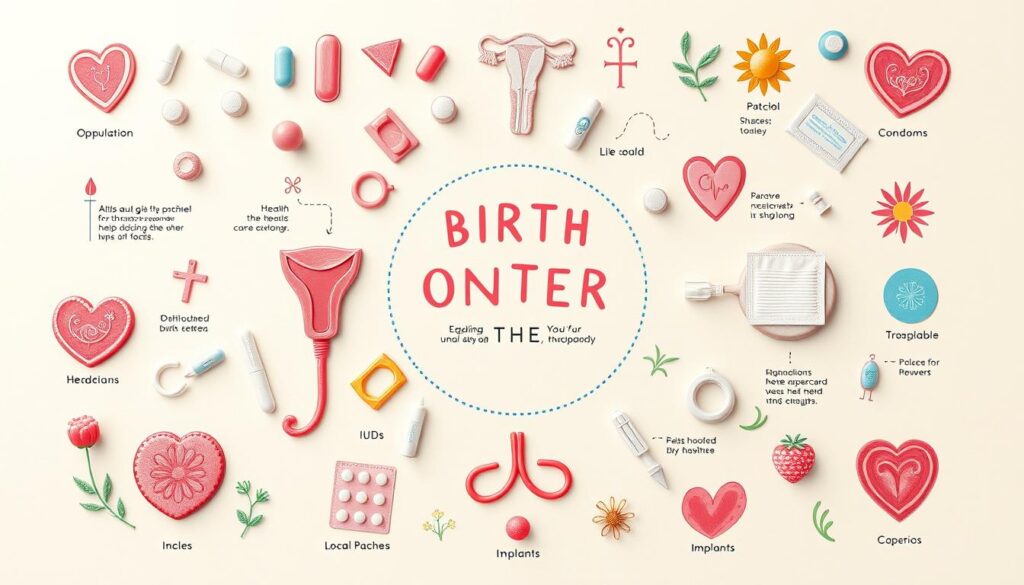
Choosing the right contraceptive can revolutionize your family planning approach. Modern methods offer various options tailored to your lifestyle and health needs. Your choice affects both reproductive health and overall well-being1.
Understanding birth control options empowers you to make informed decisions. Each method has unique benefits and considerations1.
Some contraceptives require minimal effort and are highly effective. IUDs and implants can last for years while providing reliable pregnancy prevention1.
These options appeal to those seeking low-maintenance solutions2.
Key Takeaways
- Multiple birth control methods exist to suit different lifestyles
- Effectiveness varies across different contraceptive options
- Consider personal health, convenience, and potential side effects
- Consult healthcare professionals for personalized guidance
- Birth control needs can change throughout your life
Understanding Birth Control Options
Choosing birth control can be daunting. But knowing your options helps make informed decisions about your reproductive health. Your needs, lifestyle, and health will guide you to suitable contraception.
Birth control methods fall into hormonal and non-hormonal categories. Each type has unique features and effectiveness rates.
Hormonal Contraception: How It Works
Hormonal contraception prevents pregnancy by altering your body’s reproductive processes. Pills, patches, and rings release hormones to stop ovulation. They also thicken cervical mucus and change the uterine lining3.
- Combined oral contraceptive pills are 93% effective with typical use3
- Contraceptive patches provide 93% pregnancy prevention3
- Hormonal vaginal rings offer similar effectiveness3
Non-Hormonal Contraceptive Choices
Hormone-free options include barrier methods and copper IUDs. These provide alternative contraception strategies. Barrier methods like condoms protect against pregnancy and sexually transmitted infections.
- Copper IUD is over 99% effective3
- Male condoms have a typical use failure rate of 13%4
- Fertility awareness methods range from 2-23% effectiveness4
Emergency Contraception Solutions
Emergency contraceptive pills (ECPs) are a backup when primary birth control fails. Take these morning-after pills as soon as possible after unprotected sex. This maximizes their effectiveness.
*Your reproductive health is a personal journey – choose a method that aligns with your lifestyle and comfort level.*
No single contraceptive method fits everyone perfectly. Talking with a healthcare professional helps you find the best option. They can guide you through choices based on your unique needs.
Long-Term vs Short-Term Contraceptive Methods
Birth control choices depend on understanding long-acting and short-acting methods. Your reproductive goals and lifestyle are key factors. This decision impacts your health and future.
Long-acting reversible contraception (LARC) provides extended protection with minimal upkeep. These methods offer reliable, long-term birth control options.
- Intrauterine Devices (IUDs) lasting 3-12 years5
- Implants effective for 3-4 years6
- Sterilization as a permanent solution
LARC methods provide exceptional effectiveness. IUDs outperform traditional contraceptives by 20 times. Less than 1% of women get pregnant in the first year5.
Short-acting hormonal methods need more frequent attention. These options suit different lifestyles and preferences.
- Daily birth control pills
- Weekly patches
- Monthly vaginal rings
- Quarterly contraceptive injections6
Your contraceptive journey is personal – what works for one might not work for another.
Factors influencing your choice between long-term and short-term methods include:
- Future pregnancy plans
- Convenience preferences
- Budget considerations
- Health circumstances
Long-acting methods may cost more upfront but can be cheaper over time. Short-acting methods offer flexibility but need consistent use7.
How to Choose the Right Birth Control Method
Picking the best birth control can be tricky. Your choice depends on personal factors that affect family planning and comfort.
When looking at birth control options, think about your health and lifestyle. Consider your daily routine and medicine schedule. Also, look at your health status and medical history.
Think about how comfortable you are with different methods. Check if they might affect your current health conditions.
- Your daily routine and medication schedule
- Current health status and medical history
- Personal comfort with different contraceptive methods
- Potential impact on existing health conditions
Evaluating Contraceptive Efficacy
Knowing how well each method prevents pregnancy is key. Different methods have different success rates.
| Method | Perfect Use Effectiveness |
|---|---|
| Contraceptive Implant | Over 99% effective8 |
| IUD | More than 99% effective8 |
| Condoms | 98% effective if used correctly8 |
| Birth Control Pills | 99% with perfect use8 |
Understanding Side Effects and Benefits
Each birth control method has its own side effects and health benefits. Hormonal methods may regulate periods and improve acne. Non-hormonal options avoid hormone-related issues9.
Remember, the best birth control method is one that fits seamlessly into your lifestyle and health needs.
Think about long-term options like IUDs. They can protect you for 3-10 years10. Some methods also guard against STIs, which is great for your sexual health8.
Talk to a doctor about your options. They can help you make a smart choice for your family planning goals.
Conclusion
Choosing the right birth control is a personal journey. It involves considering your health needs and lifestyle. Your decision should align with your reproductive goals11. A comprehensive approach weighs factors like effectiveness and potential side effects.
Your birth control strategy should adapt as you change. What works now might not fit later. Regular check-ups with doctors help ensure you’re using the best method12.
Over 400 million women worldwide use contraception successfully12. The right method empowers you to manage your reproductive health. Don’t be afraid to ask questions and explore options.
Your contraceptive journey is unique. It’s about balancing medical advice with personal preferences. Remember to prioritize your health and long-term goals11.
FAQ
What are the main types of birth control methods available?
Birth control options include barrier methods, hormonal methods, and long-acting reversible contraception. Barrier methods are condoms and diaphragms. Hormonal methods include pills, patches, and rings. IUDs and implants are long-acting reversible contraception.
Permanent methods like sterilization are also available. Each method has unique features, effectiveness rates, and potential side effects.
How effective are different birth control methods?
Long-acting reversible contraception and sterilization are over 99% effective. Hormonal methods range from 91-99% with perfect use. Barrier methods typically range from 71-98% effective.
The key to success is consistent and correct usage. Regular check-ups can help ensure proper use.
What factors should I consider when choosing birth control?
Consider your lifestyle, health factors, effectiveness rates, and potential side effects. Think about your daily routine and ability to follow a medication schedule. Your medical history and comfort with different methods are also important.
Don’t forget to factor in cost and future reproductive goals. Personal preferences play a big role too.
Are there non-hormonal birth control options?
Yes, non-hormonal options include barrier methods like condoms and diaphragms. Copper IUDs, fertility awareness methods, and spermicides are also available. These methods avoid hormonal side effects.
However, they may be less effective than hormonal contraceptives. Discuss with your doctor to find the best fit.
What is emergency contraception?
Emergency contraception includes emergency contraceptive pills (ECPs) and copper IUDs. These can be used within 5 days of unprotected sex. Earlier use is more effective.
They are not meant for regular birth control. Also, they don’t protect against sexually transmitted infections.
Can birth control methods have additional health benefits?
Some hormonal methods offer benefits beyond pregnancy prevention. These can include lighter periods, reduced acne, and menstrual pain relief. They may also help manage certain hormonal conditions.
However, side effects like mood changes or breast tenderness can occur. Discuss potential benefits and risks with your doctor.
How do I know which birth control method is right for me?
The best method depends on your individual needs, health, and lifestyle. Your reproductive goals also play a role. Consult with a healthcare provider for personalized advice.
They can help determine the most suitable birth control option for you. Regular check-ups can ensure your method remains effective.
Do birth control methods protect against sexually transmitted infections?
Only condoms provide protection against sexually transmitted infections. Other birth control methods focus solely on preventing pregnancy. For complete sexual health, consider using condoms with your chosen contraceptive method.
How often should I reassess my birth control method?
Your contraceptive needs can change over time due to age, health status, and life changes. It’s wise to review your birth control method annually. Also, reassess whenever significant life changes occur.
Stay in touch with your healthcare provider to ensure your method remains suitable.
Source Links
- Birth control options: Things to consider – https://www.mayoclinic.org/healthy-lifestyle/birth-control/in-depth/birth-control-options/art-20045571
- Birth Control Methods & Options | Types of Birth Control – https://www.plannedparenthood.org/learn/birth-control
- Contraception Explained: Birth Control Options for Teens & Adolescents – https://www.healthychildren.org/English/ages-stages/teen/dating-sex/Pages/Birth-Control-for-Sexually-Active-Teens.aspx
- Contraception and Birth Control Methods – https://www.cdc.gov/contraception/about/index.html
- Which Type of Long-Term Birth Control is Best for You? – https://www.webmd.com/sex/birth-control/features/long-term-birth-control-new-implants-patches
- Short-Acting Vs. Long-Acting Birth Control: Which Is Right for You? — Summit Women’s Health – https://summitwomenshealth.com/blog/short-acting-vs-long-acting-birth-control-which-is-right-for-you
- Factors influencing use of long-acting versus short-acting contraceptive methods among reproductive-age women in a resource-limited setting – https://pmc.ncbi.nlm.nih.gov/articles/PMC5379613/
- Choosing the right contraception – Theramex – https://www.theramex.com/contraception/how-to-choose-the-right-contraception-for-you/
- What to Consider When Choosing Birth Control – https://www.webmd.com/sex/birth-control/birth-control-considerations
- Choose the Right Birth Control – MyHealthfinder – https://odphp.health.gov/myhealthfinder/healthy-living/sexual-health/choose-right-birth-control
- Over-the-Counter Access to Hormonal Contraception – https://www.acog.org/clinical/clinical-guidance/committee-opinion/articles/2019/10/over-the-counter-access-to-hormonal-contraception
- Conclusions – Contraception and Reproduction – https://www.ncbi.nlm.nih.gov/books/NBK235070/

