
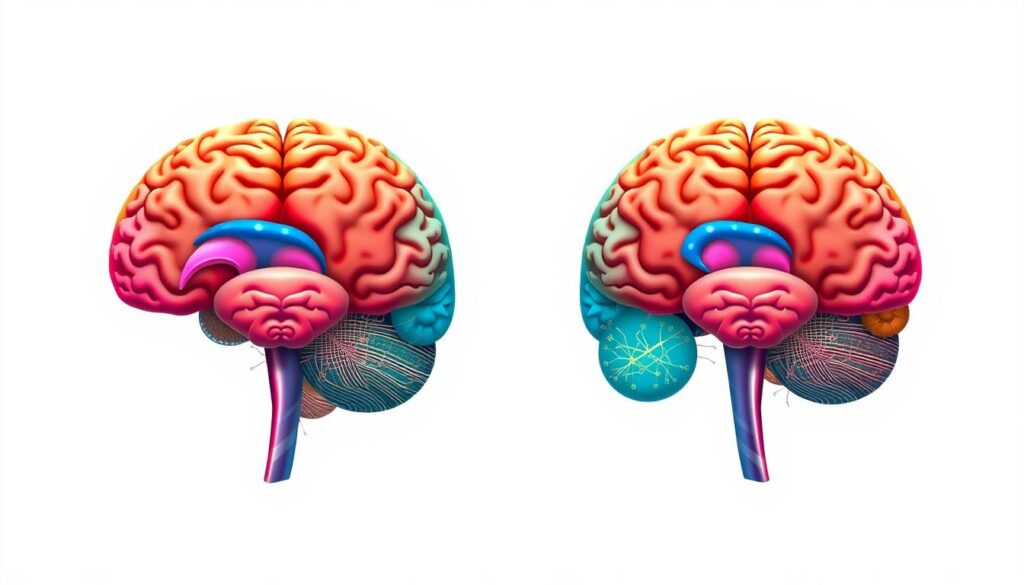
Neuroscience reveals intriguing brain anatomy differences between genders. These subtle variations challenge traditional views of male and female cerebral structures. Brain development shows fascinating distinctions that spark scientific curiosity12.
Recent brain anatomy research uncovers compelling insights into sex differences. While overall structure remains similar, regional volumes and tissue densities show subtle variations31. These differences go beyond size, involving complex neurological traits.
Your brain has unique structural traits influenced by biological factors. Male brains typically have larger overall volume than female brains2. They also show different regional gray matter distributions.
Women often have more pronounced gray matter volume in certain areas. These include prefrontal and temporal regions of the brain1. Such differences continue to intrigue scientists studying brain structure.
Key Takeaways
- Brain anatomy varies subtly between males and females
- Regional brain volume differences exist across genders
- Neuroscience continues to explore brain structure complexities
- Gender influences brain development in nuanced ways
- Research reveals small to moderate structural variations
Understanding Brain Anatomy: An Overview
Your brain is an incredibly complex organ. It serves as the command center for your entire body. Brain development shapes how you perceive and interact with the world.
The human brain has several key regions. Each region has unique functions. These functions enable your daily experiences and interactions.
Major Brain Regions and Their Significant Roles
- Frontal Lobe: Responsible for decision-making and problem-solving
- Temporal Lobe: Manages memory and language processing
- Parietal Lobe: Handles sensory information integration
- Occipital Lobe: Processes visual information
Neurons and Synaptic Connections
Neurons are the building blocks of brain communication. These cells create neural connections throughout your brain. They transmit electrical and chemical signals.
In humans, males typically have larger total brain volume than females. About 65.8% of brain regions show significant sex differences in volume4.
Brain Plasticity: The Remarkable Adaptive Capacity
Your brain can reorganize itself through development. This plasticity allows you to learn and adapt. You can form new neural connections throughout your life.
Genetic research has found interesting results. 571 genes show evidence of sex-differentiated effects on brain anatomy5.
| Brain Region | Female-Biased Volume | Male-Biased Volume |
|---|---|---|
| Frontal Cortex | Larger in Females | Smaller in Females |
| Hippocampus | Smaller in Females | Larger in Males |
“The brain is a world consisting of a number of unexplored continents and great stretches of unknown territory.” – Santiago Ramón y Cajal
Brain anatomy reveals complex mechanisms behind cognitive functions. Each region shapes your perception and memory. It influences how you interact with the world around you.
Exploring the Basics of Sex Differences in the Brain
Brain anatomy reveals intriguing gender differences. Scientists study how biology and environment shape brain development. This exploration uncovers unique neurological profiles for individuals.
Brain research unveils fascinating gender variations. Extensive studies unpack the mysteries of brain structure across different sexes. These insights help us understand neurological differences better.
Defining Sex Differences in Brain Anatomy
Sex differences in brain development go beyond simple structural variations. Biological factors play a crucial role in determining neurological characteristics.
- Chromosomal composition influences brain structure6
- Hormonal influence impacts neural connectivity
- Genetic predispositions shape brain development
“Brain differences are not about superiority, but about unique neurological adaptations.” – Neuroscience Research Team
Nature vs. Nurture: Understanding Brain Development
The debate between genetics and environment continues to intrigue researchers. Brain scans show significant volume variations across sexes7.
| Brain Region | Female Characteristics | Male Characteristics |
|---|---|---|
| Prefrontal Cortex | Greater Volume | Relatively Lower Volume |
| Temporal Regions | Smaller Volume | Larger Volume |
About 1% of the population represents intersex individuals. This highlights the complexity of biological sex6. The brain’s plasticity means both genes and environment shape its growth.
Biological differences exist, but individual variations matter more. Broad generalizations about gender and brain anatomy don’t tell the whole story.
Male and Female Brain Structure: Key Differences
The human brain has fascinating differences between males and females. These variations go beyond simple size comparisons. Let’s explore the complex nature of brain development and its structural nuances.
Size and Volume Variations
Male brains are about 10% larger than female brains8. But size isn’t everything when it comes to brain anatomy. The composition of brain matter tells a more interesting story.
Male brains have more white matter. Female brains contain a higher percentage of gray matter9. Overall brain volume also differs between sexes9.
- Male brains have more white matter
- Female brains contain a higher percentage of gray matter9
- Overall brain volume differs between sexes9
Differences in Connectivity Patterns
Brain connectivity shows interesting distinctions between male and female neural networks. Women tend to have stronger side-to-side connections in the brain8. Men typically show stronger front-to-back neural pathways8.
| Brain Characteristic | Male Brain | Female Brain |
|---|---|---|
| Brain Volume | Larger | Smaller |
| Gray Matter Percentage | Lower | Higher |
| White Matter Percentage | Higher | Lower |
| Connectivity Pattern | Front-to-back | Side-to-side |
“The brain’s structure is a complex landscape that reflects both biological and environmental influences.” – Dr. Sarah Mendelsen, Neuroscience Research Institute
These structural differences affect how males and females process information9. While individual variations exist, these trends offer insights into brain functionality. Understanding these differences can help us appreciate the brain’s complexity.
The Impact of Hormones on Brain Anatomy
Hormones deeply influence your brain’s development. They shape neural structures and functions in unique ways. Sex hormones play a crucial role in brain anatomy, creating distinct patterns of neural connectivity10.
Hormones interact with brain regions in complex ways. They affect everything from mood to cognitive function. These interactions offer fascinating insights into our neural networks’ structure10.
Estrogen’s Remarkable Effects
Estrogen shows incredible abilities in neural plasticity and brain health. Research reveals its powerful impact on brain function.
- Rapidly stimulate acetylcholine release in the hippocampus10
- Influence synaptic connections11
- Impact cognitive and emotional processing10
Estrogen acts as a powerful molecular architect, reshaping neural landscapes with remarkable precision.
Testosterone’s Role in Neural Development
Testosterone significantly impacts brain development, especially in male neural structures. Both nuclear and nongenomic androgen receptors help form spine synapses10.
Environmental factors can change how hormones affect brain growth. For instance, low-protein diets during pregnancy alter neuron numbers differently in males and females11.
Your brain’s hormonal landscape constantly adapts. It responds to biochemical signals that shape neural connections. This dynamic environment keeps evolving throughout life11.
Neurotransmitters and Behavioral Differences
The brain’s complex neurotransmitter systems offer insights into cognitive functions and behavioral differences between sexes. Research reveals how male and female brains process chemical signals differently. These signals affect mood, reward, and overall brain function12.
Dopamine and Reward Systems
Dopamine influences how your brain experiences pleasure and motivation. Studies show sex-specific variations in dopamine production that impact behavioral patterns13.
The Sry gene, linked to male sexual determination, affects dopamine-producing neurons uniquely13.
- Male brains show distinctive dopamine neuron characteristics
- Dopamine production varies between sexes
- Genetic factors contribute to neurotransmitter differences
Serotonin and Mood Regulation
Serotonin greatly affects mood, emotional processing, and cognitive functions. Studies show males and females experience serotonin signaling differently14.
This difference can explain variations in emotional responses between sexes.
| Neurotransmitter | Male Brain Characteristics | Female Brain Characteristics |
|---|---|---|
| Dopamine | Higher reward system activation | More regulated response |
| Serotonin | Less emotional variability | More complex mood regulation |
“Brain chemistry is not just about biology, but about understanding the intricate dance of neurotransmitters that shape our experiences.” – Dr. Emily Rodriguez, Neuroscience Researcher
Neurotransmitter differences help explain why cognitive functions might vary across sexes. Your brain’s unique chemical makeup shapes your experiences and behaviors12.
Cognitive Abilities: Are There Differences?
Neural connections may differ between sexes, offering insights into cognitive functions. Brain research explores subtle variations in mental processing. These findings challenge traditional assumptions about cognitive abilities.
Studies reveal intriguing patterns in cognitive performance across various mental tasks. Women and men may excel in different cognitive areas. However, individual variations remain significant.
Verbal Skills and Spatial Reasoning
Cognitive research suggests nuanced differences in mental capabilities:
- Women often exhibit stronger verbal processing skills1
- Men typically demonstrate enhanced spatial reasoning abilities15
- Mental rotation tasks show distinct performance patterns15
“Cognitive differences are subtle, not definitive markers of individual potential.”
Problem-Solving and Decision-Making
Neurological studies reveal interesting variations in problem-solving approaches:
| Cognitive Domain | Female Characteristics | Male Characteristics |
|---|---|---|
| Gray Matter Distribution | More volume in prefrontal areas1 | More volume in subcortical regions1 |
| Decision-Making Style | Often more collaborative | Tends to be more direct |
Cognitive variations stem from complex neural connections. These develop through biological and environmental interactions. Understanding these differences helps us appreciate the diversity of human mental abilities.
Brain Disorders and Gender Disparities
Brain disorders show interesting differences between males and females. These variations are key to improving diagnosis and treatment. Understanding them can lead to better patient care.
Prevalence of Neurological Conditions
Brain disorders vary greatly across genders. Some conditions affect one gender more than the other.
- Autism Spectrum Disorder (ASD) predominantly affects males, with males being 3-4 times more likely to be diagnosed than females16.
- Down Syndrome shows a slight male prevalence, with a sex ratio of 1.2416.
- Rett Syndrome uniquely impacts females, occurring in approximately 1 in 10,000 births16.
Symptom Presentation Variations
Brain development and neurological conditions differ between sexes. Research has found interesting patterns in how symptoms show up.
- Males with Down Syndrome demonstrate higher rates of behavioral problems16.
- Women with Down Syndrome face a four times higher risk of Alzheimer-like dementia compared to men16.
“Understanding gender-based neurological differences is crucial for personalized medical approaches.” – Neuroscience Research Team
New AI tech helps spot these subtle differences. Stanford Medicine created an AI model that can tell male and female brain scans apart.
The model has over 90% success rate. This shows there are big structural differences we couldn’t see before17.
Global studies also shed light on these distinctions. MRI scans from 29 countries show gender inequality can change brain structure. This affects areas linked to stress and emotions18.
The Role of Environment and Culture
Your brain’s development is a complex mix of biology and environment. Genetics play a key role, but your upbringing and culture shape brain development too. Brain research reveals fascinating insights into this process19.
How Upbringing Shapes Brain Differences
Environmental factors greatly impact brain development across genders. Even identical twins show differences in brain structure. This highlights how powerful external experiences can be19.
- Early childhood experiences can modify neural connections
- Educational environments play a critical role in brain plasticity
- Social interactions contribute to cognitive skill development
Neuroscientists have found that genetics don’t solely determine brain development. Your experiences, learning chances, and social interactions can reshape neural pathways20.
Societal Expectations and Their Influence
Cultural expectations can subtly guide brain development and gender-specific behaviors. Different social pressures might encourage diverse cognitive skills between males and females21.
“Our brains are not fixed entities but dynamic systems constantly adapting to environmental inputs.” – Neuroscience Research
These complex interactions show brain development goes beyond simple biology. Scientists keep exploring these intricate connections19.
Research Trends in Brain Anatomy and Sex Differences
Neuroscience explores brain development and cognitive functions, uncovering fascinating insights into sex differences. Recent research reveals complex patterns that challenge previous assumptions. These findings push the boundaries of our understanding.
Current Studies and Findings
Cutting-edge research has made remarkable progress in understanding brain anatomy. Scientists have developed sophisticated methods to analyze brain structures. These methods reveal nuanced differences between male and female brains22.
Studies have shown impressive classification accuracies when distinguishing between male and female brain structures. These accuracies range from 69% to 93%22.
- Machine learning techniques have become crucial in brain research
- Advanced imaging technologies enable precise brain structure analysis
- Large-scale studies provide comprehensive insights
Significant research has emerged from extensive studies, including:
| Study | Participants | Key Findings |
|---|---|---|
| Queensland Twin IMaging Study | 1,040 individuals | 64.81% females, average age 22.42 years23 |
| Human Connectome Project | 1,113 individuals | 54.40% females, average age 28.80 years23 |
Future Directions in Research
The future of brain research looks promising. Researchers are focusing on:
- Improving machine learning algorithms
- Expanding diverse participant pools
- Integrating biological and environmental factors
“The brain is a complex ecosystem that continues to surprise us with its intricate variations,” says Dr. Emily Rodriguez, leading neuroscience researcher.
Technology advances will lead to a more precise understanding of cognitive functions and brain development. Neuroscience, artificial intelligence, and comprehensive research methodologies are joining forces. This collaboration will unlock new mysteries of the human brain.
Conclusion: The Interconnectedness of Brain Structure and Gender
Brain anatomy and sex differences reveal a complex neuroscience landscape. Your exploration uncovers fascinating insights into how biology shapes neural networks. Neurological research has highlighted these connections24.
Large neuroimaging studies show reproducible sex differences in regional brain anatomy. These findings challenge traditional assumptions about cognitive capabilities24. Research indicates significant variations in brain structure between males and females.
These differences manifest in varied health risks and neurological conditions. Males face a greater risk of Parkinson’s disease. Females show higher rates of multiple sclerosis and adolescent mood disorders24.
These findings stress the need for gender-specific approaches in medical research. They also highlight the importance of tailored treatment strategies25. Your grasp of brain anatomy can lead to more personalized healthcare.
Recognizing the interplay between biology and environment helps break harmful stereotypes. It promotes a more inclusive understanding of gender in neuroscience. Future research should embrace these complexities and develop targeted interventions25.
FAQ
Are there significant differences between male and female brains?
Research reveals subtle brain differences between males and females. Men typically have larger brains, while women have more gray matter. Specific areas show variations in structure and function.
These differences are nuanced and shouldn’t be oversimplified. They affect cortical regions, connectivity patterns, and neurotransmitter systems.
How do hormones influence brain structure?
Sex hormones are vital in brain development. Estrogen is key for brain sexual differentiation. Testosterone greatly impacts male brain development.
These hormones can change brain structure and chemistry. They may also affect cognitive processing and behavior patterns.
Do brain differences mean men and women have different cognitive abilities?
Small cognitive differences exist, like potential variations in verbal and spatial skills. However, these are usually minor and heavily influenced by environment.
Factors like education and cultural expectations play a big role. It’s important to avoid stereotyping based on these findings.
How do environmental factors impact brain development?
Environment and culture greatly shape brain development. Upbringing, education, and social experiences interact with biological predispositions.
These factors are as crucial as biological sex. They influence brain structure and function significantly.
Are there sex-specific differences in brain disorders?
Yes, some brain disorders differ between males and females. Women are more prone to depression. Men have higher rates of autism spectrum disorder.
These differences may relate to underlying neurological and hormonal variations.
Can brain plasticity override sex-based differences?
Brain plasticity allows for significant adaptation throughout life. Biological differences exist, but the brain can change and adapt remarkably.
Individual experiences and training can greatly modify neural connections. Environmental factors can substantially impact cognitive capabilities.
How reliable are current research findings about brain sex differences?
Large-scale studies show mixed results. Some researchers find minimal sex differences. Others report consistent, small-to-moderate variations.
Methodological differences contribute to these inconsistencies. Ongoing research aims to standardize methods and increase sample sizes.
Source Links
- Novel findings from 2,838 Adult Brains on Sex Differences in Gray Matter Brain Volume – Scientific Reports – https://www.nature.com/articles/s41598-018-38239-2
- Neuroscience of sex differences – https://en.wikipedia.org/wiki/Neuroscience_of_sex_differences
- A meta-analysis of sex differences in human brain structure – https://pmc.ncbi.nlm.nih.gov/articles/PMC3969295/
- Comparative neuroimaging of sex differences in human and mouse brain anatomy – https://elifesciences.org/reviewed-preprints/92200
- A sex-stratified analysis of the genetic architecture of human brain anatomy – Nature Communications – https://www.nature.com/articles/s41467-024-52244-2
- Sex differences in the human brain: a roadmap for more careful analysis and interpretation of a biological reality – Biology of Sex Differences – https://bsd.biomedcentral.com/articles/10.1186/s13293-022-00448-w
- Sex differences in brain anatomy – https://www.nih.gov/news-events/nih-research-matters/sex-differences-brain-anatomy
- Battle of the Brain: Men Vs. Women [Infographic] – https://www.nm.org/healthbeat/healthy-tips/battle-of-the-brain-men-vs-women-infographic
- Evolving Knowledge of Sex Differences in Brain Structure, Function and Chemistry – https://pmc.ncbi.nlm.nih.gov/articles/PMC2711771/
- Sex in the brain: hormones and sex differences – https://pmc.ncbi.nlm.nih.gov/articles/PMC5286723/
- Frontiers | Editorial: Sex differences in the brain – https://www.frontiersin.org/journals/neuroanatomy/articles/10.3389/fnana.2022.1000121/full
- Ewha Med J: Current status and significance of research on sex differences in neuroscience: a narrative review and bibliometric analysis – https://www.e-emj.org/archive/view_article?pid=emj-47-2-16
- 11.3 Sex Differences in Brain and Behavior: Genetic, Hormonal, and Environmental Mechanisms – Introduction to Behavioral Neuroscience | OpenStax – https://openstax.org/books/introduction-behavioral-neuroscience/pages/11-3-sex-differences-in-brain-and-behavior-genetic-hormonal-and-environmental-mechanisms
- Frontiers | Exploring sex differences: insights into gene expression, neuroanatomy, neurochemistry, cognition, and pathology – https://www.frontiersin.org/journals/neuroscience/articles/10.3389/fnins.2024.1340108/full
- Sex/gender differences in cognition, neurophysiology, and neuroanatomy – https://pmc.ncbi.nlm.nih.gov/articles/PMC6013760/
- Sex Differences in Brain Disorders – https://www.mdpi.com/1422-0067/24/19/14571
- Stanford Medicine study identifies distinct brain organization patterns in women and men – https://med.stanford.edu/news/all-news/2024/02/men-women-brain-organization-patterns.html
- Gender inequality linked to brain structure — Department of Psychiatry – https://www.psych.ox.ac.uk/news/gender-inequality-linked-to-brain-structure
- Linking brain biology and behavioural differences – https://qbi.uq.edu.au/blog/2021/10/linking-brain-biology-and-behavioural-differences
- The Difference Between Men and Women: Is It All in the Brain? – Southern Regional AHEC – https://www.southernregionalahec.org/men-women-brain/
- A Study Finds Sex Differences in the Brain. Does It Matter? – https://www.wired.com/story/a-study-finds-sex-differences-in-the-brain-does-it-matter/
- Development of sex differences in the human brain – https://pmc.ncbi.nlm.nih.gov/articles/PMC8510853/
- Are Sex Differences in Human Brain Structure Associated With Sex Differences in Behavior? – https://pmc.ncbi.nlm.nih.gov/articles/PMC8726594/
- Males and females show different patterns of risk for brain-based conditions. Ignoring these differences does us all a disservice. – https://www.thetransmitter.org/sex-differences-in-the-brain/males-and-females-show-different-patterns-of-risk-for-brain-based-conditions-ignoring-these-differences-does-us-all-a-disservice/
- Insights into Sex and Gender Differences in Brain and Psychopathologies Using Big Data – https://pmc.ncbi.nlm.nih.gov/articles/PMC10455614/

