
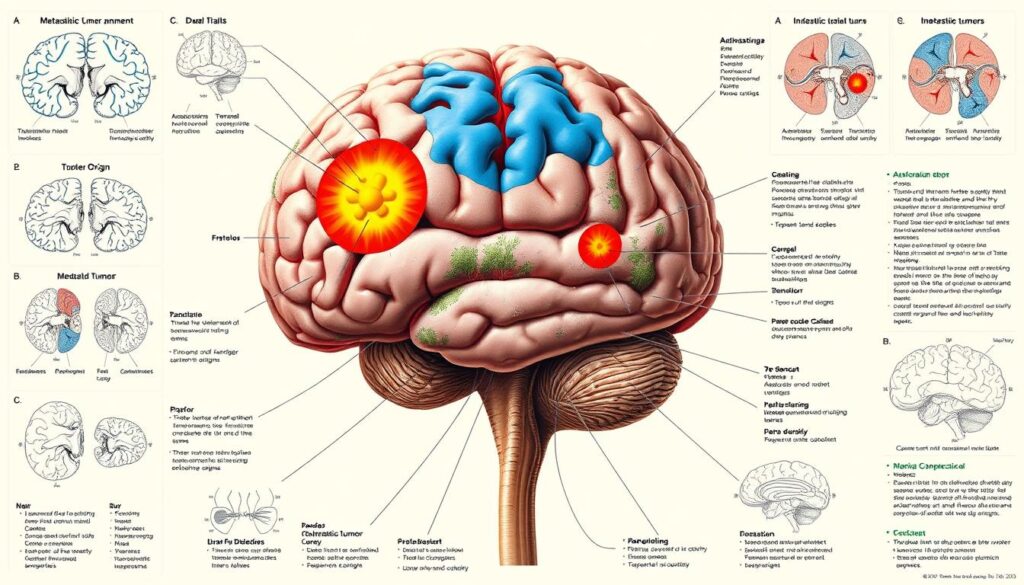
Brain metastases are a complex health challenge when cancer spreads beyond its original location. These secondary brain tumors form when cancer cells migrate to the brain. Understanding brain cancer spread is vital for effective management strategies1.
Brain metastases are more common than primary brain tumors. About 100,000 brain and spinal cord tumor cases are diagnosed in adults yearly1. Dealing with secondary brain cancer requires thorough knowledge and proactive care.
Early detection of brain metastases can greatly improve treatment outcomes. Doctors use MRI, CT, and PET scans to diagnose these tumors2. Recognizing symptoms like persistent headaches or cognitive changes can lead to timely medical help.
Key Takeaways
- Brain metastases occur when cancer spreads from other body parts
- Early detection is critical for effective management
- Multiple imaging techniques help diagnose secondary brain tumors
- Symptoms can vary based on tumor location and size
- Personalized treatment approaches are essential
Understanding Brain Metastases and Their Impact
Brain metastases occur when cancer cells spread from their origin to the brain. These secondary brain tumors greatly affect a patient’s life quality. They require specialized medical care3.
What Causes Secondary Brain Tumors
Cancer cells can travel through blood or lymph, settling in the brain. This forms metastatic brain tumors. The process involves several key steps:
- Cancer cells break away from the primary tumor
- Cells enter the bloodstream
- Survive immune system responses
- Establish new growth in brain tissue
Common Primary Cancers That Spread to Brain
Some cancers are more likely to develop brain metastases. The most common primary cancers include:
| Cancer Type | Metastasis Likelihood |
|---|---|
| Lung Cancer | Highest Risk |
| Breast Cancer | High Risk |
| Melanoma | Significant Risk |
| Colon Cancer | Moderate Risk |
| Kidney Cancer | Moderate Risk |
Risk Factors and Warning Signs
Recognizing warning signs of metastatic brain tumors is vital for early detection. Potential symptoms include:
- Persistent headaches
- Seizures
- Weakness in arms or legs
- Balance problems
- Memory changes
- Vision disturbances
Brain metastases prognosis varies based on primary cancer type and treatment approach. About one-third of cancer patients may develop brain metastases4.
Each year, 150,000 to 200,000 people are diagnosed with brain metastases4.
Early detection and personalized brain tumor treatment can significantly improve patient outcomes.
Diagnosis and Early Detection Methods
Early detection of brain metastases is vital for effective treatment. Doctors use advanced imaging and comprehensive assessments to diagnose brain metastases. These methods combine to provide a thorough evaluation.
The diagnosis of brain metastases involves several key steps. These include neurological exams, brain imaging, medical history reviews, and specialized tests.
- Comprehensive neurological examination
- Advanced brain tumor imaging techniques
- Detailed medical history review
- Specialized diagnostic tests
Neurological assessments help evaluate cognitive function, motor skills, and potential symptoms. Doctors check speech, vision, balance, muscle strength, and sensory responses.
- Speech patterns
- Vision capabilities
- Balance and coordination
- Muscle strength
- Sensory responses
Brain tumor imaging is crucial in diagnosis. It provides insights into the location, size, and features of metastatic tumors.
| Imaging Technique | Key Diagnostic Features |
|---|---|
| MRI | Detailed soft tissue visualization |
| CT Scan | Quick structural assessment |
| PET Scan | Metabolic activity detection |
“Early detection transforms brain metastases management from reactive to proactive.” – Oncology Research Team
A biopsy might be needed to confirm the specific type of metastatic cancer. Diffusion tensor imaging can reveal microscopic changes in brain tissue, enabling earlier detection.
Knowing risk factors and recognizing symptoms can improve early detection. Stay alert and consult doctors if you notice any neurological changes5.
Treatment Options for Brain Metastases
Brain metastases treatment offers many innovative approaches. Understanding your options is vital for an effective treatment strategy. Modern medicine provides multiple ways to manage this complex condition6.
Surgical Interventions and Procedures
Brain tumor surgery is crucial for specific types of brain metastases. Your medical team might suggest surgical procedures to remove brain metastases. These aim to reduce tumor size and relieve pressure.
Surgery can also help obtain tissue samples for further analysis.
- Reducing tumor size
- Relieving intracranial pressure
- Obtaining tissue samples for further analysis
Radiation Therapy Approaches
Radiation therapy for brain metastases has greatly improved. Stereotactic radiosurgery (SRS) benefits patients with 1-4 brain metastases. It targets tumors with precision7.
Modern techniques include stereotactic radiosurgery, modulated arc therapy, and proton therapy. These methods can reduce treatment times to just 15-30 minutes7.
- Stereotactic radiosurgery
- Modulated arc therapy
- Proton therapy
Targeted Drug Treatments and Immunotherapy
New targeted therapies and immunotherapy offer hope for patients. Precision medicine allows treatments that specifically target cancer cells.
Different cancers respond to various targeted treatments. For example, breast cancer patients can benefit from HER2-targeted therapies.
- Breast cancer patients can benefit from HER2-targeted therapies
- Lung cancer patients with specific genetic mutations may receive targeted treatments
- Melanoma patients might respond to immunotherapies like ipilimumab and pembrolizumab7
Palliative Care Options
Managing patient comfort is crucial while treating brain metastases. Palliative care focuses on improving quality of life. It helps manage symptoms and provides support throughout treatment6.
Conclusion
Brain metastases management is a complex medical challenge requiring personalized strategies. Modern medical advances offer patients renewed hope and improved treatment options8. Early intervention is crucial, as 20-40% of cancer patients may develop brain metastases8.
Your brain metastases survival rate depends on various factors. These include primary cancer type, number of metastases, and overall health. Lung and breast cancers are the most common sources of brain metastases8.
Advanced MRI techniques have improved tumor detection and characterization. This enables more targeted treatment approaches8. A multidisciplinary approach now offers the best outcomes for patients.
Emerging therapies and personalized strategies expand treatment options. Ongoing research and clinical trials provide hope for improved management9. These advancements may potentially extend survival periods.
Your brain metastases journey is unique. Work closely with your healthcare team to develop an appropriate treatment strategy. Stay informed and maintain a positive attitude while exploring all available options.
FAQ
What are brain metastases?
Brain metastases are secondary tumors formed by cancer cells spreading from other body parts. They’re five times more common than primary brain tumors and grow rapidly. These tumors develop when cancer cells break away from the original tumor and travel through the bloodstream.
What types of cancer most commonly spread to the brain?
The primary cancers that often spread to the brain include lung, breast, and skin (melanoma). Colon, kidney, and thyroid cancers also have a higher chance of creating metastatic brain tumors.
What are the typical symptoms of brain metastases?
Warning signs include persistent headaches, seizures, and weakness in arms or legs. Other symptoms are loss of balance, memory loss, and speech disturbances.
Behavior changes, vision problems, and numbness may also occur. If you experience multiple symptoms, consult your healthcare provider immediately.
How are brain metastases diagnosed?
Diagnosis involves physical exams, neurological assessments, and imaging studies. Doctors use MRI, CT scans, and PET scans to locate and measure brain metastases.
In some cases, a biopsy might be necessary to confirm the diagnosis.
What treatment options are available for brain metastases?
Treatment options include surgery, radiation therapy, and chemotherapy. Targeted drug treatments, immunotherapy, and palliative care are also available.
The approach depends on tumor number, size, location, and overall health. Options might include craniotomy, stereotactic radiosurgery, and immunotherapy drugs.
What is the prognosis for patients with brain metastases?
Prognosis varies based on primary cancer type, number of metastases, and overall health. Newer treatments have improved survival rates and quality of life.
Ongoing research and clinical trials explore innovative therapies, offering hope for better management.
Are brain metastases more common in certain age groups?
The risk of brain metastases increases after age 45 and is highest in people over 65. However, they can occur at any age, especially with primary cancers prone to brain spread.
Can brain metastases be prevented?
Complete prevention isn’t always possible, but early detection of primary cancer can reduce the risk. Regular screenings and following your treatment plan are crucial.
Maintaining a healthy lifestyle and working closely with your healthcare team help minimize cancer spread to the brain.
Source Links
- Brain Metastases: Staging and Treatment – https://www.oncolink.org/cancers/brain-tumors/brain-metastasis/brain-metastases-staging-and-treatment
- Brain metastases – Diagnosis and treatment – https://www.mayoclinic.org/diseases-conditions/brain-metastases/diagnosis-treatment/drc-20350140
- Brain metastases – Symptoms and causes – https://www.mayoclinic.org/diseases-conditions/brain-metastases/symptoms-causes/syc-20350136
- Brain Metastases – https://www.mdanderson.org/cancer-types/brain-metastases.html
- Early detection of brain metastases and appropriate local therapy followed by systemic chemotherapy may improve the prognosis of gastric cancer – https://pmc.ncbi.nlm.nih.gov/articles/PMC10681977/
- Overview of the treatment of brain metastases – https://www.uptodate.com/contents/overview-of-the-treatment-of-brain-metastases
- Brain Metastases Treatment Approach | Dana-Farber Cancer Institute – https://www.dana-farber.org/cancer-care/treatment/neuro-oncology/programs/brain-metastases/approach
- Brain metastases: an overview – PMC – https://pmc.ncbi.nlm.nih.gov/articles/PMC6093020/
- Breast cancer brain metastases: the last frontier – Experimental Hematology & Oncology – https://ehoonline.biomedcentral.com/articles/10.1186/s40164-015-0028-8

