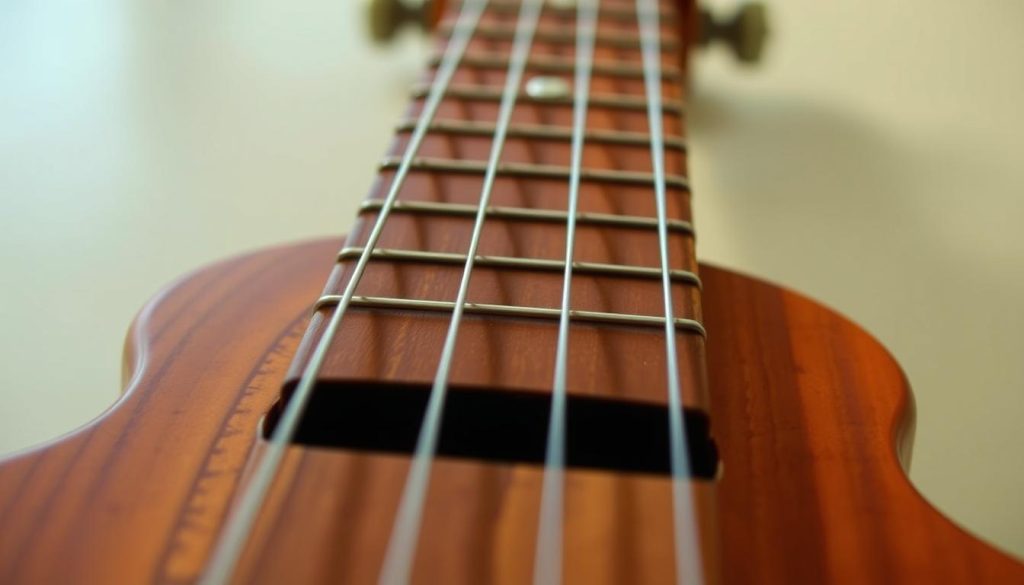
Ukulele tuning opens up new musical possibilities. Ukuleles and guitars have some things in common, but their tuning is quite different12. Guitars use EADGBE tuning, while ukuleles stick to GCEA2.
Ukuleles have unique features that affect their tuning. They have four strings and a different pitch range than guitars1. Many players use chromatic tuners for the best results3.
New players often want to use guitar skills on ukuleles. With practice, many guitar chord shapes can work on ukuleles. Clip-on tuners make tuning easier for beginners3.
Key Takeaways
- Ukuleles have a unique four-string configuration different from guitars
- Standard ukulele tuning is GCEA, contrasting with guitar’s EADGBE
- Chromatic tuners provide the most accurate ukulele tuning method
- Beginners can successfully adapt guitar techniques to ukulele playing
- Specialized ukulele tuners help musicians achieve perfect pitch
Understanding Traditional Guitar and Ukulele Tuning
Musical instruments have unique tuning traits that shape their sound. Ukulele tuning differs from guitar tuning, creating a distinct musical experience. These differences make each instrument special4.
Stringed instruments offer fascinating tuning variations. Ukulele strings play a key role in the instrument’s sound. They help create its unique character5.
Standard Guitar Tuning Basics
Guitarists typically use EADGBE tuning. This follows a linear pitch progression. It forms the basis for most guitar music4.
- E (lowest string)
- A
- D
- G
- B
- E (highest string)
Ukulele Tuning Methods
Ukuleles are usually tuned to GCEA. This standard tuning includes a unique approach called re-entrant tuning5.
- G-string (4th string)
- C-string (3rd string)
- E-string (2nd string)
- A-string (1st string)
The Unique Re-entrant Tuning Concept
Re-entrant tuning is a special feature of ukuleles. It creates a non-sequential pitch arrangement. This gives the ukulele its signature sound4.
| Ukulele Type | Typical Tuning |
|---|---|
| Soprano/Concert | G C E A (High G) |
| Tenor | G C E A (Low or High G) |
| Baritone | D G B E |
Musicians can explore different tuning options with ukulele tuning pegs. Electronic tuners help ensure precise pitch alignment. Most players use clip-on tuners for accuracy5.
Converting Guitar Chords to Ukulele
Switching from guitar to ukulele is easy when you grasp chord relationships. The ukulele offers a compact option with simpler chord structures6. Guitarists can quickly adapt by learning how chords translate between these instruments chord conversion techniques.
The fourth interval shift is key for converting ukulele chords. Guitar chords usually need the root note moved up a fourth on ukulele67. For example, a G major guitar chord becomes a C major ukulele chord6.
Ukulele tuner apps can help musicians navigate these changes. The baritone ukulele shares tuning with the top four guitar strings67. This allows for direct chord shape usage.
Proper ukulele care helps maintain accurate sound translation. It preserves the instrument’s unique tonal qualities. Exploring ukulele chords opens new musical doors for guitarists.
Understanding these techniques helps musicians expand their skills. They can enjoy the ukulele’s compact four-string versatility8. With practice, guitarists can easily add ukulele playing to their musical toolkit.
FAQ
Can I tune my ukulele exactly like a guitar?
Not exactly. Ukuleles use a standard GCEA tuning, different from a guitar’s EADGBE. The ukulele’s unique re-entrant tuning creates its distinctive sound.
What is re-entrant tuning on a ukulele?
Re-entrant tuning is unique to ukuleles. The strings aren’t tuned in strict pitch order. The G-string is typically higher than the C-string, creating the ukulele’s special sound.
How do different ukulele sizes affect tuning?
Ukulele sizes can slightly change tuning. Most use GCEA tuning. Baritone ukuleles often use DGBE tuning, like a guitar’s top four strings.
Can I use a guitar tuner for my ukulele?
Yes, most digital tuners work for both. It’s best to use a tuner that recognizes ukulele tunings. Many smartphone apps offer specific ukulele tuning modes.
How do I convert guitar chords to ukulele?
Converting chords requires understanding the fourth interval shift. Reposition chord shapes up a fourth from their guitar position. For example, a guitar C chord becomes an F on ukulele.
Chord conversion apps and online resources can help with this process.
What’s the best way to maintain my ukulele’s tuning?
Store your ukulele in a stable environment. Avoid extreme temperatures and humidity. Regularly check and adjust your tuning pegs.
Use high-quality strings and invest in a digital tuner. These steps will help keep your instrument in tune.
Are there different tuning methods for ukuleles?
Yes! GCEA is the most common tuning. Some musicians use alternative tunings like low G or Hawaiian slack key.
Each tuning creates unique sounds and playing possibilities. Experiment to find your favorite style.
Source Links
- Can You Tune A Ukulele With A Guitar Tuner – https://goldenmusic.co/blogs/culture/can-you-tune-a-ukulele-with-a-guitar-tuner
- How To Tune A Ukulele Like A Guitar – https://www.mozartproject.org/how-to-tune-a-ukulele-like-a-guitar/
- How To Tune A Ukulele – https://www.gear4music.com/blog/how-to-tune-a-ukulele/
- Ukulele Tuning for Guitar Players – https://www.playableguitar.com/ukulele-tuning.html
- Ukulele Tuning Tips: How to Tune a Uke – https://liveukulele.com/lessons/tuning-your-ukulele/
- How To Translate Guitar Chords To Ukulele – https://kraftgeek.com/blogs/musician-guide/how-to-translate-guitar-chords-to-ukulele?srsltid=AfmBOooJ7-gRgTQEtv0Lb_Yc2OSwjElEUbCtUbEVPQvadojb2Q4VScmE
- How To Transpose Guitar Chords To Ukulele Chords – https://www.mozartproject.org/how-to-transpose-guitar-chords-to-ukulele-chords/
- Convert Guitar Chords to Ukulele Chords the Easy Way – https://acousticbridge.com/guitar-chords-to-ukulele-chords/