
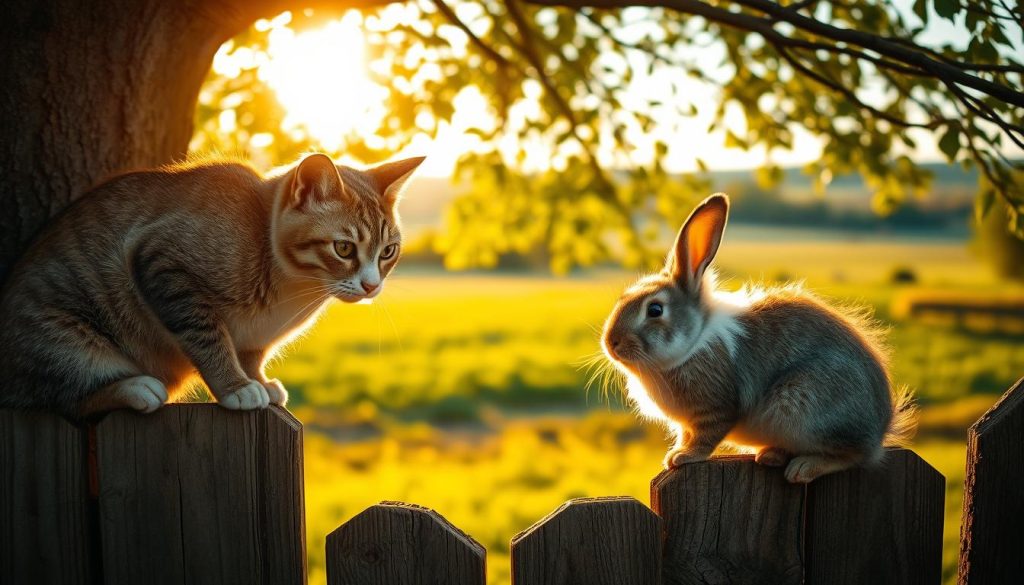
Rabbits mounting cats is a strange sight that has sparked wild ideas. Some wonder if these odd pairings could create hybrid offspring. However, science says this is impossible.
Cats and rabbits can’t produce viable offspring together. Their genetic makeup is too different. “Cabbits,” the imaginary cat-rabbit mix, remain a popular myth.
Experts have debunked the cabbit idea repeatedly. The chromosomal differences between cats and rabbits make breeding impossible. Cats have 19 chromosome pairs, while rabbits have 22.
This genetic barrier stops any chance of successful mating. No documented cases exist of cat-rabbit pairings resulting in offspring. The idea remains firmly in the realm of fiction.
Key Takeaways
- Rabbits mounting cats does not result in hybrid offspring
- Genetic differences prevent cat-rabbit reproduction
- The “cabbit” remains a persistent but scientifically impossible myth
- Chromosomal variations block cross-species breeding
- Anecdotal claims lack scientific validation
Understanding the Cabbit Phenomenon
Interspecies mating has sparked myths about impossible animal combinations. The cabbit myth blends cats and rabbits into a mysterious hybrid creature2. This folklore represents one of the most intriguing wildlife encounters in popular imagination.
Origins of the Cabbit Myth
Historical reports sparked widespread curiosity about cabbits. Eyewitness accounts and alleged sightings have fueled speculation for decades2.
Key aspects of the myth include:
- Reported sightings of cat-rabbit hybrids
- Historical articles mentioning unusual animal appearances
- Claims of breeding these hybrid creatures
Physical Characteristics of Alleged Cabbits
Predator-prey interactions are sometimes mistaken for evidence of hybrid animals. Most alleged cabbits are actually cats with unique genetic mutations2. Examples include Manx cats with shortened tails or unusual body structures.
| Characteristic | Cat Trait | Rabbit Trait |
|---|---|---|
| Chromosome Count | 38 chromosomes | 44 chromosomes |
| Gestation Period | 64 days | 31 days |
Popular Culture and Media Coverage
The cabbit phenomenon has captured public imagination through various media outlets. Numerous videos and eyewitness reports continue to circulate, despite scientific impossibility2.
Genetic experts highlight that chromosomal differences make cat-rabbit breeding impossible. Yet, the myth persists in popular culture.
The line between scientific fact and imaginative folklore remains delightfully blurry in the world of animal hybrids.
The Science Behind Animal Hybridization
Animal hybridization is a complex scientific phenomenon. It challenges our understanding of genetic boundaries. Researchers have studied cross-species interactions, revealing intricate genetic mechanisms that prevent successful reproduction between different species3.
About 10% of animal species have experienced some form of hybridization3. Veterinary case studies show significant genetic barriers preventing interspecies breeding. Cats and rabbits have incompatible chromosomal structures, making hybridization impossible3.
Cats have 38 chromosomes while rabbits carry 44. These differences prevent successful breeding between the two species. Responsible pet owners should understand these natural reproductive limitations3.
Hybridization attempts can lead to significant genetic challenges. Studies show negative consequences in 49% of cases. Genetic swamping is the most common issue at 21%3.
Geneticists stress the importance of maintaining species integrity. This protects biological diversity and prevents potential genetic disruptions. Genetic research supports these findings3.
The idea of hybrid animals like “cabbits” might seem fascinating. However, scientific evidence proves such claims impossible. Genetic and reproductive barriers between cats and rabbits are insurmountable.
This reminds us to appreciate each species’ unique biological traits. We should value their evolutionary adaptations and distinct characteristics.
FAQ
Are “cabbits” real animals?
“Cabbits” are not real animals. They’re a myth born from misunderstandings about animal reproduction. Rabbits may try to mount cats, but this doesn’t create hybrid offspring.
Why do rabbits sometimes mount cats?
Rabbits may mount cats for territorial reasons or hormonal impulses. This behavior is usually a form of communication, not a reproductive act. It doesn’t mean these species can breed together.
Can cats and rabbits actually produce offspring together?
No, cats and rabbits cannot produce offspring. They are genetically incompatible with different chromosome counts. Their reproductive systems and biological mechanisms make cross-species breeding impossible.
Where did the cabbit myth come from?
The cabbit myth likely started from misidentified cat breeds with unusual looks. Media hype and folklore also played a role. Some rare cats with genetic mutations may have been mistaken for hybrids.
How can I prevent rabbits from mounting my cat?
Spay or neuter both animals to prevent mounting. Provide separate living spaces and manage their interactions carefully. If the problem continues, consult a vet or animal behaviorist for specific advice.
Are there any health risks when rabbits and cats interact?
Close interactions between rabbits and cats can pose health risks. These include disease transmission and potential injuries. Stress can also affect both animals. Supervise their time together and ensure proper vet care.
How do I recognize unusual animal behavior between different species?
Watch for signs of stress, territorial marking, or aggressive interactions. Learn each species’ natural behaviors and body language. This knowledge helps you spot when interactions become problematic or harmful.
Source Links
- WHY CATS CAN’T BREED WITH RABBITS – http://messybeast.com/cabbit3.htm
- Cat-rabbit Hybrids (Cabbits) – Fact or fiction? – Biology Dictionary – http://www.macroevolution.net/cat-rabbit-hybrids.html
- Consequences of Hybridization in Mammals: A Systematic Review – https://pmc.ncbi.nlm.nih.gov/articles/PMC8774782/

