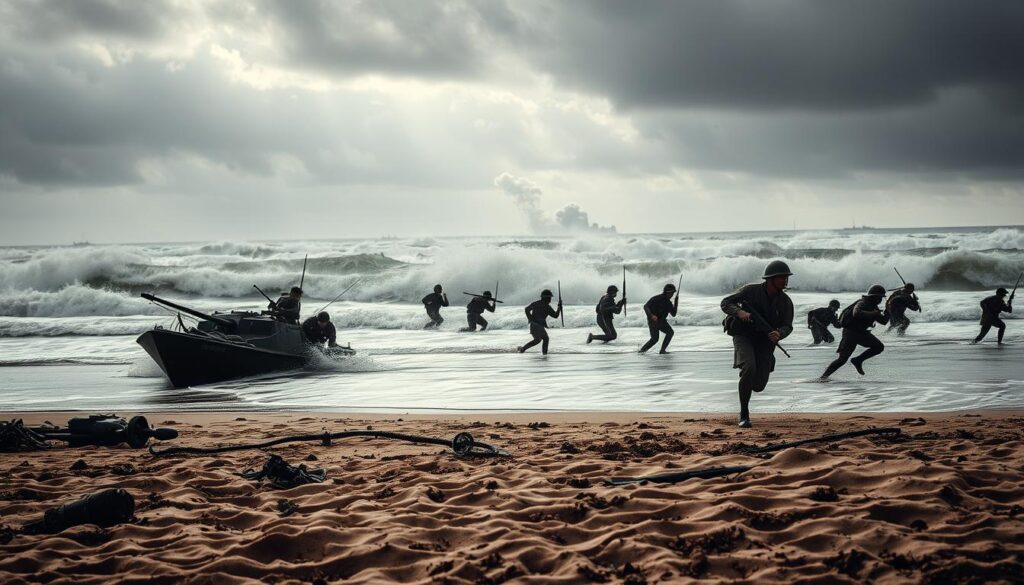
The Normandy Invasion, known as Operation Overlord, was a key moment in World War II. On June 6, 1944, it involved 7,000 ships and over 195,000 sailors from eight countries1. This marked the start of the end of Germany’s rule in Western Europe. It was the biggest seaborne invasion ever, with more than 156,000 troops landing.
June 6, 1944, was not the only D-Day. Every amphibious attack, like those in the Pacific and North Africa, also had their D-Days2.
The invasion took place in Normandy, France, at 49°20′N 0°36′W. The Allies won a major victory3. They had 156,000 soldiers, 195,700 sailors, 50,350+ vehicles, and 170 guns ready for battle3.
The D-Day was a turning point in World War II. It set the stage for the Allies’ victory on the Western Front.
Key Takeaways
- The D-Day operation involved 7,000 ships and landing craft manned by over 195,000 naval personnel from eight allied countries1.
- The invasion of Normandy on June 6, 1944, was the largest seaborne invasion in history, involving over 156,000 Allied troops.
- The location of the Normandy landings was Normandy, France, with the coordinates 49°20′N 0°36′W, resulting in an Allied victory3.
- The strength of the Allied forces included 156,000 soldiers, 195,700 naval personnel, 50,350+ vehicles, and 170 coastal artillery guns3.
- The D-Day operation was a significant turning point in World War II, and it laid the foundation for the Allied victory on the Western Front.
- The Normandy Invasion, codenamed Operation Overlord, was a key event in World War II.
Historical Context of D-Day
The lead-up to World War II was filled with turmoil, calling for a bold Allied move. The planning for Operation Overlord started in 1943. The Allies carefully picked the best places to land4.
The Build-Up to World War II
Europe was on high alert as countries geared up for war. Nazi Germany’s aggressive push under Adolf Hitler made everyone nervous. This led to detailed military plans5.
Key Players Involved
Leaders like Dwight D. Eisenhower and Winston Churchill were key in planning the invasion. Their teamwork with other Allied Forces was vital. It helped fight off German forces4.
The Strategic Importance of Normandy
Normandy was picked for its good location. It allowed the Allies to gain a strong foothold in Europe. The coast’s layout was perfect for a big amphibious attack6.
| Statistic | Details | Source |
|---|---|---|
| Allied Troops Landed | Approximately 156,000 soldiers | 4 |
| Casualties at Omaha Beach | Over 2,000 American casualties | 6 |
| Total Allied Equipment | About 100,000 tons | 4 |
The Invasion Process
The success of D-Day was due to careful planning and logistics. This ensured the vast scale of Operation Overlord could be achieved. Special equipment, like Mulberry harbors and Hobart’s Funnies, was key in supporting the Allied Forces7.
Planning and Logistics
Operation Overlord needed precise coordination of resources and people. The creation of Mulberry harbors helped the Allies set up temporary ports. This allowed for quick unloading of troops and supplies7.
The Role of Allied Forces
The Allied Forces, made up of American, British, and Canadian troops, worked together. Each nation’s military brought its own strengths. These strengths helped shape the overall strategy and success7.
Beach Landings: Operation Neptune
The beach landings, known as Operation Neptune, were central to the invasion. American forces faced tough resistance at Omaha Beach and Utah Beach8. Despite the strong Atlantic Wall defenses, the Allies’ determination won out.
The Challenges Faced
Bad weather and strong German defenses were big challenges. The rough seas of the English Channel tested the troops’ endurance. But, good weather on June 6, 1944, gave the Allies a surprise and tactical edge8.
Aftermath of D-Day
The success of the Battle of Normandy was a turning point in World War II. The Allied Forces quickly took control of the beaches. This allowed them to move troops and equipment inland fast9.
By June 30, over 850,000 men, 148,000 vehicles, and 570,000 tons of supplies had landed. This massive effort helped keep the Allied push into France strong9.
Immediate Military Outcomes
Securing the beachheads was key for the offensive to continue. The Allies fought hard against German resistance. This fight allowed them to move deeper into Western Europe9.
Long-Term Implications for the War
The Battle of Normandy led to the liberation of Western Europe. This victory directly helped defeat Nazi Germany10. It also sped up the end of World War II and changed the world order after the war.
D-Day’s Impact on Modern Military Strategy
D-Day changed military tactics, focusing on joint operations and amphibious warfare. The Battle of Normandy showed how important teamwork is in war9.
Commemoration and Remembrance
The legacy of D-Day is honored through various activities around the world.
Annual D-Day Celebrations
Every year, communities come together to remember the bravery of D-Day. This is more significant on the 80th anniversary in 2024. Events include the H-Hour Gathering, performances by the 29th Division Band, and interactive displays by the Living History Corps.
Memorials and Museums
Memorials like the Normandy American Cemetery remind us of World War II’s losses11. The D-Day Museum in Portsmouth has exhibits on the invasion’s importance and personal stories. Outdoor shows like Expressions of America offer immersive experiences that honor the sacrifices made on D-Day.
Personal Stories of Veterans
Veterans share their experiences, keeping the sacrifices of those who served alive. Programs like Soaring Valor, with the Gary Sinise Foundation and American Airlines, help veterans visit memorials12. These stories create a strong emotional connection and show the lasting impact of D-Day.
Efforts to honor D-Day remind us of World War II’s key moments and heroes13.
FAQ
What was D-Day and why is it important in World War II?
D-Day, also known as the Normandy Invasion, was a key event on June 6, 1944, in World War II. It was the largest amphibious invasion in history. The successful landing of Allied Forces on the Normandy coast was a turning point, leading to the liberation of Western Europe from Nazi occupation.
It ultimately contributed to the Allied victory.
Who were the key leaders involved in planning and executing D-Day?
Key figures included General Dwight D. Eisenhower, the Supreme Commander of the Allied Expeditionary Forces, and British Prime Minister Winston Churchill. They played a significant role in strategizing the invasion. On the opposing side, Adolf Hitler led Nazi Germany, orchestrating the defenses against the Allied assault.
Their decisions and leadership were critical in shaping the Battle of Normandy’s outcome.
Why was Normandy chosen as the landing site for D-Day?
Normandy was chosen for several strategic reasons. Its extensive coastline provided multiple landing beaches, such as Omaha Beach and Utah Beach. These beaches were suitable for large-scale amphibious operations.
Normandy’s location in northern France allowed the Allied Forces to establish a strong foothold. This avoided the heavily fortified Pas de Calais region. The region’s terrain and climate also played a role in the invasion planning.
What were some of the key logistical preparations for Operation Overlord?
Operation Overlord required detailed planning and extensive logistical preparations. This included developing specialized equipment like the Mulberry harbors. These were portable temporary harbors used to facilitate the rapid offloading of cargo onto the beaches.
Hobart’s Funnies, a series of modified tanks and armored vehicles, were also created to overcome obstacles on the beaches. Coordinating the movement of thousands of troops, ships, and aircraft was essential to the success of the Normandy Invasion.
What challenges did the Allied Forces face during the beach landings?
The Allied Forces faced numerous challenges during the beach landings on Omaha Beach and Utah Beach. Strong German defenses, including fortified bunkers, mines, and machine-gun nests, posed significant obstacles. Adverse weather conditions, such as rough seas and heavy fog, complicated the landing operations.
Despite these hardships, the determination and bravery of the Allied soldiers enabled them to secure the beaches and establish beachheads.
What were the immediate military outcomes of the D-Day invasion?
The immediate military outcomes of D-Day included the successful establishment of multiple beachheads along the Normandy coast. This allowed the Allied Forces to begin their push inland, leading to the Battle of Normandy.
The breach in German defenses facilitated the liberation of key cities and regions in Western Europe. The invasion also disrupted Nazi supply lines and weakened their overall defensive capabilities, accelerating the downfall of Nazi Germany.
How did D-Day influence modern military strategy?
D-Day had a profound impact on modern military strategy, focusing on joint operations and amphibious warfare. The coordination of land, sea, and air forces during the Normandy Invasion demonstrated the effectiveness of combined arms operations.
The use of innovative technologies and specialized equipment, such as Mulberry harbors and Hobart’s Funnies, influenced future military engineering and logistics. The lessons learned from the planning and execution of Operation Overlord continue to inform contemporary military tactics and strategies.
How is D-Day commemorated and remembered today?
D-Day is commemorated annually with ceremonies and events in Normandy and other locations involved in the invasion. Memorials and museums, such as the Normandy American Cemetery and the D-Day Museum in Portsmouth, honor the sacrifices of those who participated in the invasion.
Personal stories from veterans are shared to provide a human perspective on the events of June 6, 1944. These commemorations serve to educate future generations and preserve the legacy of the bravery and determination exhibited during the Normandy Invasion.
What was the role of the Mulberry harbors in the success of D-Day?
The Mulberry harbors were critical to the success of D-Day, serving as temporary portable harbors. They allowed the Allied Forces to rapidly offload troops, vehicles, and supplies onto the Normandy beaches. These engineered structures ensured a continuous flow of resources, which was essential for sustaining the invasion and subsequent operations inland.
The ability to establish efficient supply lines contributed significantly to maintaining the momentum of the Battle of Normandy and the overall success of Operation Overlord.
Who were some of the key Allied nations involved in the Normandy Invasion?
The Normandy Invasion involved a coalition of Allied Forces from several nations, including the United States, the United Kingdom, Canada, and Free French forces. These countries contributed troops, naval vessels, and air support to execute the large-scale amphibious assault on June 6, 1944.
The combined efforts and cooperation among these nations were instrumental in overcoming the formidable defenses of Nazi Germany and achieving the objectives of Operation Overlord.
Source Links
- World War II: D-Day, The Invasion of Normandy – https://www.eisenhowerlibrary.gov/research/online-documents/world-war-ii-d-day-invasion-normandy
- What does the “D” in D-Day mean – https://www.army.mil/e2/downloads/rv7/d-day/the-meaning-of-dday-fact.pdf
- Normandy landings – https://en.wikipedia.org/wiki/Normandy_landings
- D‑Day ‑ Normandy Invasion, Facts & Significance | HISTORY – https://www.history.com/topics/world-war-ii/d-day
- What’s the Context? D-Day, 6 June 1944 – History of government – https://history.blog.gov.uk/2014/06/06/whats-the-context-d-day-6-june-1944/
- The 10 Things you Need to Know about D-Day – https://www.iwm.org.uk/history/the-10-things-you-need-to-know-about-d-day
- D-Day and the Normandy Campaign | The National WWII Museum | New Orleans – https://www.nationalww2museum.org/war/topics/d-day-and-normandy-campaign
- D-Day: The Allies Invade Europe – https://www.nationalww2museum.org/war/articles/d-day-allies-invade-europe
- D-Day and Its Profound Impact on American History – https://soldiersangels.org/d-day-and-its-profound-impact-on-american-history/
- D-Day and the German Surrender [ushistory.org] – https://www.ushistory.org/us/51c.asp?srsltid=AfmBOop28f9V81qkZTXxi98HSbQtiyZO0wfckwSVCxOEmolfdp50sG31
- Remembering D-Day – https://www.defense.gov/Multimedia/Experience/Remembering-D-Day/
- 80th Anniversary of D-Day | The National WWII Museum | New Orleans – https://www.nationalww2museum.org/80th-anniversary-d-day
- National Day of Remembrance of the 80th Anniversary of D-Day | The White House – https://www.whitehouse.gov/briefing-room/statements-releases/2024/06/05/national-day-of-remembrance-of-the-80th-anniversary-of-d-day/