
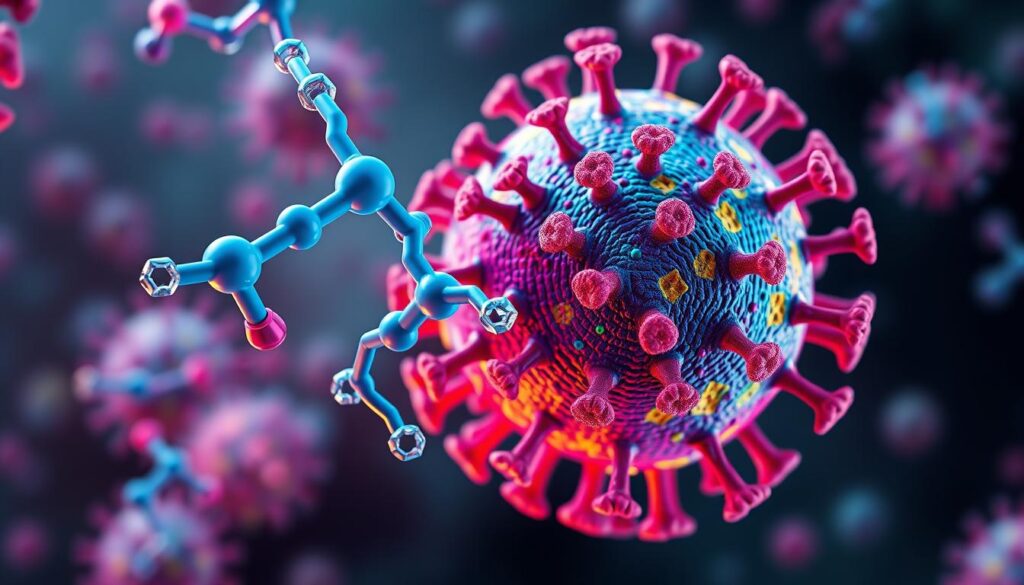
Your body’s defense against influenza relies on powerful antibodies. Scientists have made exciting discoveries about these microscopic guardians1. They’ve found new ways to target hidden parts of the flu virus1.
Influenza remains a global health challenge affecting millions yearly. It can cause severe illness, making advanced antibody therapies crucial2. Flu viruses are complex, requiring sophisticated defense mechanisms.
New research shows antibodies can target a common region in various flu viruses. This includes the tricky H3N2 subtype. Lab tests reveal these antibodies can stop virus spread across species1.
This breakthrough helps us understand Flu Virus Antibodies better. It shows potential for protecting against multiple viral strains. These findings mark a big step forward in flu research.
Key Takeaways
- Antibodies offer promising new strategies for targeting hidden regions of influenza viruses
- Recent research shows potential for broad-spectrum protection against multiple flu strains
- Innovative approaches are expanding our understanding of Influenza Virus Antibodies
- Laboratory studies demonstrate effectiveness across different virus subtypes
- Advanced antibody research could lead to more comprehensive flu prevention methods
Understanding Influenza Virus Structure
The influenza virus is a complex microorganism that challenges our immune system. Its structure reveals how these viruses interact with human cells. Understanding this helps us grasp how influenza triggers immune responses.
Components of the Influenza Virus
Influenza viruses are fascinating biological entities with unique structural features. They’re typically spherical and measure about 100 nm in diameter3.
The virus contains eight RNA segments. These encode different proteins crucial for its survival and replication3.
- Surface proteins: Hemagglutinin (HA) and Neuraminidase (NA)
- Core proteins: Nucleoprotein and Matrix proteins
- Genetic material: Eight RNA segments
How the Virus Invades Cells
Antigen-specific antibodies are key to understanding viral invasion. The virus attaches to host cells by recognizing specific sialic acid receptors.
Human tracheal epithelial cells mainly have α-2,6-linkages. Influenza viruses target these for cellular entry3.
| Virus Type | Receptor Preference | Invasion Mechanism |
|---|---|---|
| Human Influenza | α-2,6-linkages | Cellular surface binding |
| Avian Influenza | α-2,3-linkages | Different cellular entry |
Importance of Virus Structure in Antibody Development
Knowing the virus structure is crucial for creating effective antigen-specific antibodies. The CDC uses advanced techniques to analyze genetic sequences and track viral changes4.
Researchers study viral mutations like antigenic drift and shift. This helps them design more targeted immune responses4.
The key to combating influenza lies in comprehending its intricate structural dynamics.
The Role of Antibodies in Immunity
Your immune system protects you from harmful invaders like viruses. Antibodies are key players in this defense. They act as specialized guardians against infectious threats such as influenza.
What Are Antibodies?
Antibodies are proteins your immune system makes to fight specific pathogens. In Influenza Antibody Therapy, these proteins recognize and neutralize viral particles. They work like precision weapons, targeting specific antigens on viruses5.
Types of Antibodies
Different antibodies serve unique functions in your immune response. The main types include:
- IgG: Most common antibody in blood circulation
- IgM: First responders during initial infection
- IgA: Protects mucosal surfaces
- Neutralizing antibodies: Specifically block viral entry into cells
How Antibodies Respond to Viruses
Antiviral antibodies quickly recognize and bind to specific viral proteins. This binding stops the virus from entering healthy cells. It effectively neutralizes the threat6.
“The immune system’s ability to create targeted Antiviral Antibodies is a remarkable defense mechanism against viral infections.”
Your body’s immune memory helps create fast responses to familiar viruses. Memory B cells offer long-lasting protection. They quickly produce antibodies when a similar virus appears5.
| Antibody Type | Primary Function | Viral Response |
|---|---|---|
| IgG | Long-term immunity | Neutralizes circulating viruses |
| IgM | Initial immune response | Quickly identifies new infections |
| Neutralizing Antibodies | Block viral entry | Prevents virus from infecting cells |
Understanding antibody responses is key to developing effective Influenza Antibody Therapy strategies.
Antibodies Targeting Influenza Virus: An Overview
Influenza Virus Antibodies offer a fascinating defense against viral infections. Researchers have made big strides in fighting flu viruses. They use advanced antibody technologies to develop targeted strategies.
How These Antibodies Work
Flu Virus Antibodies neutralize viral threats. They target specific protein regions on the virus surface. This prevents viral entry and replication.
Scientists have found amazing ways antibodies interact with flu viruses7:
- Targeting common protein regions across virus subtypes
- Inhibiting virus propagation in multiple viral strains
- Protecting against lethal viral infections
Types of Antibodies Developed for Influenza
Studies have found different antibody types with unique abilities. Scientists isolated anti-neuraminidase monoclonal antibodies with great potential8:
- Anti-NA monoclonal antibodies targeting Influenza B
- Broadly neutralizing antibodies
- Antibodies with multiple strain inhibition
The Significance of Neutralizing Antibodies
Neutralizing antibodies are a big breakthrough in flu virus defense. Two monoclonal antibodies (1G05 and 2E01) can neutralize various flu strains8. They protect against viral infections both before and after exposure.
The potential of targeted antibody therapies could revolutionize our approach to managing influenza infections.
Scientists are exploring new ways to develop better Influenza Virus Antibodies. This brings hope for more complete viral protection in the future.
The History of Influenza Antibodies
Influenza research has led to groundbreaking discoveries about viral immunity. Scientists have tirelessly studied the flu virus and its effects on human immune systems. Their work has transformed our understanding of this complex disease.
Milestones in Early Influenza Research
The 1918 flu pandemic was a turning point in medical history. It infected about 500 million people worldwide and caused 20 to 50 million deaths9. This outbreak was so severe that it lowered global life expectancy rates9.
Key Discoveries in Antibody Development
Scientists made big advances in understanding how our bodies fight the flu. The first inactive flu vaccine came out in 1933. It was first tested on U.S. soldiers and approved for wider use in 19459.
By 1942, researchers created a vaccine that protected against both A and B flu viruses9. This was a major step forward in flu prevention.
The Evolution of Vaccines and Therapies
- 1952: WHO established the Global Influenza Surveillance System9
- 2003: Live attenuated nasal spray vaccine introduced9
- 2013: Recombinant DNA vaccine technology approved9
Learning about specific antibodies was key to making better vaccines. Studies showed that people build stronger defenses against flu strains they meet as kids10. These early antibodies can help fight off later infections and make them less severe10.
“The history of influenza research is a testament to human resilience and scientific innovation.” – Anonymous Immunologist
Today, flu vaccines keep changing to match new virus strains. The World Health Organization suggests which strains to include for each half of the world9. Despite progress, seasonal flu remains a big health problem, causing up to 650,000 deaths each year9.
Current Research Trends in Antibody Development
Novel Influenza Treatments are evolving rapidly. Scientists are creating innovative strategies to fight the changing influenza virus. Groundbreaking research is advancing Immunotherapy for Influenza11.
Innovative Approaches in Antibody Design
Scientists are exploring new methods to create better antibodies against influenza. They’re focusing on targeting conserved viral regions and developing broad-spectrum antibodies.
Advanced microscopy techniques are also being used in this research1.
- Targeting conserved viral regions
- Developing broad-spectrum antibodies
- Utilizing advanced microscopy techniques1
Advances in Monoclonal Antibody Engineering
Monoclonal antibody development has made great strides. The FDA has fully approved six monoclonal antibodies for infectious disease treatments11.
Research is focused on targeting the neuraminidase “dark side” and creating stronger antibody responses. Scientists aim to develop antibodies with broader protection1.
- Targeting the neuraminidase “dark side”
- Creating more potent antibody responses
- Developing antibodies with broader protection1
Synthetic Antibodies: A New Frontier
Synthetic antibody technologies offer promising solutions for influenza immunotherapy. These engineered antibodies can potentially target multiple influenza strains and improve patient outcomes.
They may also help reduce hospitalization rates and lower patient mortality12.
| Capability | Potential Impact |
|---|---|
| Broad Viral Protection | Target multiple influenza strains |
| Enhanced Neutralization | Improve patient outcomes |
| Reduced Hospitalization | Potentially lower patient mortality12 |
“The future of influenza treatment lies in our ability to create more adaptable and powerful antibody responses.” – Leading Immunology Researcher
These new approaches in Novel Influenza Treatments are a big step forward. They improve our understanding and management of influenza viruses1.
Assessing the Effectiveness of Influenza Antibodies
Antiviral antibodies play a vital role in combating influenza. Scientists constantly improve methods to evaluate antibody protection against viral infections13.
Key Factors Influencing Antibody Efficacy
Several factors determine how well influenza antibodies fight infections. These include:
- Antibody affinity
- Specificity to virus strains
- Neutralization capabilities
Understanding Antibody Affinity and Specificity
The immune response relies on antibodies binding to viral proteins. High-affinity antibodies can neutralize various virus strains more effectively14.
| Antibody Characteristic | Impact on Virus Neutralization |
|---|---|
| High Affinity | Stronger Viral Binding |
| Low Specificity | Reduced Effectiveness |
Testing Methods for Antibody Response
Scientists use various techniques to assess antibody performance. The hemagglutination inhibition (HI) test is crucial for evaluating antiviral antibodies15.
This method helps researchers understand how antibodies prevent viral attachment and infection.
“Antibody testing is a complex but essential process in developing effective influenza treatments.”
Refining these assessment methods leads to more targeted antiviral antibodies. This ongoing research improves our ability to fight influenza13.
The Role of Antibodies in Vaccine Development
Influenza vaccine research is crucial for better protection against this tricky virus. Influenza Antibody Therapy is a new approach to targeting complex viral structures.
Mechanisms of Action in Flu Vaccines
Your immune response is key to vaccine effectiveness. Antigen-specific Antibodies help fight specific flu strains13.
Seasonal flu vaccines have shown varying success rates. They range from 10% to 60% across different seasons13.
Combining Antibodies with Traditional Vaccines
New strategies are boosting vaccine protection. Researchers are working on universal influenza vaccines (UIVs) with bold goals:
- Targeting less variable viral regions
- Developing broadly neutralizing antibodies
- Creating computationally-optimized antigens
Future Prospects for Vaccines Against Influenza
The goal is to create vaccines that are 75% effective against many flu virus groups13. Scientists are excited about these approaches:
- Stalk domain-based vaccines
- Chimeric HA strategies
- Mosaic HA development
The future of influenza prevention lies in understanding and manipulating our immune system’s most sophisticated defense mechanisms.
Ongoing Influenza Antibody Therapy research promises stronger, more flexible vaccines. These could greatly reduce the impact of seasonal and pandemic flu16.
Challenges in Antibody Production
Creating effective Influenza Virus Antibodies is a complex task. It involves tackling scientific and practical obstacles. Viral evolution makes it hard to develop reliable antiviral treatments. Researchers are exploring new solutions to overcome these challenges.
Antigenic Variation and Its Impact
Influenza viruses are highly adaptable, making antibody development tricky. Viral strains can quickly mutate, reducing the power of existing Antiviral Antibodies15.
The high mutation rate helps viruses escape immune responses. This creates an ongoing challenge for scientists15.
- Viral subtypes can change rapidly
- Immune evasion strategies complicate antibody design
- Genetic diversity increases complexity
Production Scalability and Cost
Creating antibody treatments involves big economic factors. The production process needs advanced tech and lots of money.
Innovative approaches like camelid single domain antibodies offer potential cost-effective alternatives17.
| Production Challenge | Potential Solution |
|---|---|
| High Production Costs | Camelid Antibody Technologies |
| Complex Manufacturing | Advanced Microbiological Techniques |
Regulatory Considerations
Ensuring safe and effective Influenza Virus Antibodies requires strict oversight. Researchers must navigate complex approval processes. They also need to maintain high scientific standards18.
The path to effective antibody development demands persistent innovation and careful scientific investigation.
Understanding these challenges is key to developing new antiviral treatments. These treatments can protect people against evolving influenza threats18.
Future Directions for Antibody Research
Novel Influenza Treatments are evolving fast. Scientists are exploring new ways to protect against flu viruses. They’re pushing the limits of Immunotherapy for Influenza.
Potential for Universal Flu Vaccines
Researchers have made big steps toward universal flu vaccines. New tech has found several antibodies that fight many flu A strains. These new methods aim to create vaccines that protect against multiple flu types.
- More than 300 unique monoclonal antibodies have been discovered19
- Some antibodies can neutralize multiple influenza subtypes
- Structural insights are helping design more effective vaccines
Innovations in Targeting Varied Strains
The search for comprehensive influenza protection has led to amazing finds. Scientists found an antibody that shielded mice from 12 different flu strains. It worked on human, bird, and other nonhuman virus types20.
This breakthrough gives hope for stronger defense against flu. It could lead to better ways to fight multiple virus strains.
The future of influenza treatment lies in our ability to develop broadly protective antibodies that can combat multiple virus strains.
Combining Antibody Therapy with Other Treatments
New Immunotherapy for Influenza is looking at combo treatments. One antibody (18_14D) showed great results in preventing and treating flu. It gave full or partial protection against viral attacks21.
- Prophylactic treatments show potential for virus prevention
- Therapeutic approaches can reduce infection severity
- Combination therapies may offer enhanced protection
Research on antibodies keeps pushing our knowledge forward. It offers hope for better Novel Influenza Treatments in the future. These new methods could change how we fight flu.
Real-World Applications of Influenza Antibodies
Influenza Antibody Therapy shows promise in modern medical treatment. Researchers are exploring new ways to fight viral infections more effectively. They aim to develop innovative solutions for better patient care22.
Monoclonal antibodies are a breakthrough in Novel Influenza Treatments. These special antibodies offer unique advantages in fighting viral infections:
- Rapid onset of protective immunity22
- Potential for broad-spectrum effectiveness22
- Targeted approach to virus neutralization
Clinical Applications and Challenges
Influenza antibody therapies face several critical issues. Researchers have identified key challenges that affect widespread use:
| Challenge | Impact |
|---|---|
| Production Cost | Higher expense compared to traditional vaccines22 |
| Protection Duration | Relatively short-term immunity22 |
| Clinical Development | Limited progress beyond phase 2 trials22 |
Vaccine Composition and Antibody Response
The World Health Organization is vital in vaccine development. They hold meetings twice a year to recommend flu vaccine compositions. This ensures the most effective protection against current viral strains23.
Antibody levels typically peak 3-4 weeks after vaccination and gradually decrease over time23.
Future Prospects
Influenza Antibody Therapy continues to show promise despite challenges. Researchers are working to develop more effective and accessible treatments. These new therapies aim to provide rapid protection against influenza viruses22.
Most monoclonal antibody products come from US-based companies. This highlights America’s leadership in this crucial medical research field22.
Conclusion: The Future of Antibodies Against Influenza
Scientists are making big strides in antibody research against influenza. Their work aims to tackle a major health issue. Seasonal flu causes millions of severe cases and hundreds of thousands of deaths worldwide24.
New discoveries in flu immune response show great promise. Universal vaccine candidates target stable parts of the virus. Monoclonal antibodies can fight many virus subtypes24.
Progress needs ongoing research and public support. Current vaccines need yearly updates. New methods aim to provide stronger protection24.
Your knowledge can help drive advances in reducing flu’s impact. Staying informed aids in developing better antibody-based treatments.
Summarizing Key Insights
Our study shows how complex influenza is. Antibodies play a crucial role in fighting viral infections. Ongoing research promises more effective treatments against flu outbreaks.
The Importance of Continued Research
Research is key to understanding and fighting influenza. Each discovery brings us closer to better protection. Progress helps us combat this ever-changing virus.
Encouraging Public Awareness and Support
Your awareness and support drive scientific progress. Staying informed about flu antibodies is crucial. Your interest helps develop life-saving treatments and prevention strategies.
FAQ
What are antibodies targeting influenza viruses?
Antibodies are proteins made by your immune system. They recognize and neutralize specific parts of the flu virus. Some antibodies target hidden areas like the neuraminidase protein head.
These antibodies could offer broader protection against multiple flu strains. Researchers are studying them to develop more effective vaccines.
How do antibodies work against influenza?
Antibodies bind to specific parts on the virus surface. They attach to proteins like hemagglutinin (HA) and neuraminidase (NA). This prevents the virus from infecting cells and stops it from multiplying.
Antibodies also help your immune system destroy viral particles more effectively. They play a crucial role in fighting off flu infections.
What makes the “dark side” of the neuraminidase protein important?
The “dark side” is a hidden area on the neuraminidase protein head. It contains vulnerable spots that stay the same across different flu strains. Antibodies targeting this region could provide broader protection against various flu types.
This includes protection against H3N2 subtypes. Researchers are exploring ways to use this knowledge for better vaccines.
Can antibodies help develop universal flu vaccines?
Yes, antibodies are key to creating universal flu vaccines. Researchers are focusing on antibodies that recognize consistent viral structures across multiple strains. This approach could lead to vaccines that offer broader and longer-lasting protection against influenza.
What challenges exist in developing influenza antibodies?
The flu virus changes quickly, making it hard to create a one-size-fits-all solution. Other challenges include making antibodies on a large scale and keeping costs down. Regulatory issues also need to be addressed.
Researchers must constantly adapt their work to keep up with new viral strains. This makes developing effective antibody treatments an ongoing process.
How are monoclonal antibodies being used against influenza?
Scientists have isolated human monoclonal antibodies like FluB-400. These antibodies can broadly stop virus growth. They’re designed to target specific parts of the virus.
Lab tests and animal studies show promise in protecting against influenza B viruses. This research could lead to new treatments for flu infections.
What testing methods are used to assess antibody effectiveness?
The main test is called the hemagglutination inhibition (HI) assay. It measures how well antibodies bind to hemagglutinin proteins. This test shows if antibodies can stop virus particles from infecting cells.
The HI assay provides important information about vaccine and antibody performance. It helps researchers develop better flu treatments.
Are antibody-based treatments currently available for influenza?
Widespread antibody treatments aren’t standard yet, but research is moving quickly. Some therapies show promise for severe cases and people with weak immune systems. Scientists are working to make these treatments more accessible and effective.
Source Links
- New antibodies target “dark side” of influenza virus protein – https://www.nih.gov/news-events/news-releases/new-antibodies-target-dark-side-influenza-virus-protein
- Influenza A Virus Antibodies with Antibody-Dependent Cellular Cytotoxicity Function – https://pmc.ncbi.nlm.nih.gov/articles/PMC7150983/
- THE BIOLOGY OF INFLUENZA VIRUSES – https://pmc.ncbi.nlm.nih.gov/articles/PMC3074182/
- Understanding Influenza Viruses – https://espanol.cdc.gov/flu/php/viruses/index.html
- Pre-existing influenza immunity impacts antibody quality following seasonal infection and vaccination – https://www.uchicagomedicine.org/forefront/research-and-discoveries-articles/2020/december/preexisting-influenza-immunity
- Host Immune Response to Influenza A Virus Infection – https://pmc.ncbi.nlm.nih.gov/articles/PMC5845129/
- New Antibodies Target “Dark Side” of Influenza Virus Protein – https://www.niaid.nih.gov/news-events/new-antibodies-target-dark-side-influenza-virus-protein
- Human Antibodies Targeting Influenza B Virus Neuraminidase Active Site Are Broadly Protective – https://pmc.ncbi.nlm.nih.gov/articles/PMC7572813/
- History of influenza vaccination – https://www.who.int/news-room/spotlight/history-of-vaccination/history-of-influenza-vaccination
- Immune history and influenza virus susceptibility – https://pmc.ncbi.nlm.nih.gov/articles/PMC5467731/
- Antibodies to combat viral infections: development strategies and progress – Nature Reviews Drug Discovery – https://www.nature.com/articles/s41573-022-00495-3
- Frontiers | Antibody-Based Strategies to Prevent and Treat Influenza – https://www.frontiersin.org/journals/immunology/articles/10.3389/fimmu.2015.00315/full
- Targeting Antigens for Universal Influenza Vaccine Development – https://pmc.ncbi.nlm.nih.gov/articles/PMC8225176/
- Antigenic Characterization – https://www.cdc.gov/flu/php/viruses/antigenic.html
- The human antibody response to influenza A virus infection and vaccination – Nature Reviews Immunology – https://www.nature.com/articles/s41577-019-0143-6
- Key details about broadly neutralizing antibodies provide insights for universal flu vaccine – https://www.uchicagomedicine.org/forefront/research-and-discoveries-articles/2020/october/neutralizing-antibodies-insights-for-universal-flu-vaccine
- Broad Reactivity Single Domain Antibodies against Influenza Virus and Their Applications to Vaccine Potency Testing and Immunotherapy – https://pmc.ncbi.nlm.nih.gov/articles/PMC8001348/
- Antibody Responsiveness to Influenza: What Drives It? – https://www.mdpi.com/1999-4915/13/7/1400
- Recent strategies to identify broadly neutralizing antibodies against influenza A virus – https://pmc.ncbi.nlm.nih.gov/articles/PMC2920675/
- Flu antibody protects against numerous and wide-ranging strains | WashU Medicine – https://medicine.washu.edu/news/flu-antibody-protects-against-numerous-and-wide-ranging-strains/
- A human monoclonal antibody targeting the monomeric N6 neuraminidase confers protection against avian H5N6 influenza virus infection – Nature Communications – https://www.nature.com/articles/s41467-024-53301-6
- Passive immunization for influenza through antibody therapies, a review of the pipeline, challenges and potential applications – https://pmc.ncbi.nlm.nih.gov/articles/PMC5357764/
- Human Serology & Flu – https://www.cdc.gov/flu/php/viruses/human-serology.html
- Universal influenza virus vaccines and therapeutic antibodies – https://pmc.ncbi.nlm.nih.gov/articles/PMC5389886/

