
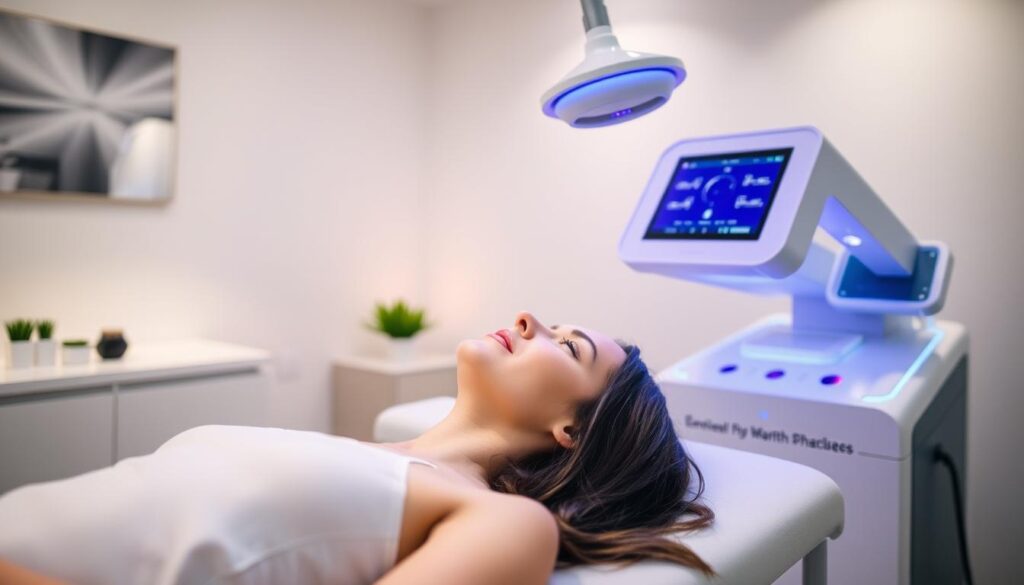
Extracorporeal Shock Wave Therapy (ESWT) offers a non-invasive solution for chronic musculoskeletal pain. Since 1980, shockwave therapy has transformed pain management approaches. This innovative technique stimulates your body’s natural healing processes, bringing hope to many1.
ESWT is gaining popularity among athletes, physical therapists, and medical professionals. It uses high-energy acoustic waves to target specific areas, promoting tissue repair. The therapy reduces inflammation and has FDA approval for conditions like plantar fasciitis2.
ESWT sessions are quick, lasting only 5 to 15 minutes. This efficient approach tackles chronic pain effectively. It addresses challenging musculoskeletal issues that often resist traditional treatments12.
Key Takeaways
- ESWT is a non-invasive pain relief treatment
- Effective for multiple musculoskeletal conditions
- FDA-approved for specific orthopedic treatments
- Quick treatment sessions lasting 5-15 minutes
- Stimulates natural healing processes
Understanding Extracorporeal Shock Wave Therapy
Shock Wave Treatment is a modern way to manage pain and heal tissues. It uses sound waves to boost the body’s natural healing process3.
What Is ESWT and How It Works
ESWT sends high-energy sound waves to injured areas. These waves create tiny injuries, which trigger the body to heal itself.
This process increases blood flow and forms new blood vessels. As a result, it reduces swelling and helps tissues heal faster4.
- Stimulates cellular regeneration
- Reduces chronic pain
- Enhances tissue healing
Types of Shock Wave Therapy
Two main types of Shockwave Therapy exist:
- Focused ESWT: Delivers precise acoustic waves with deeper tissue penetration
- Radial ESWT: Covers larger surface areas with shallower penetration
Historical Development and FDA Approval
Scientists started studying ESWT’s healing powers in the 1990s and early 2000s3. In 2000, the FDA approved ESWT for treating plantar fasciitis.
ESWT represents a breakthrough in non-invasive treatment strategies for chronic pain management.
Scientists keep finding new uses for ESWT. It’s proving useful for many bone, muscle, and nerve problems3.
Benefits and Clinical Applications for Pain Management
Extracorporeal Shock Wave Therapy (ESWT) has transformed pain management for many musculoskeletal conditions. This innovative treatment offers remarkable benefits that can change how we approach chronic pain5. Practitioners use Shockwave Therapy in various medical fields5.
ESWT has impressive clinical applications for pain relief. It can significantly improve several conditions.
- Shoulder tendinopathy
- Lateral epicondylosis
- Greater trochanteric pain syndrome
- Patellar tendinopathy
- Achilles tendinopathy
- Plantar fasciitis
- Knee osteoarthritis
ESWT’s non-invasive nature makes it compelling. Patients often feel less pain and move better right away6. Most treatments take three to four weeks.
Many people feel much better after just one session6. This therapy helps those with stubborn injuries that other treatments couldn’t fix.
Shockwave therapy increases cell activity by stimulating the synthesis of biomolecules, primarily adenosine triphosphate (ATP)7.
Your doctor can tell if this therapy is right for you6. Pro athletes and medical teams love ESWT for its fast, effective results.
Shockwave therapy has few side effects. It might help you avoid surgery. This makes it a promising way to manage chronic pain5.
Conclusion
Extracorporeal shock wave therapy (ESWT) is a game-changer in pain management. It shows incredible promise for chronic musculoskeletal conditions. Researchers are finding new ways to use this evolving technology3.
ESWT can transform your pain management journey. Scientific research backs its ability to ease pain and boost healing. Studies show it works for knee osteoarthritis and soft tissue injuries89.
The future of shockwave therapy looks bright. Ongoing research is exploring new uses for this treatment. Expect more targeted and personalized approaches as doctors refine the technology3.
Shock wave therapy leads the way in pain management innovation. Look forward to advanced treatments that offer hope. These may improve your quality of life and healing potential8.
FAQ
What is Extracorporeal Shock Wave Therapy (ESWT)?
ESWT is a non-invasive treatment using high-energy acoustic waves. It relieves pain and promotes healing in musculoskeletal conditions. ESWT stimulates natural healing, increases blood flow, and reduces inflammation.
How does Shock Wave Therapy work?
The therapy creates microtrauma in the tissue, triggering your body’s healing response. It boosts blood flow and promotes new blood vessel formation. This process reduces pain and speeds up tissue repair.
What types of Shock Wave Therapy exist?
There are two main types: Focused ESWT and Radial ESWT. Focused ESWT uses narrow waves that penetrate up to 12 cm deep. Radial ESWT delivers waves in a diffuse pattern, covering a larger area.
What conditions can ESWT treat?
ESWT effectively treats various conditions, including shoulder tendinopathy and tennis elbow. It also helps with plantar fasciitis, Achilles tendinopathy, and knee osteoarthritis. ESWT shows promise for bone disorders like delayed union fractures.
Is ESWT a painful treatment?
Most patients experience minimal discomfort during ESWT. Each session typically lasts 15-20 minutes and is done on an outpatient basis. Some might feel a mild tingling sensation during treatment.
What are the advantages of ESWT?
ESWT is non-invasive and has minimal side effects. It’s quick and often helps patients avoid more invasive procedures. Many experience significant pain relief after a series of treatments.
When was ESWT first developed?
ESWT was developed in Germany in the late 1960s and early 1970s. It was initially used for breaking down kidney stones. In the 1990s, it began being explored for musculoskeletal disorders.
How many treatments are typically required?
The number of treatments varies based on the condition and patient needs. Typically, patients undergo 3-5 sessions spaced about a week apart. Your provider will create a personalized treatment plan for you.
Source Links
- Extracorporeal Shock Wave Therapy for the Treatment of Musculoskeletal Pain: A Narrative Review – https://pmc.ncbi.nlm.nih.gov/articles/PMC10648068/
- What Is Extracorporeal Shockwave Therapy? – https://www.webmd.com/pain-management/what-is-extracorporeal-shockwave-therapy
- The evolving use of extracorporeal shock wave therapy in managing musculoskeletal and neurological diagnoses – https://www.mayoclinic.org/medical-professionals/physical-medicine-rehabilitation/news/the-evolving-use-of-extracorporeal-shock-wave-therapy-in-managing-musculoskeletal-and-neurological-diagnoses/mac-20527246
- Extracorporeal shock wave therapy: an update – https://pmc.ncbi.nlm.nih.gov/articles/PMC7608508/
- What Is Shockwave Therapy? – https://www.webmd.com/pain-management/what-is-shockwave-therapy
- Shockwave therapy can help those who have chronic injuries – https://www.uchealth.org/today/shockwave-therapy-can-help-those-who-have-chronic-injuries/
- Use of the Shock Wave Therapy in Basic Research and Clinical Applications—From Bench to Bedsite – https://pmc.ncbi.nlm.nih.gov/articles/PMC8944950/
- Extracorporeal shockwave therapy in musculoskeletal disorders – Journal of Orthopaedic Surgery and Research – https://josr-online.biomedcentral.com/articles/10.1186/1749-799X-7-11
- Effectiveness of extracorporeal shock wave therapy on functional ability in grade IV knee osteoarthritis – a randomized controlled trial – Scientific Reports – https://www.nature.com/articles/s41598-024-67511-x

