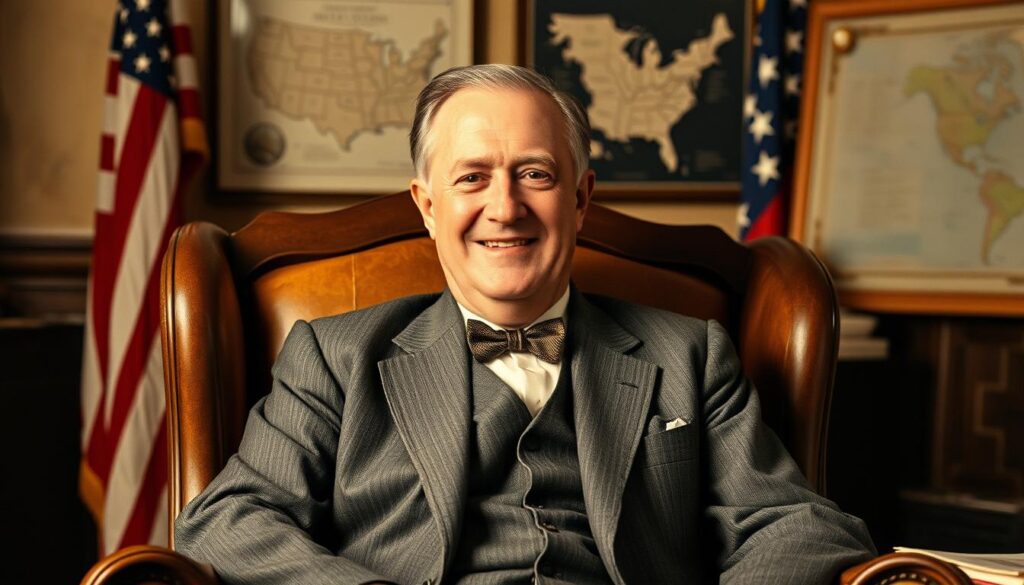
Franklin D. Roosevelt was the 32nd President of the United States. He was born in 18821 and served until his death in 19452. He led the country through the Great Depression and World War II. His New Deal helped tackle the economic crisis.
As President, Roosevelt was key in shaping America’s response to these crises. His leadership left a lasting mark on American history.
His presidency was filled with significant events. He was elected in November 19321 and re-elected in 19361 and 19402. He was the only president to serve more than two terms2. His leadership greatly influenced the New Deal and other important laws.
Key Takeaways
- Franklin D. Roosevelt was the 32nd President of the United States, serving from 1933 to 19452.
- He led the country through the Great Depression and World War II, implementing the New Deal to address economic turmoil.
- Roosevelt was born in 18821 and died on April 12, 194512.
- He was the only president to have served for more than two terms2.
- Franklin D. Roosevelt’s presidency had a lasting impact on American history, shaping the nation’s response to economic and global challenges.
- The New Deal, a series of programs and policies implemented by Roosevelt, played a critical role in addressing the Great Depression.
- Roosevelt’s leadership during World War II helped establish the United States as a global superpower.
Early Life and Background
Franklin D. Roosevelt was born into a life of luxury. He grew up in Hyde Park, New York. His family’s large estate was managed by many workers. This taught him about wealth and responsibility.
Family and Childhood Influences
Roosevelt was born on January 30, 1882. His parents were James and Sara Roosevelt. His mother was twenty-six years younger than his father3.
The Roosevelt family was known for its privilege and high expectations. His cousin, President Theodore Roosevelt, was a big influence. He showed Franklin the importance of public service and leadership.
Education and Early Interests
At fourteen, Roosevelt went to the prestigious Groton School. There, he started to develop his leadership skills and sense of duty4. He then went to Harvard University, graduating in three years with a history degree5.
At Harvard, Roosevelt became interested in politics and public affairs. This interest would shape his future political career.
Political Awakening
In 1910, Roosevelt was elected to the New York State Senate. He worked hard to solve social and economic problems. His efforts showed his commitment to helping Americans35.
Later, as Assistant Secretary of the Navy, Roosevelt learned more about politics. This experience prepared him for his future as president.
| Year | Event |
|---|---|
| 1882 | Born in Hyde Park, New York3 |
| 1896-1900 | Attended Groton School5 |
| 1900-1903 | Graduated from Harvard University5 |
| 1910 | Elected to New York State Senate3 |
| 1913-1920 | Served as Assistant Secretary of the Navy5 |
Presidency and Major Policies
Franklin D. Roosevelt’s time in office was filled with big changes. He launched the New Deal Programs to help the economy and support those in need.
The New Deal Programs
Roosevelt brought in several important New Deal Programs to fight the Great Depression. The Civilian Conservation Corps (CCC) gave jobs to over two million young men in environmental projects6. The Works Progress Administration (WPA) also created many jobs, helping the economy grow7.
The Social Security Act helped the elderly and those without jobs. It’s a program that helps Americans even today.
Foreign Policy Initiatives
Roosevelt worked hard to improve relations with Latin America through the Good Neighbor Policy. He also set the stage for alliances that were key in World War II. By building strong diplomatic ties and supporting trade, he aimed to make the United States a world leader.
Response to World War II
During World War II, Roosevelt led the country with great skill. The Lend-Lease Act helped the Allies a lot6. The Manhattan Project was a big step towards ending the war7.
Roosevelt kept in touch with the people through his Fireside Chats. He shared his plans and brought the nation together.
Legacy and Impact on America
Franklin D. Roosevelt changed the United States in big ways. He left a mark on its social, economic, and political scenes.
Social and Economic Reforms
Roosevelt’s New Deal programs were key in fixing the economy during the Great Depression. Programs like Social Security and labor laws created a safety net for millions. These efforts not only helped right away but also built a fairer society. His policies continue to shape American life8.
Influence on Future Presidents
FDR set a high standard for presidents, growing the government’s role and using media well in his “fireside chats.” Later presidents followed and changed his ways of leading and handling crises. This shows how much he influenced the presidency9.
Commemoration and Cultural References
Roosevelt is remembered through many memorials, museums, and cultural works. These celebrate his contributions and leadership. His legacy is often talked about in discussions on American strength and leadership. This shows the respect and recognition he holds in the nation’s memory10.
FAQ
Who was Franklin D. Roosevelt and why is he significant in American history?
A: Franklin D. Roosevelt was the President of the United States from 1933 to 1945. He is known for leading the country through the Great Depression and World War II. His innovative policies and Fireside Chats have greatly influenced American politics and society.
What were the key components of Roosevelt’s New Deal programs?
The New Deal was a series of reforms to help during the Great Depression. It included the Civilian Conservation Corps (CCC), Works Progress Administration (WPA), and Social Security Act. These programs aimed to restore confidence and stability in the economy.
How did Franklin D. Roosevelt address the challenges of the Great Depression?
Roosevelt introduced the New Deal to tackle the Great Depression. He created jobs through public works, reformed the banking system, and introduced Social Security. His efforts helped revive the economy and boost public confidence.
What role did Roosevelt play in World War II?
Roosevelt played a key role in World War II as President. He supported the Lend-Lease Act and led major wartime initiatives like the Manhattan Project. His leadership was vital to the Allied victory and the rise of the United States as a global power.
What were Roosevelt’s Fireside Chats and how did they impact his presidency?
The Fireside Chats were radio talks by Roosevelt to connect with the public. He discussed important issues and explained government policies. These chats built trust and strengthened his leadership.
What are the Four Freedoms articulated by Roosevelt?
In 1941, Roosevelt spoke about the Four Freedoms in his State of the Union address. These were Freedom of Speech, Freedom of Worship, Freedom from Want, and Freedom from Fear. This vision guided American foreign policy and influenced the United Nations.
How did Roosevelt’s policies influence future American presidents?
Roosevelt’s policies expanded the government’s role in the economy and society. His New Deal programs and Social Security set precedents for future presidents. They have shaped American politics and governance ever after.
What is Franklin D. Roosevelt’s lasting legacy in American society?
Roosevelt’s legacy includes the New Deal reforms and Social Security. His leadership during crises and the Four Freedoms continue to influence American values. His impact is seen in memorials, museums, and popular culture, making him a significant president in U.S. history.
Source Links
- https://www.whitehouse.gov/about-the-white-house/presidents/franklin-d-roosevelt/ – Franklin D. Roosevelt | The White House
- https://en.wikipedia.org/wiki/Franklin_D._Roosevelt – Franklin D. Roosevelt
- https://millercenter.org/president/fdroosevelt/life-before-the-presidency – Franklin D. Roosevelt: Life Before the Presidency | Miller Center
- https://www.history.com/news/fdr-childhood-early-life – Inside FDR’s Isolated Childhood—and Privileged Upbringing | HISTORY
- https://www.fdrlibrary.org/fdr-biography – FDR Biography – FDR Presidential Library & Museum
- https://millercenter.org/president/franklin-d-roosevelt/key-events – Franklin D. Roosevelt – Key Events | Miller Center
- https://millercenter.org/president/fdroosevelt/domestic-affairs – Franklin D. Roosevelt: Domestic Affairs | Miller Center
- https://www.britannica.com/biography/Franklin-D-Roosevelt – Franklin D. Roosevelt | Biography, Accomplishments, New Deal, Great Depression, World War II, & Facts | Britannica
- https://millercenter.org/president/fdroosevelt/impact-and-legacy – Franklin D. Roosevelt: Impact and Legacy | Miller Center
- https://www.nationalww2museum.org/war/articles/interview-nigel-hamilton-fdr – The Leadership, Death, and Legacy of Franklin D. Roosevelt | The National WWII Museum | New Orleans