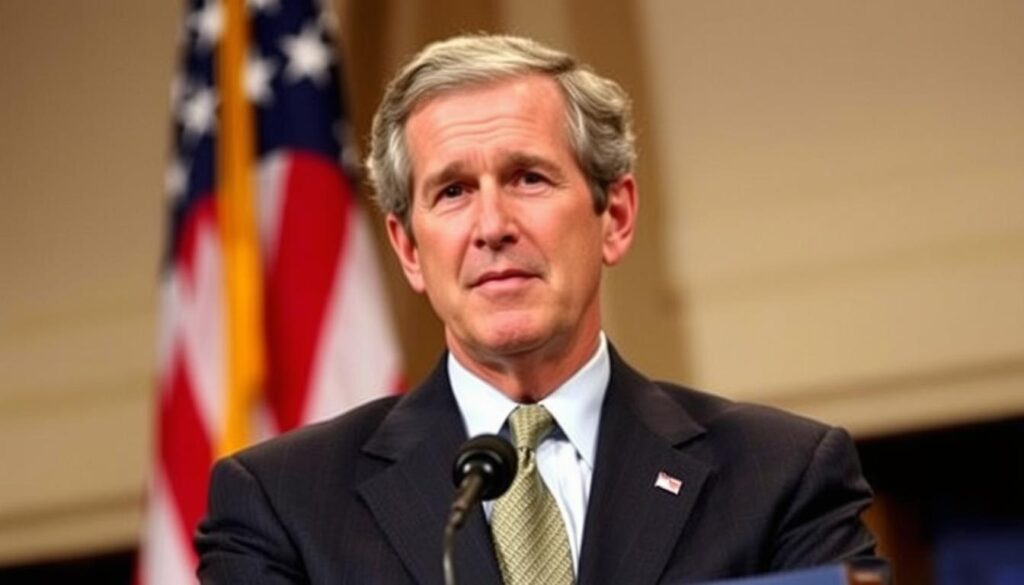
George W. Bush was the 43rd President of the United States, serving from 2001 to 20091. He belonged to the Republican Party and was part of the Bush family. His father, George H. W. Bush, was the 41st U.S. President1. As President, he introduced tax cuts and the No Child Left Behind Act1.
Born on July 6, 1946, in New Haven, Connecticut, Bush went to Yale University. He then got an MBA from Harvard Business School in 19751. Before becoming President, he was the 46th Governor of Texas from 1995 to 20001.
As the 43rd President, George W. Bush was key in the U.S. response to the 9/11 attacks2. He created the Department of Homeland Security and sent troops to Afghanistan to fight the Taliban2. He also cut taxes and won re-election in 2004, beating Senator John Kerry2. He was first sworn in on January 20, 2001, and later served as Texas’s 46th Governor3.
Key Takeaways
- George W. Bush was the 43rd President of the United States, serving from 2001 to 20091.
- He was a member of the Republican Party and the Bush family1.
- Bush implemented policies such as tax cuts and the No Child Left Behind Act1.
- He was the 46th Governor of Texas from 1995 to 20001.
- Bush played a significant role in shaping the country’s response to the 9/11 terrorist attacks2.
- He was re-elected in 2004, defeating Senator John Kerry with 51% of the votes2.
Early Life and Education
George Bush Jr. was born on July 6, 1946, in New Haven, Connecticut. He was the eldest of six children4. His family later moved to Midland and then Houston, Texas, where he went to public school5.
Childhood and Family Background
George W. Bush grew up in a well-known family. They valued education and public service6. His early years in Texas helped shape his character and sense of responsibility.
Academic Pursuits
Bush went to Phillips Academy in Andover, Massachusetts, from 1961 to 1964. He played baseball and was the head cheerleader5. He also did well in school, earning a Bachelor of Arts in History from Yale University in 19686.
Later, he got an MBA from Harvard Business School in 1975. This made him the only U.S. president with an MBA5.
Formation of Political Ideologies
At Yale and Harvard, Bush formed his conservative views. His family’s politics and his business and military experiences influenced him4. These years were key in shaping his political career and leadership style.
Political Career
George W. Bush’s political journey started long before he became President. His approach to governance and policy decisions prepared him for leading the United States.
Texas Governor
As Texas Governor from 1995 to 2000, Bush made big changes. He pushed for tort reform to make the legal system better7. He also increased education funding and set higher school standards7.
Bush improved the criminal justice system, making law enforcement stronger7. Texas became a leader in wind energy under his leadership7.
Presidency (2001-2009)
George W. Bush was the 43rd President from 2001 to 2009. He won the 2000 election, despite losing the popular vote8. His presidency was marked by key events like the 9/11 attacks8.
He declared war on terrorism, creating the Department of Homeland Security8. He also invaded Afghanistan and Iraq8. Bush cut taxes, continued education reform, and handled Hurricane Katrina8.
His approval ratings changed, peaking after 9/11 and dropping during the Iraq War and financial crisis8.
Post-Presidency Activities
After leaving office, George W. Bush stayed busy. He worked on global health, fighting diseases like HIV/AIDS7. He also painted, reflecting on his experiences7.
Bush supported veterans and education through his foundation7. His post-presidency has been marked by service and personal growth.
Major Policies and Achievements
The George W. Bush administration made many important policies. These policies have had a big impact on the United States and the world.
Education Reform: No Child Left Behind
The No Child Left Behind Act was a key initiative. It aimed to make sure all American kids could read and do math well by 2013-20149. This law brought in standardized tests and made schools more accountable. It tried to close the gap in education and improve schools everywhere.
Foreign Policy Decisions: Iraq and Afghanistan
After the September 11 attacks, the administration started the War on Terror. This led to wars in Iraq and Afghanistan1011. They also created the Department of Homeland Security to make the country safer10. These moves changed global politics and had big effects on international relations.
Economic Impact and Financial Policies
The administration cut taxes by $4 trillion over ten years to boost the economy9. These policies led to strong economic growth. Unemployment fell from 6.3% in 2003 to 4.7% by 20079. Homeownership rates also hit new highs, and the stock market saw big gains.
| Policy | Implementation | Impact |
|---|---|---|
| No Child Left Behind Act | Standardized testing and accountability measures | Aimed to improve educational outcomes for all students9 |
| Tax Cuts | Three major tax cuts totaling $4 trillion over a decade | Stimulated economic growth and reduced unemployment rates9 |
| War on Terror | Military interventions in Iraq and Afghanistan | Enhanced national security but led to prolonged conflicts1011 |
| Department of Homeland Security | Established to consolidate federal security agencies | Improved coordination and response to national threats10 |
Legacy and Public Perception
George W. Bush’s presidency is a topic of much debate. His time in office was filled with key events that have shaped his legacy.
Challenges Faced During Presidency
After the September 11 attacks, Bush played a key role in uniting the nation. He reached a high approval rating of 90 percent12. But, the Iraq War and the 2008 financial crisis posed big challenges. These issues led to a drop in public support later on12.
Public Opinion Over Time
At first, Bush had high approval ratings, but they changed with economic downturns12. Over time, opinions have softened. Many now see his presidency more positively in hindsight. Scholars rank him in the lower half of U.S. presidents, showing ongoing debates about his impact.
Contributions to Art and Global Health
After leaving office, Bush took up painting. It gives a peek into his life after the presidency. He also works on global health initiatives. This shows his ongoing dedication to public service and helping others.
FAQ
Who is George W. Bush?
George W. Bush was the 43rd President of the United States. He served from 2001 to 2009. He is the son of former President George H. W. Bush. He played a big role in American politics during his time in office.
What were the key achievements of the George W. Bush administration?
The George W. Bush administration made big moves. They passed the No Child Left Behind Act. They also created the Department of Homeland Security. And they started the President’s Emergency Plan for AIDS Relief (PEPFAR).
They made big decisions in foreign policy too. This included the wars in Iraq and Afghanistan.
How did George W. Bush’s early life influence his presidency?
George W. Bush grew up in Texas. Being part of the Bush family helped him learn leadership. He went to Yale and Harvard Business School.
His sports and activities shaped his conservative views. This helped him in governing.
What were the major challenges faced during George W. Bush’s presidency?
George W. Bush faced big challenges. The September 11 attacks were a major one. The War on Terror followed.
He also invaded Iraq and dealt with the 2008 financial crisis. These events affected his policies and international relations.
What post-presidency activities has George W. Bush been involved in?
After leaving office, George W. Bush got involved in global health. He worked through PEPFAR. He also painted.
He remembered his presidency and talked about national and international issues.
How has public perception of George W. Bush’s presidency evolved over time?
People’s views on George W. Bush’s presidency changed. At first, they supported him, like after 9/11. But then, they criticized him for the Iraq War and Hurricane Katrina.
Now, historians and analysts see both his good and bad points.
What educational reforms did George W. Bush implement during his tenure?
George W. Bush focused on education. He passed the No Child Left Behind Act. It aimed to make schools better.
It made schools accountable and tested students more. It also helped schools be fair for everyone.
How did George W. Bush’s foreign policy decisions impact global politics?
George W. Bush’s foreign policy changed the world. He invaded Iraq and Afghanistan. These actions caused long wars.
They changed alliances and affected stability and security worldwide.
What economic policies did George W. Bush implement, and what were their effects?
George W. Bush had big economic plans. He cut taxes and made financial rules. These moves were meant to boost the economy.
But they also sparked debates on money management and the economy’s future.
In what ways has George W. Bush contributed to global health initiatives?
George W. Bush helped global health a lot. He started PEPFAR. It has helped millions with HIV/AIDS worldwide.
His work shows his dedication to solving global health problems.
Source Links
- https://en.wikipedia.org/wiki/George_W._Bush – George W. Bush
- https://www.whitehouse.gov/about-the-white-house/presidents/george-w-bush/ – George W. Bush | The White House
- https://georgewbush-whitehouse.archives.gov/president/biography.html – Biography of President George W. Bush
- https://www.britannica.com/biography/George-W-Bush – George W. Bush | Biography, Presidency, & Facts | Britannica
- https://www.georgewbushlibrary.gov/bush-family/george-w-bush – George W. Bush | George W. Bush Library
- https://en.wikipedia.org/wiki/Early_life_of_George_W._Bush – Early life of George W. Bush
- https://millercenter.org/president/gwbush/life-before-the-presidency – George W. Bush: Life Before the Presidency | Miller Center
- https://en.wikipedia.org/wiki/Presidency_of_George_W._Bush – Presidency of George W. Bush
- https://millercenter.org/president/gwbush/domestic-affairs – George W. Bush: Domestic Affairs | Miller Center
- https://georgewbush-whitehouse.archives.gov/infocus/achievement/index.html – Record of Achievement – Introduction
- https://georgewbush-whitehouse.archives.gov/infocus/ – Policies and Initiatives
- https://millercenter.org/president/gwbush/impact-and-legacy – George W. Bush: Impact and Legacy | Miller Center