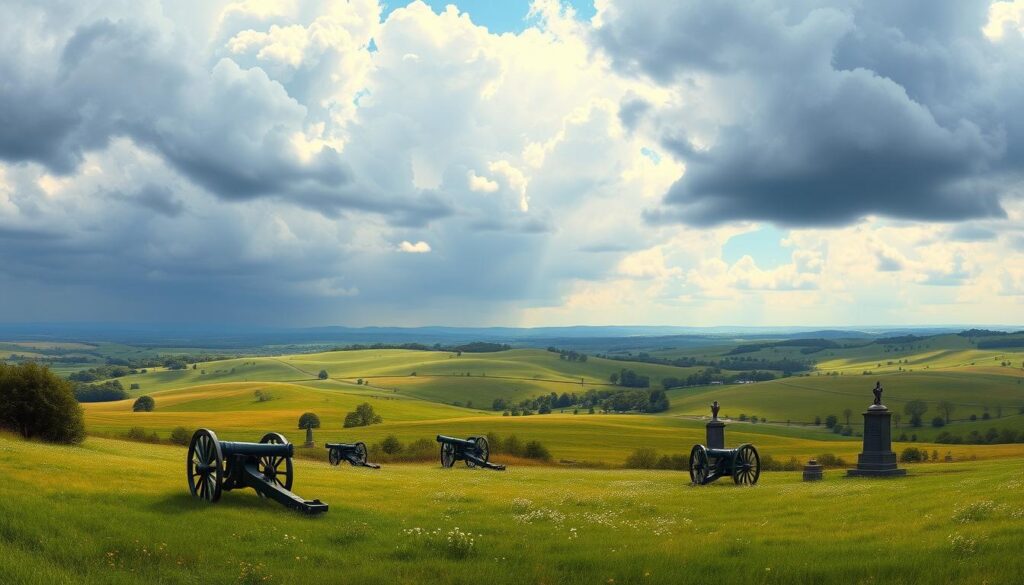
The Battle of Gettysburg was a key event in the American Civil War. It happened from July 1–3, 1863, in and around Gettysburg, Pennsylvania. It is seen as a turning point in the war1.
This battle was a major fight in the American Civil War. It took place on the Gettysburg battlefield. It is known for its importance in American history.
The battle saw between 46,000 to 51,000 casualties from both sides. This made it the most costly battle in U.S. history1. The Union had 93,500–104,256 troops, 360 artillery pieces, and 36 cavalry regiments2.
The Battle of Gettysburg lasted from July 1 to July 3, 18633. It was fought 35 miles southwest of Harrisburg, Pennsylvania3. This made it a key event in the Gettysburg Civil War and the history of the Gettysburg battlefield.
Key Takeaways
- The Battle of Gettysburg was a turning point in the American Civil War.
- The battle occurred from July 1–3, 1863, in and around the town of Gettysburg, Pennsylvania.
- The Gettysburg battlefield was the site of the most costly battle in U.S. history.
- The Union and Confederate forces suffered between 46,000 to 51,000 casualties.
- The battle was a significant event in the Gettysburg Civil War and American history.
- The Gettysburg Civil War and the Battle of Gettysburg are widely studied and remembered as key moments in American history.
- The battle’s significance goes beyond the Gettysburg battlefield. It impacts the nation’s understanding of the Civil War and its legacy.
Overview of the Battle of Gettysburg
The Battle of Gettysburg was a key moment in the American Civil War. It was the bloodiest battle and a turning point for the Union.
Historical Context of the Civil War
By mid-1863, the Civil War had spread across the nation. The Union had 34 states, while 11 states had seceded to form the Confederacy4. General Robert E. Lee wanted to invade the North. He hoped to change the war’s direction and get foreign support for the Confederacy.
Key Dates and Events of the Battle
- July 1, 1863: The first clashes happened as Confederate forces met Union troops near Gettysburg.
- July 2, 1863: Fighting was intense, with over 9,000 casualties on each side5.
- July 3, 1863: Pickett’s Charge led to heavy losses for the Confederacy4.
The Gettysburg National Military Park keeps these historic sites alive. It lets visitors see where important decisions were made.
Significance in American History
The Union won at Gettysburg, stopping Lee’s invasion and causing heavy losses for the Confederacy. About 28,000 Confederate soldiers were lost5. This victory changed the war’s direction and boosted Northern morale.
After the battle, the Gettysburg museum was set up. It’s a place for education and remembering4.
| Army | Number of Soldiers | Casualties |
|---|---|---|
| Union Army of the Potomac | 75,000 | ≈23,000 |
| Confederate Army of Northern Virginia | 75,000 | ≈28,000 |
| Total Casualties | ≈51,000 | |
Key Figures Involved
The Battle of Gettysburg was shaped by the strategic minds and brave hearts of its key figures. Their decisions and actions not only influenced the battle’s outcome but also left a lasting legacy in American history.
Union Leadership: George Meade and Others
General George G. Meade led the Union Army of the Potomac with determination. Born on December 31, 1815, in Cadiz, Spain, Meade graduated from West Point, ranking 19th in his class6. He took command just days before the battle and successfully repelled Pickett’s Charge, demonstrating his effective leadership6.
Other notable Union generals included John Buford, who played a key role in the initial defense. Winfield Scott Hancock was known for his steadfast presence on Cemetery Ridge. John Reynolds’ leadership on the first day was also critical, before his untimely death7.
Confederate Leadership: Robert E. Lee and Associates
Confederate General Robert E. Lee led his troops with strategic brilliance. His commanders, such as James Longstreet and Richard S. Ewell, executed timely attacks that initially pressured Union lines7. General George Pickett’s ill-fated charge became a defining moment of the battle, symbolizing the high cost of Confederate ambitions7.
Other key figures like Ambrose Powell Hill opened the battle on July 1st. He took part in the major assault on the third day, while J.E.B. Stuart’s delayed arrival affected the Confederate coordination7
Notable Soldiers and Their Contributions
Individuals such as Col. Edward P. Alexander, who commanded artillery during Pickett’s Charge, and Brig. General Lewis Armistead, who was wounded during the assault, showcased remarkable bravery7. Col. William C. Oates and his regiment’s defense of Little Round Top was critical in maintaining Union positions7.
The experiences of these soldiers are often highlighted in Gettysburg tours, providing personal perspectives that bring the battle’s human element to life. President Abraham Lincoln’s later visit and his Gettysburg Address connected the battle’s sacrifices to the nation’s enduring values.
| Figure | Role | Contribution |
|---|---|---|
| George G. Meade | Union General | Led Union forces to victory, repelled Pickett’s Charge6 |
| Robert E. Lee | Confederate General | Strategic leadership, led major assaults7 |
| John Buford | Union General | Secured initial defensive positions7 |
| James Longstreet | Confederate General | Bore the brunt of fighting, executed key attacks7 |
| Lewis Armistead | Confederate Brig. General | Led charge, wounded and captured7 |
The Battle Tactics and Strategies
The Battle of Gettysburg was a clash of detailed strategies on the Gettysburg battlefield. The Union army used defensive tactics, taking advantage of high ground.
Overview of Union Strategies
The Union army focused on keeping key spots like Cemetery Hill and Little Round Top. This strategy helped limit Confederate movements. It also used artillery well to fight off attacks.
Confederate Strategies and Maneuvers
General Lee’s Confederate forces aimed to break through the Union lines with bold attacks. Pickett’s Charge was a key example, a large infantry push against the Union center on the third day.
Analysis of the Battle’s Outcomes
The Union’s defensive strategy won the battle, stopping the Confederates from reaching their goals on the Gettysburg Civil War field. Pickett’s Charge showed the risks of attacking strongly8.
| Aspect | Union | Confederate |
|---|---|---|
| Cannons Used | 360 Union cannons | 270 Confederate cannons9 |
| Cannon Types | Rifled and smoothbore | Rifled and smoothbore |
| Infantry Regiments | ~350 officers and men per regiment | ~350 officers and men per regiment |
| Total Casualties | Over 50,000 soldiers dead or wounded | Over 50,000 soldiers dead or wounded8 |
Legacy and Commemoration
The Battle of Gettysburg has deeply influenced American culture and history. President Abraham Lincoln’s dedication of the Gettysburg National Cemetery on November 19 is a key moment. It helped redefine the nation’s purpose10.
Impact on American Culture and Memory
Lincoln’s Gettysburg Address is a key part of American speech. It talks about unity and freedom. The battle’s story is told in many ways, teaching future generations.
Gettysburg National Cemetery
The Gettysburg National Cemetery honors Union soldiers who died. It is a quiet reminder of their sacrifices. Every year, almost a million people visit10.
Annual Reenactments and Educational Programs
Gettystadgh National Military Park is key in keeping the battlefield alive. It has over 1,328 monuments and memorials10. The park holds reenactments and living history events. These let visitors connect with history.
Gettysburg is a top tourist spot, with many hotels for visitors. Efforts to preserve the battlefield keep its legacy alive10.
FAQ
What was the significance of the Battle of Gettysburg in the Civil War?
The Battle of Gettysburg was a key moment in the Civil War. It was the first big loss for Confederate General Robert E. Lee’s army. This win for the Union stopped the Confederate push into the North and lifted Union spirits, changing the war’s course.
Why did General Robert E. Lee decide to invade the North?
General Robert E. Lee wanted to win a big battle in the North. He hoped this would get more support for the Confederacy, disrupt Union supplies, and maybe get help from Europe. His invasion led to the important fight at Gettysburg.
Who was General George G. Meade and what was his role in the Battle of Gettysburg?
General George G. Meade was chosen to lead the Union Army of the Potomac just before the battle. He made key decisions on where to place troops and defend important spots, like Little Round Top. His efforts were key to the Union’s win at Gettysburg.
What is the Gettysburg National Military Park?
The Gettysburg National Military Park is a place to see the battlefield. It lets visitors see where important events happened. It’s also a big learning spot, showing the battle’s strategies and what soldiers went through.
What can visitors expect when touring the Gettysburg museum?
The Gettysburg museum has lots of exhibits on the Battle of Gettysburg. You can see artifacts, interactive displays, and stories of soldiers. It helps visitors understand the battle’s importance and its lasting effect on American history.
What was the Gettysburg Address and why is it important?
The Gettysburg Address was a speech by President Abraham Lincoln at the Gettysburg National Cemetery. It talked about freedom and equality. It’s one of the most famous speeches in American history, showing the country’s unity and purpose.
How can I participate in Gettysburg tours?
Gettysburg tours are guided walks over the battlefield, led by historians. They share stories of the battle, strategic moves, and soldier experiences. These tours help visitors learn more about this historic site.
What accommodations are available for visitors to Gettysburg?
Gettysburg has hotels from old inns to new places to stay. These hotels are close to the battlefield, museums, and educational programs. They make it easy for visitors to explore Gettysburg.
Why is Gettysburg considered a major tourist destination today?
Gettysburg draws millions each year because of its history, preserved battlefield, and educational resources. Its historical value, engaging tours, and events make it a top spot for history lovers.
How have annual reenactments contributed to the legacy of the Battle of Gettysburg?
Reenactments and living history programs at Gettysburg make the battle come alive. They let people today see and join in historical events. These activities help people understand and honor the sacrifices made, keeping the battle’s memory alive for the future.
Source Links
- Battle History | Gettysburg PA – https://www.gettysburgpa.gov/history/slideshows/battle-history
- Battle of Gettysburg – https://en.wikipedia.org/wiki/Battle_of_Gettysburg
- Battle of Gettysburg | Summary, History, Dates, Generals, Casualties, & Facts | Britannica – https://www.britannica.com/event/Battle-of-Gettysburg
- Gettysburg Overview – Gettysburg National Military Park (U.S. National Park Service) – https://www.nps.gov/gett/learn/historyculture/gettysburg-overview.htm
- Battle of Gettysburg: Summary, Facts & Casualties | HISTORY – https://www.history.com/topics/american-civil-war/battle-of-gettysburg
- George G. Meade ‑ General, Civil War & Gettysburg | HISTORY – https://www.history.com/topics/american-civil-war/george-g-meade
- Confederate Commanders at Gettysburg – Gettysburg National Military Park (U.S. National Park Service) – https://www.nps.gov/gett/learn/historyculture/confederate-commanders-at-gettysburg.htm
- The Battle of Gettysburg: Hallowed Ground That Shaped the Civil War – https://thestrategybridge.org/the-bridge/2015/7/16/the-battle-of-gettysburg-hallowed-ground-that-shaped-the-civil-war
- NPS Historical Handbook: Gettysburg – https://www.nps.gov/parkhistory/online_books/hh/9/hh9j.htm
- Gettysburg tells the story of more than a battle • Pennsylvania Capital-Star – https://penncapital-star.com/pa-history-legacy/gettysburg-tells-the-story-of-more-than-a-battle/