
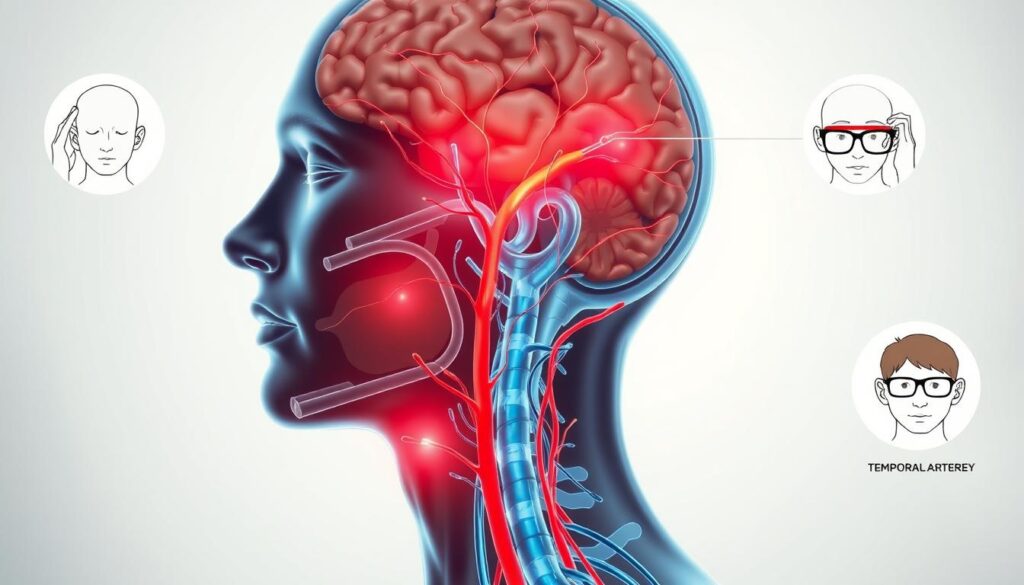
Giant cell arteritis (GCA) is a serious inflammatory condition affecting head arteries. It can greatly impact your health if left untreated. Early detection and management are crucial for better outcomes.
The risk of GCA increases after age 50. Most people experience symptoms between 70 and 80 years old. Women are twice as likely to develop GCA compared to men.
This disease mainly affects white populations of Northern European or Scandinavian descent1.
Temporal arteritis can cause severe headaches and scalp tenderness. Sudden, painless vision loss in one or both eyes is a critical warning sign. Seek immediate medical help if you experience this symptom.
Quick treatment with corticosteroids can manage symptoms effectively. It may also prevent permanent vision problems1.
Key Takeaways
- Giant cell arteritis primarily affects adults over 50
- Women have a higher risk of developing the condition
- Symptoms include severe headaches and potential vision loss
- Early detection and treatment are critical
- Corticosteroids can help manage symptoms effectively
Understanding Giant Cell Arteritis
Giant cell arteritis (GCA) is a complex inflammatory condition affecting arteries. It challenges both doctors and patients. GCA can cause inflammation and complications that significantly impact your health2.
The Mystery Behind Temporal Arteritis
The exact cause of cranial arteritis remains unclear. An abnormal immune response attacking artery walls may be responsible. Genetic factors play a crucial role in who gets the disease2.
- Genetic markers like HLA-DRB1*0401 are associated with increased risk
- Epigenetic modifications influence inflammatory responses
- Overexpression of specific microRNAs contributes to vascular inflammation
Risk Factors and Prevalence
Giant cell arteritis mainly affects specific groups of people. It’s most common in those over 50, especially women2. Studies show that 71.9% of GCA patients are female2.
| Risk Factor | Details |
|---|---|
| Age | Typically affects individuals 50-80 years old |
| Gender | Significantly more common in women |
| Ethnicity | Higher prevalence in Northern European populations |
Connection with Polymyalgia Rheumatica
Polymyalgia rheumatica has a unique link to giant cell arteritis. About 50% of GCA patients also have polymyalgia rheumatica symptoms3. On the flip side, 5-15% of PMR patients may develop GCA3.
“The intricate connection between GCA and PMR highlights the complexity of inflammatory conditions in aging populations.”
Knowing these links can help you and your doctor manage these tricky conditions. It allows for more focused treatment approaches for inflammatory issues in older adults.
Key Symptoms and Warning Signs
Giant Cell Arteritis (GCA) shows worrying symptoms that need quick action. Older Caucasian women face the highest risk. The main signs can greatly affect your life and cause serious problems.
- Severe headache, often concentrated in the temple area
- Scalp tenderness that makes even gentle touch painful
- Jaw claudication (pain when chewing)
- Unexpected fatigue and weight loss
- Vision changes or potential vision loss
Vision issues are very important. Sudden vision loss can be permanent if not addressed quickly. Most GCA patients have high inflammation, so early detection is key4.
The biggest worry is permanent blindness from artery damage4. Quick medical help can stop serious problems and save your sight.
Prompt medical intervention can prevent serious complications and preserve your vision.
Symptoms often grow slowly. About one-third of patients show unusual signs like unexplained fever4.
If you have lasting headaches, jaw pain, or sudden vision changes, see a doctor right away. Quick diagnosis and treatment can lower the risk of lasting damage5.
Treatment Options and Management Strategies
GCA management requires a comprehensive treatment approach. Your healthcare provider will create a personalized plan for this inflammatory condition. This strategy will address your unique challenges6.
Corticosteroid Therapy Fundamentals
Corticosteroid therapy is the main treatment for GCA. Prednisone is typically prescribed at high initial doses of 40-60 mg daily. The dosage is then slowly reduced over 1-2 years6.
This therapy aims to quickly control inflammation. It also prevents potential complications like vision loss.
Advanced Treatment Approaches
Scientists are exploring new treatments to reduce long-term corticosteroid side effects. Tocilizumab has emerged as a promising option for managing GCA6. It offers a targeted approach to treatment.
| Treatment Option | Primary Benefits | Potential Challenges |
|---|---|---|
| Prednisone | Rapid inflammation control | Significant side effects |
| Tocilizumab | Reduced steroid dependency | Newer treatment approach |
| Immunosuppressants | Alternative management | Limited clinical impact |
Managing Medication Side Effects
Corticosteroid therapy can cause various side effects. These may include osteoporosis, high blood pressure, and muscle weakness. Weight gain and mood changes are also possible.
- Osteoporosis
- High blood pressure
- Muscle weakness
- Weight gain
- Mood changes
Your doctor may suggest ways to lessen these challenges. These could include taking supplements and making lifestyle changes.
- Calcium and vitamin D supplements
- Bisphosphonates
- Regular exercise
- Healthy diet
- Routine medical check-ups
Managing GCA is a collaborative journey between you and your healthcare team.
Innovative therapies like tocilizumab continue to expand treatment options for patients with giant cell arteritis6.
Conclusion
Giant Cell Arteritis (GCA) management requires understanding and proactive healthcare. Early detection is vital to prevent serious complications, especially vision loss7.
Proper medical intervention can effectively control symptoms for most patients. Geriatric medicine research emphasizes tailored care strategies8. GCA mainly affects people over 50, with peak incidence between 70 and 79 years old8.
Your healthcare team will create a personalized treatment plan. This may include corticosteroid therapy, side effect monitoring, and regular check-ups. Collaborative care and staying informed are crucial for maintaining life quality7.
Living with GCA demands patience and resilience. Keep in touch with your doctors and track your symptoms. Your active involvement is essential for managing this condition and protecting your health8.
FAQ
What is Giant Cell Arteritis (GCA)?
Giant Cell Arteritis is an inflammatory condition affecting artery linings in the head and neck. It mainly impacts temple arteries, reducing blood flow to important tissues. GCA typically affects adults over 50, with women being more susceptible.
What are the main symptoms of Giant Cell Arteritis?
Primary symptoms include severe head pain, scalp tenderness, and jaw pain when chewing. Fever, fatigue, and unintended weight loss are also common. Vision problems can occur suddenly and may become permanent.
You might experience double vision or pain in the neck, shoulders, or hips. Seek medical help immediately if you notice these symptoms.
Who is most at risk for developing Giant Cell Arteritis?
Adults between 70-80 years old are at highest risk, especially white people of Northern European descent. Women are twice as likely to develop GCA compared to men.
Genetic predisposition and environmental triggers may also play a role in developing the condition.
How is Giant Cell Arteritis diagnosed?
Diagnosis involves clinical evaluation, blood tests, and imaging studies. Doctors check for characteristic symptoms and inflammatory markers in blood tests.
Imaging can examine artery inflammation. A temporal artery biopsy may provide definitive confirmation of the condition.
What is the primary treatment for Giant Cell Arteritis?
High-dose corticosteroids, typically prednisone, are the main treatment. The starting dose is 40-60 mg daily, gradually tapering over 1-2 years.
Tocilizumab (Actemra) was approved in 2017 as an additional treatment option. The goal is to control inflammation and prevent complications like vision loss.
Can Giant Cell Arteritis be cured?
While there’s no permanent cure, GCA can be effectively managed with proper treatment. Early diagnosis and prompt treatment usually lead to a good prognosis.
Ongoing monitoring and care are essential to manage potential flares and treatment side effects.
Is there a connection between Giant Cell Arteritis and Polymyalgia Rheumatica?
Yes, there’s a strong connection between GCA and Polymyalgia Rheumatica (PMR). About 50% of GCA patients also experience PMR symptoms.
Both conditions involve inflammation and can cause similar symptoms like pain and stiffness.
What are the potential side effects of GCA treatment?
Corticosteroid treatment can cause osteoporosis, high blood pressure, muscle weakness, and weight gain. Mood changes are also possible side effects.
Doctors may recommend supplements, medications, and lifestyle changes to manage these side effects. Regular exercise and a healthy diet can help mitigate them.
Source Links
- Giant cell arteritis – Symptoms and causes – https://www.mayoclinic.org/diseases-conditions/giant-cell-arteritis/symptoms-causes/syc-20372758
- Giant Cell Arteritis: Advances in Understanding Pathogenesis and Implications for Clinical Practice – https://pmc.ncbi.nlm.nih.gov/articles/PMC10855045/
- Giant Cell Arteritis – https://rheumatology.org/patients/giant-cell-arteritis
- Giant Cell Arteritis : Johns Hopkins Vasculitis Center – https://www.hopkinsvasculitis.org/types-vasculitis/giant-cell-arteritis/
- No title found – https://www.arthritis.org/diseases/giant-cell-arteritis
- Treatment of Giant Cell Arteritis (GCA) – https://pmc.ncbi.nlm.nih.gov/articles/PMC8999932/
- Giant cell arteritis: early diagnosis is key – https://pmc.ncbi.nlm.nih.gov/articles/PMC6340646/
- Giant Cell Arteritis (Temporal Arteritis) – StatPearls – https://www.ncbi.nlm.nih.gov/books/NBK459376/

