
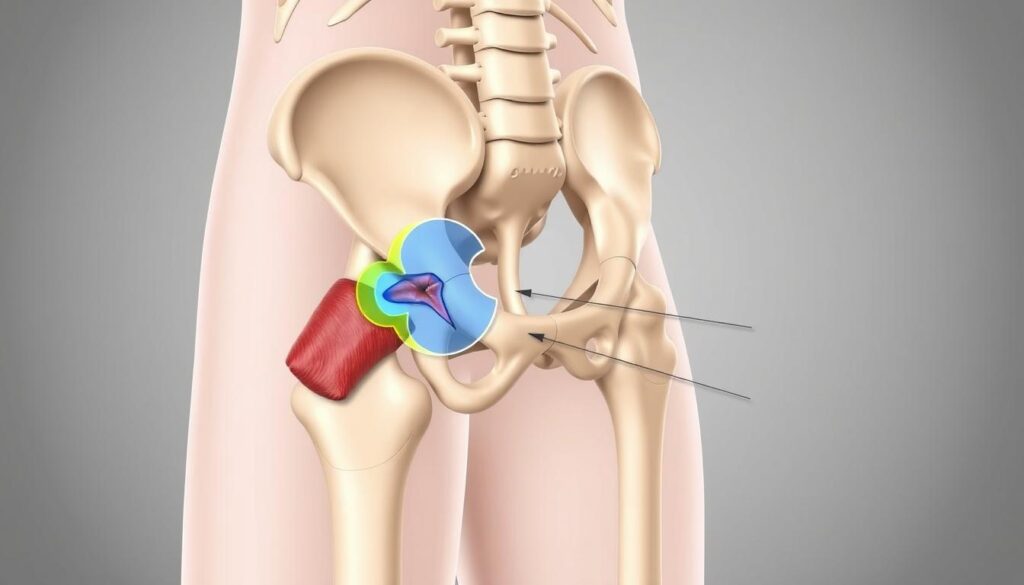
Hip labral tears can limit your mobility and affect your daily life. This injury impacts the cartilage in your hip socket, causing pain and restricting movement. Athletes and active people face a higher risk of this condition1.
These tears can result from repetitive motions, injuries, or hip impingement2. They often involve multiple hip joint structures, making them complex injuries3. Knowing the causes and symptoms is key for proper treatment.
Your hip health is crucial. Spotting signs of a labral injury early can lead to better outcomes. Athletes who frequently flex their hips, like runners and football players, are more vulnerable1.
Key Takeaways
- Hip labral tears can affect anyone, especially athletes
- Multiple factors contribute to labral tear development
- Early diagnosis improves treatment outcomes
- Treatment ranges from conservative methods to surgical intervention
- Recovery time varies based on injury severity
Understanding Hip Labral Tear and Its Impact on Joint Health
Your hip joint is complex. It includes bones, cartilage, and soft tissues. These parts work together for stability and movement. Knowing about hip health can help protect this vital joint.
The hip labrum is crucial for joint function. It protects your mobility. Athletes and active people are at risk for hip labral issues. These problems can affect their performance and life quality4.
What is a Hip Labrum?
The hip labrum is a cartilage ring. It surrounds the acetabular socket. This cartilage stabilizes the femoral head and ensures smooth motion. It maintains joint integrity and prevents damage during movement.
Types of Labral Tears
Hip labral tears can occur in different spots. Each type has specific features:
- Anterior (front) tears: Most common type of hip labral tear4
- Posterior (back) tears: Occur on the back of the hip joint4
Risk Factors and Common Causes
Several factors can lead to hip labral tears:
- Repetitive hip motions4
- Traumatic injuries4
- Structural hip problems like Femoroacetabular Impingement5
Some athletes face a higher risk of hip labral tears. These include hockey, soccer, ballet, and golf players5. People with hip issues like impingement or dysplasia are also at risk5.
“Prevention and early intervention are key to maintaining long-term hip joint health and preventing potential complications.”
Hip labral tears don’t heal on their own. However, various treatments exist. These include Hip Preservation Surgery and Hip Arthroscopy4. Talk to a doctor about managing Acetabular Labral Tears. They can help you keep your joints healthy.
Signs, Symptoms, and Diagnostic Approaches for Hip Labral Tear
Persistent hip discomfort may indicate a hip labral tear. Recognizing the signs and symptoms is crucial for prompt medical care6.
Hip labral tears can affect your daily life. Common symptoms include groin pain during movement and hip stiffness. You might also experience clicking sensations or instability while walking.
- Groin Pain during movement6
- Hip Stiffness limiting range of motion6
- Clicking or locking sensations in the hip joint6
- Instability while walking or running6
Athletes in soccer, ice hockey, and football face higher risks of these injuries67. Repetitive activities and hip abnormalities can also lead to labral tears7.
“Early recognition of symptoms is crucial for effective treatment” – Orthopedic Specialists
Doctors use several methods to diagnose hip labral tears. These include physical exams and imaging tests. Let’s look at the typical diagnostic approaches:
- Detailed physical examination comparing injured and uninjured hips6
- X-ray imaging to detect joint abnormalities6
- MRI scans for soft tissue visualization6
- Potential ultrasound-guided diagnostic injections7
Severe cases may require Hip Arthroscopy for diagnosis and treatment7. Treatment options vary based on the severity of your Hip Impingement67.
Conclusion
Understanding your hip labral tear is vital for effective treatment. This hip preservation surgery is complex and requires careful consideration of various factors8.
Your Labrum Injury journey may involve multiple treatment approaches. Hip labral tears affect 22-55% of patients with hip pain9. Early detection and personalized treatments can greatly improve outcomes10.
Hip labral tears can limit your mobility and life quality. Surgical options like arthroscopic procedures show promise. However, conservative treatments remain crucial8.
Team up with medical experts to understand your condition. This collaboration helps create a plan tailored to your hip pain and needs9.
Stay proactive in managing your joint health. Address your hip labral tear promptly. Your dedication can lead to better mobility and overall well-being.
FAQ
What is a hip labral tear?
A hip labral tear damages the cartilage lining the hip socket. This cartilage keeps the femoral head aligned and ensures smooth motion. Tears can result from repetitive motions, injuries, structural problems, or wear and tear.
What are the most common symptoms of a hip labral tear?
Common symptoms include pain in the hip, groin, or buttocks during movement. Hip stiffness and limited range of motion may also occur. Some people experience clicking or locking sensations in the hip joint.
Not everyone with a tear has symptoms. The severity and location of the tear affect symptom presentation.
What causes hip labral tears?
Several factors can cause hip labral tears. These include femoroacetabular impingement (FAI), repetitive hip motions, and traumatic injuries. Hip joint deformities like dysplasia and degenerative conditions such as osteoarthritis are also culprits.
Athletes in high-impact sports face a higher risk of developing these tears.
How are hip labral tears diagnosed?
Doctors use a comprehensive approach to diagnose hip labral tears. This includes a physical exam and X-rays to detect abnormalities. MRI scans provide better soft tissue visualization.
Sometimes, ultrasound-guided injections with painkillers help confirm the diagnosis.
What are the treatment options for a hip labral tear?
Treatment options range from conservative methods to surgical interventions. Non-surgical approaches include rest, activity changes, and over-the-counter medications. Physical therapy can also help manage symptoms.
For severe cases, doctors may recommend hip arthroscopy when conservative treatments don’t provide relief.
Can a hip labral tear heal on its own?
Hip labral tears don’t heal on their own. However, proper treatment can manage them effectively. The severity of the tear determines the best course of action.
Some find relief through conservative treatments, while others may need surgery.
Who is most at risk for hip labral tears?
Athletes in high-impact or repetitive motion sports face increased risk. These sports include ballet, golf, football, and hockey. People with structural hip problems like impingement or dysplasia are also more susceptible.
What types of labral tears exist?
There are two main types of hip labral tears: anterior (front) and posterior (back). The tear’s location affects symptoms and treatment approaches.
Source Links
- About Hip Labrum Tears and Injuries | Orthopedic Hip Service – https://www.hss.edu/condition-list_labral-tears-hip.asp
- Hip Labral Tear Folsom, CA – https://www.folsomortho.com/hip-labral-tear-orthopaedic-surgery-ca.html
- Hip labral tear-Hip labral tear – Diagnosis & treatment – Mayo Clinic – https://www.mayoclinic.org/diseases-conditions/hip-labral-tear/diagnosis-treatment/drc-20354878
- Hip Labral Tear – https://www.hopkinsmedicine.org/health/conditions-and-diseases/hip-labral-tear
- Hip labral tear-Hip labral tear – Symptoms & causes – Mayo Clinic – https://www.mayoclinic.org/diseases-conditions/hip-labral-tear/symptoms-causes/syc-20354873
- Hip Labral Tear: Symptoms & Treatment – https://www.massgeneralbrigham.org/en/patient-care/services-and-specialties/sports-medicine/conditions/hip/labral-tear
- Hip Labral Tears – https://www.pennstatehealth.org/services-treatments/hip-labral-tears
- Hip Labral Tears – Lake Charles, LA – Orthopedic Surgeon – https://casciosports.com/hip-conditions/hip-labral-tears/
- A comprehensive review of hip labral tears – https://pmc.ncbi.nlm.nih.gov/articles/PMC2697339/
- Diagnosis and treatment of labral tear – https://pmc.ncbi.nlm.nih.gov/articles/PMC6365273/

