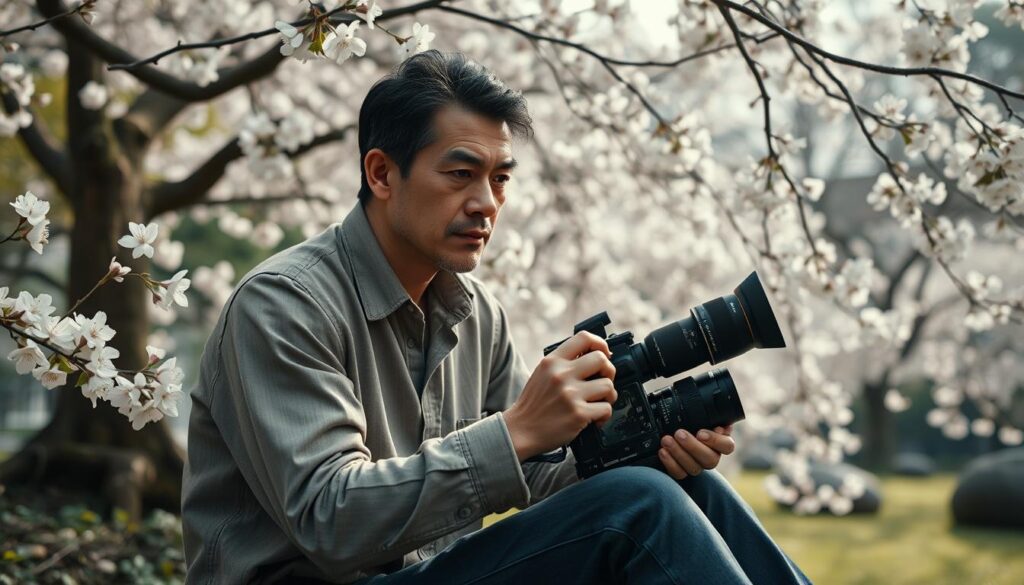
Hirokazu Kore-eda is a famous Japanese filmmaker known for his touching and human-focused stories. He has directed over a dozen films starting from 19911. His work in capturing human connections has greatly influenced Japanese cinema.
“Nobody Knows” (2004) won big in 2005, earning him the Blue Ribbon Awards for Best Film and Best Director1. This shows his skill as a filmmaker.
Kore-eda’s films show real life and deep character bonds2. He wrote most of his films, with “Monster” being an exception by Yuji Sakamoto2. His 2013 film “Like Father, Like Son” moved viewers deeply, proving his worth as a filmmaker.
Key Takeaways
- Hirokazu Kore-eda is a Japanese filmmaker known for his humanistic approach to storytelling.
- He has directed more than a dozen feature films, starting from 19911.
- Kore-eda’s film “Nobody Knows” (2004) won the Blue Ribbon Awards for Best Film and Best Director in 20051.
- His filmmaking style is characterized by a humanist and realist approach2.
- Kore-eda’s film “Like Father, Like Son” premiered in 2013 and was a quiet tour-de-force2.
- He won the Gold Hugo for Best Film at the Chicago International Film Festival for his debut feature Maborosi in 19953.
Introduction to Hirokazu Kore-eda
Hirokazu Kore-eda is a key figure in today’s cinema. He mixes storytelling with deep insights into human nature. His career shows his commitment to exploring life’s everyday moments.
Overview of His Career
Kore-eda started making films in 1995 with Maborosi. It won the Best Cinematography award at Venice4. He then made films like After the Storm (2016)5.
Like Father, Like Son won the Jury Prize at Cannes in 20135. In 2018, Shoplifters became the first Japanese film to win the Palme d’Or in over 20 years4.
Notable Themes in His Work
Kore-eda’s films explore family, memory, and human connections. He shows the beauty in everyday moments. His work is influenced by Japan’s aging population6.
He celebrates the lives of ordinary people through his films. This tradition is a big part of Japanese cinema6. His stories blend reality and fiction, making his characters relatable.
Early Life and Education
Hirokazu Kore-eda, a famous Japanese filmmaker, was born on June 6, 1962, in Nerima, Tokyo. He was the youngest of three siblings. From a young age, he loved telling stories.
Childhood Influences
Kore-eda spent hours watching movies with his mother. This sparked his love for cinema. Watching films early on shaped his storytelling skills7.
Formal Training in Film
In 1987, Kore-eda graduated from Waseda University. He studied literature and arts. His studies gave him a strong base in storytelling and visuals, which he uses in his films7.
| Year | Milestone |
|---|---|
| 1962 | Born in Nerima, Tokyo |
| 1987 | Graduated from Waseda University |
| Early Years | Developed passion for cinema through family influence |
Breakthrough with “Maborosi”
Hirokazu Kore-eda’s career soared with “Maborosi”. It was his first step into fiction filmmaking after documentaries. This film showed his talent for exploring deep emotions.
Plot Summary
“Maborosi” tells the story of Yumiko, a woman facing deep grief after her husband’s sudden death. The film looks at loss and the search for meaning. It’s a quiet but powerful story that touches many viewers.
Critical Reception
The film received high praise, winning the Golden Osella Award for Best Cinematography at the 1995 Venice Film Festival8. This achievement made Kore-eda a notable name in Japanese cinema. It highlighted his unique storytelling and deep character development98.
Exploration of Family Dynamics
Hirokazu Kore-eda dives deep into family relationships, showing both strength and weakness. His movies give us a close look at how families face challenges and the ties that keep them together.
“Nobody Knows” Analysis
“Nobody Knows” shows kids who must look out for themselves, highlighting their resilience. It brings to light the dark side of neglect in society10.
Impact of Family on Characters
In “Stil Walking,” Kore-eda looks at the complex ties between generations. He uncovers hidden tensions and deep feelings at a family gathering. This shows how family shapes who we are and our shared experiences11.
| Film | Awards | Impact on Family Portrayal |
|---|---|---|
| Shoplifters | Palme d’Or, Golden Globe Nomination | Highlights unconventional family bonds and societal margins1011, |
| Stil Walking | Best Director at 2009 Asian Film Awards | Explores intergenerational relationships and family tensions11 |
Celebrated Film: “Shoplifters”
“Shoplifters” is a shining example of Hirokazu Kore-eda’s skill in storytelling. This Palme d’Or winner at the Cannes Film Festival explores the lives of a family living on society’s edges.
Overview of the Story
The story revolves around a family of shoplifters who adopt a young girl. They face challenges as a makeshift family, living outside the law. Kore-eda shows how their bond keeps them strong, despite their tough circumstances.
Awards and Accolades
“Shoplifters” received widespread praise, winning the Palme d’Or at the Cannes Film Festival12. It was also nominated for an Academy Award for Best Foreign Language Film12. The film made $72.6 million worldwide, the highest among its Oscar nominees12.
- Released on May 15, 2018, at Cannes and June 9, 2018, in Japan12
- Box office earnings: ¥4.55 billion in Japan and $72,625,772 worldwide12
- Strong performance in China with $14 million12
- Most commercially successful nominee for the 2019 Academy Award for Best International Film12
Kore-eda’s ability to connect with his characters deeply resonated with viewers and critics alike13.
Themes of Memory and Loss
Hirokazu Kore-eda explores memory and loss in Stil Walking. He shows how past experiences shape family bonds and who we are.
Examination of “Stil Walking”
Stil Walking shows a family coming together. It reveals hidden tensions and unspoken sadness. The story is told in a way that lets viewers feel the characters’ emotions14.
The film won many awards, including Best Director at the 2009 Asian Film Awards. It also won the Golden Ástor for Best Film at the 2008 Mar del Plata International Film Festival14. These wins show Kore-eda’s skill in touching hearts through his stories of memory and loss.
How Memory Shapes Identity
Memory is key in shaping who Kore-eda’s characters are. In Stil Walking, looking back at the past shows how it shapes their lives today15. This idea is seen in many of Kore-eda’s films. Memories help us understand our place in family and society.
| Award | Year | Event |
|---|---|---|
| Best Director | 2009 | Asian Film Awards |
| Golden Ástor for Best Film | 2008 | Mar del Plata International Film Festival |
Collaborations with Actors
Hirokazu Kore-eda’s filmography stands out because of his work with actors. He teams up with both experienced stars and new faces. These partnerships are key to the films’ true feelings and deep emotions.
Notable Partnerships
Kore-eda has worked with many famous actors. They’ve helped tell his stories:
- Hiroshi Abe
- Kirin Kiki
- Song Kang-ho
- Lee Ji-eun
Each actor brings something special to the table. This makes the stories more real and touching16.
Impact on His Films
The connection between Kore-eda and his actors leads to performances that feel real. He trusts his actors to bring their characters to life. This makes his filmography feel more real and relatable.
As he works with different actors, his films grow more complex and true to life:
| Actor | Films Collaborated | Impact |
|---|---|---|
| Hiroshi Abe | “Maborosi”, “After Life” | Brings contemplative depth to characters |
| Kirin Kiki | “Stil Walking”, “Before We Vanish” | Adds warmth and nuanced emotion |
| Song Kang-ho | “Broker” | Provides dynamic and expressive performances |
| Lee Ji-eun | “Broker” | Infuses youthful energy and complexity |
International Recognition
Hirokazu Kore-eda has become a well-known filmmaker worldwide.
Film Festivals and Awards
Kore-eda’s films have been shown at top events like the Cannes Film Festival. His movie Like Father, Like Son won the Jury Prize in 201317. This showed his skill in storytelling.
In 2018, he won the Palme d’Or for Shoplifters17 at Cannes. This win made him a Palme d’Or winner. It also showed his ability to connect with people all over the world.
Influence on Global Cinema
Kore-eda’s films have deeply influenced filmmakers everywhere. His stories about family and culture have inspired many. His work has helped bridge cultural gaps, making his stories loved by people everywhere.
His success at Cannes has helped Japanese cinema gain more respect. It has encouraged more people to appreciate and include Japanese films in the global film scene18.
| Year | Festival | Film | Award |
|---|---|---|---|
| 2013 | Cannes Film Festival | Like Father, Like Son | Jury Prize |
| 2018 | Cannes Film Festival | Shoplifters | Palme d’Or |
Teaching and Mentorship
Hirokazu Kore-eda has made a big impact on new filmmakers. He goes beyond just directing. He teaches film education, sharing his storytelling and technical skills.
Contributions to Film Education
Kore-eda’s way of telling stories and creating characters is now taught in film schools. Students learn from his detailed work and focus on real emotions. His workshops teach the value of subtlety and realism in movies.
Inspiring Future Filmmakers
Kore-eda mentors many young directors. He teaches them to mix traditional Japanese styles with modern filmmaking. His work has not only improved Japanese cinema but also helped Japanese filmmakers reach global audiences19.
| Year | Mentorship Program | Participants | Focus Areas |
|---|---|---|---|
| 2015 | Kore-eda Film Workshop | 20 aspiring filmmakers | Storytelling, Technical Skills |
| 2018 | International Directors Mentorship | 15 filmmakers | Cross-cultural Narratives |
| 2021 | NextGen Filmmaker Program | 25 participants | Innovative Cinematography |
His success and fame, like being chosen for Cannes Film Festival, motivate young talents. Kore-eda’s caring approach inspires a new wave of filmmakers worldwide.
Conclusion and Legacy
Hirokazu Kore-eda has greatly influenced modern cinema. His stories are full of depth and explore human connections. His films touch people all over the world, showing universal themes through Japanese eyes.
Lasting Impact on Cinema
Kore-eda’s way of telling stories focuses on emotions and truth. This has set a high standard for Japanese filmmakers20. His ability to show simple yet elegant life has inspired many directors worldwide20.
His movies, like “Shoplifters” and “Stil Walking,” show his skill in showing family ties and social issues. They have made him famous internationally20.
Future Projects and Aspirations
Kore-eda is always working on new projects. He finished filming “Monster” in November 2022. The film will come out on June 2, 2023, adding to his impressive list of works21.
He keeps exploring complex human feelings and social issues. He promises to share more stories that will move and connect people everywhere.
Kore-eda’s legacy is strong, thanks to his award-winning movies and his help to new filmmakers. His impact will keep shaping global cinema for years to come20.
FAQ
Who is Hirokazu Kore-eda?
Hirokazu Kore-eda is a famous Japanese filmmaker. He is known for his deep and touching stories. His films show the complex sides of human connections.
What notable awards has Hirokazu Kore-eda won?
Hirokazu Kore-eda has won many big awards. He got the Palme d’Or at the Cannes Film Festival for “Shoplifters.” He also won the Jury Prize at Cannes for “Like Father, Like Son.”
What are some recurring themes in Kore-eda’s films?
His films often talk about family, memory, loss, and human connections. These themes help shape who we are and how we relate to others. His films are known for being deep and thought-provoking.
How did Hirokazu Kore-eda transition from television to feature films?
He started in TV before moving to feature films. His first big film was “Maborosi” in 1995. This marked a shift to fiction and helped him find his quiet, reflective style.
What is the significance of the film “Shoplifters” in Kore-eda’s career?
“Shoplifters” is a highlight in his career. It won the Palme d’Or at Cannes and got an Oscar nod. It’s about family and being accepted, touching many hearts worldwide.
How does Kore-eda portray family dynamics in his films?
In films like “Nobody Knows” and “Stil Walking,” he shows how families stick together. He explores the deep bonds and tensions within families. His films are full of complex family stories.
What influence did Kore-eda’s early life have on his filmmaking?
Growing up in Tokyo, his love for movies started with his mom. His studies at Waseda University helped shape his storytelling and visual style. This education laid the groundwork for his unique films.
Can you describe Kore-eda’s collaboration with actors?
Kore-eda works closely with actors, both famous and new. He’s known for getting real performances. His method focuses on building trust and understanding, leading to authentic and moving scenes.
How has Hirokazu Kore-eda influenced global cinema?
His films have made a big impact worldwide. His stories and themes have inspired many filmmakers. His work has helped bring Japanese cinema to the global stage.
What are some other notable films in Kore-eda’s filmography?
Apart from “Shoplifters” and “Stil Walking,” he has made many acclaimed films. “Like Father, Like Son,” “After the Storm,” and “Our Little Sister” all explore his favorite themes. These films show his unique storytelling voice.
What future projects does Hirokazu Kore-eda plan to undertake?
He’s always looking to grow as a filmmaker. His next project, “Monster,” is eagerly awaited. Fans are excited to see what he’ll explore next in his films.
How has Kore-eda contributed to film education and mentorship?
His work has inspired many aspiring filmmakers. His storytelling and technical skills are studied in film schools. His success has opened doors for other Japanese filmmakers to shine globally.
Source Links
- Hirokazu Kore-eda – https://en.wikipedia.org/wiki/Hirokazu_Kore-eda
- Interview – The Man Behind The Monster: Hirokazu Kore-eda | Layered Butter – https://layeredbutter.com/editorial/interview-hirokazu-koreeda
- CineYouth – https://www.chicagofilmfestival.com/festival/kore-eda-hirokazu/
- An Introduction to the Gentle, Human Cinema of Hirokazu Kore-eda – https://www.anothermag.com/design-living/12873/the-gentle-human-dramas-of-hirokazu-kore-eda-after-life-shoplifters
- In Focus: Hirokazu Kore-eda – https://bampfa.org/program/in-focus-hirokazu-kore-eda
- Hirokazu Koreeda: Global and Local – | College of Humanities – https://humanities.byu.edu/hirokazu-koreeda-global-and-local/
- ‘My father buried his friends in minus-40 Siberia’: director Hirokazu Kore-eda on trauma and childhood – https://www.theguardian.com/film/2024/mar/11/minus-40-siberia-director-hirokazu-kore-eda-shoplifters-monster-pow-russia
- Japanese master whose films never lack heart – Taipei Times – https://www.taipeitimes.com/News/feat/archives/2018/05/22/2003693490
- The cinema of Japanese master Hirokazu Kore-eda – https://felixonline.co.uk/articles/2018-06-19-the-cinema-of-japanese-master-hirokazu-kore-eda/
- Shoplifters: Kore-eda’s Big Hearted Exploration of Morality and Family – https://thetwingeeks.com/2019/01/29/shoplifters/
- AwardsWatch – Interview: Hirokazu Kore-eda on why SHOPLIFTERS is a unique examination of family ties – https://awardswatch.com/interview-hirokazu-kore-eda-on-why-shoplifters-is-a-unique-examination-of-family-ties/
- Shoplifters (film) – https://en.wikipedia.org/wiki/Shoplifters_(film)
- Interview: Hirokazu Kore-eda on the Stolen Moments of “Shoplifters” – The Moveable Fest – https://moveablefest.com/hirokazu-kore-eda-shoplifters/
- Of Love, Loss, Regret and Growth: A feature on Japanese master filmmaker Hirokazu Koreeda and his work – https://zetsubofreezone.wordpress.com/2022/03/01/of-love-loss-regret-and-growth-a-feature-on-japanese-master-filmmaker-hirokazu-koreeda-and-his-work/
- Cultivating Self in the Other in Hirokazu Kore-eda’s Without Memory (1996) – Senses of Cinema – https://www.sensesofcinema.com/2017/cteq/without-memory/
- Japan’s Kore-eda back at Cannes with Korea collaboration – Taipei Times – https://www.taipeitimes.com/News/feat/archives/2022/05/28/2003778909
- Hirokazu Kore-eda: My 5 Favorite Films | Academy Newsletter – https://aframe.oscars.org/what-to-watch/post/hirokazu-kore-eda-my-5-favorite-films
- An encounter with Hirokazu Kore-Eda, member of the Feature Film Jury – Festival de Cannes – https://www.festival-cannes.com/en/2024/an-encounter-with-hirokazu-kore-eda-member-of-the-feature-film-jury/
- Legend of the Croisette: How Hirokazu Kore-eda Put a Fresh Spin on His Trademark Humanism for Competition Title ‘Monster’ – https://www.hollywoodreporter.com/movies/movie-features/cannes-legends-hirokazu-kore-eda-monster-interview-1235494103/
- Echoes Of Humanity: Hirokazu Kore-Eda’s Sublime Craft Of Storytelling – https://vietcetera.com/en/echoes-of-humanity-hirokazu-kore-edas-sublime-craft-of-storytelling
- With AFTER THE STORM, Hirokazu Kore-eda Continues to Speak to the Soul | Tribeca – https://tribecafilm.com/news/after-the-storm-hirokazu-kore-eda-family