
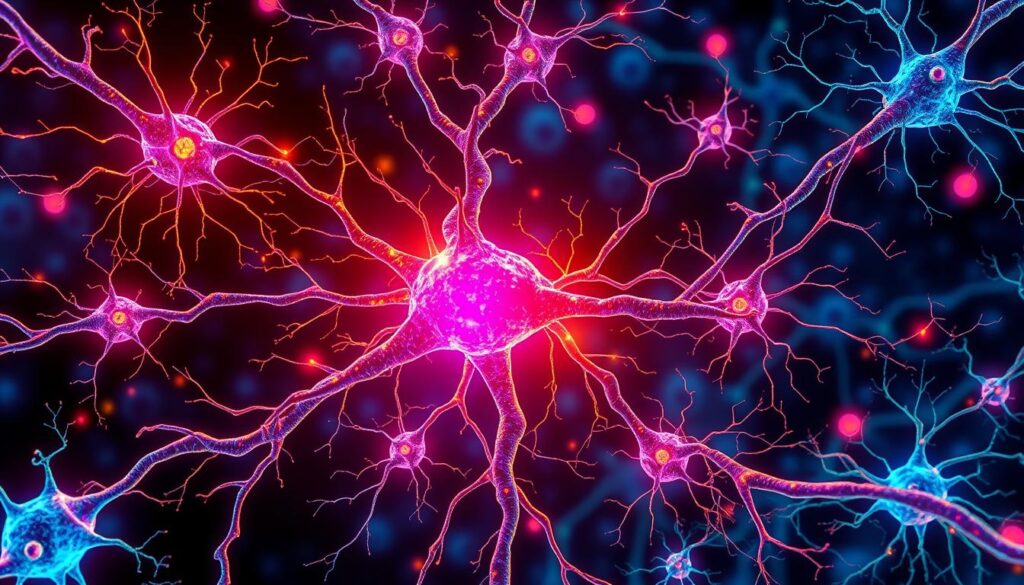
Astrocytes are the unsung heroes of the central nervous system. These remarkable glial cells regulate neuron signal speeds. They influence how your brain processes information1.
Astrocytes aren’t just passive support cells. They actively regulate neural communication. Scientists found these tiny cellular managers can dramatically impact neuron signal transmission speed2.
Perinodal astrocytes showed an impressive ability. They can modify neural transmission by regulating key molecular processes3.
The most startling finding involves thrombin regulation. Blocking this process reduced neuron signal speeds by 15%. This decrease was enough to impair reflexes in experimental models2.
This discovery opens up exciting possibilities. It could help us understand neural function better. It might also lead to new treatments for neurological conditions1.
Key Takeaways
- Astrocytes are critical regulators of neuron signal transmission
- Blocking thrombin can reduce neural signal speeds by 15%
- Glial cells play an active role in neural communication
- Astrocytes impact myelin thickness and neural signal efficiency
- Understanding astrocyte function could lead to neurological treatments
Introduction to Astrocytes and Neurons
The human brain is a complex network of cells. Astrocytes and neurons are key players in this system. They form the foundation of brain function and enable neural communication4.
Understanding Astrocytes
Astrocytes are star-shaped neuroglia cells in the human brain. They make up about 40% of all brain cells4. These cells are vital for brain health and neural communication.
Astrocytes come in various types. These include protoplasmic astrocytes in gray matter and fibrous astrocytes in white matter. Varicose and interlaminar astrocytes are also present.
- Protoplasmic astrocytes in gray matter
- Fibrous astrocytes in white matter
- Varicose and interlaminar astrocytes
Astrocytes are master regulators of brain function. They control ion and neurotransmitter levels. This directly affects how neurons communicate5.
Role of Neurons in the Brain
Neurons are the brain’s main information processors. The human brain has 86 billion neurons6. There are four primary types of neurons.
- Unipolar neurons
- Bipolar neurons
- Multipolar neurons
- Pseudounipolar neurons
Neurons are the communication highways of your brain, transmitting electrical and chemical signals that enable everything from basic reflexes to complex thoughts.
Astrocytes and neurons work together in the brain. They create a dynamic system that supports brain function. This collaboration ensures efficient brain operation5.
The partnership regulates various processes. These include metabolic functions and signal transmission. Together, they keep your brain running smoothly.
The Connection Between Astrocytes and Neurons
Brain communication involves neurons and glial cells, with astrocytes playing a key role. These cells actively participate in neural signaling. They’re not just passive support structures.
Astrocytes interact with neurons through complex mechanisms. This interaction ensures smooth brain function. Several key processes are involved.
- Calcium signaling between cells
- Release of gliotransmitters
- Maintenance of white matter integrity
- Ionic homeostasis regulation
How They Communicate
Astrocytes regulate adhesion molecules connecting myelin to axons. This can significantly impact neural signal speeds2. Specific enzymes like thrombin can cause myelin to detach from axons layer by layer2.
“Astrocytes are not mere spectators, but active conductors in the neural symphony.” – Neuroscience Research Team
Importance of Their Interaction
The astrocyte-neuron interaction is vital for brain health. Blocking astrocytic functions can reduce signal speeds by about 15%2. This could impair neurological processes.
Spinal astrocytes can modulate pain-related behaviors through complex glycogen dynamics7. This shows their wide-ranging impact on neural function.
| Astrocyte Function | Impact on Neurons |
|---|---|
| Calcium Signaling | Enhances synaptic communication |
| Gliotransmitter Release | Supports neural plasticity |
| Ionic Regulation | Maintains signal transmission efficiency |
Studying these connections could lead to new treatments for neurological disorders. This offers hope for more targeted interventions in the future.
Astrocytes and Neural Support
Your brain’s central nervous system relies on an intricate network of cells. Astrocytes are unsung heroes in this complex biological landscape. They provide critical support to neurons and ensure smooth communication within the brain8.
Nutritional Role of Astrocytes
Astrocytes play a pivotal role in neuronal nutrition and metabolic support. They manage an impressive metabolic network that sustains neuronal health. A single astrocyte can connect with about 100,000 synapses in the hippocampus8.
- Provide essential metabolic substrates to neurons
- Regulate neurotransmitter levels in extracellular spaces
- Support energy metabolism through the lactate shuttle
Maintaining Brain Homeostasis
Your brain’s delicate balance depends on astrocytes’ ability to maintain ionic homeostasis. They regulate critical elements like potassium levels and manage neurotransmitter concentrations. This ensures optimal neuronal communication2.
Astrocytes can potentially alter neural transmission speeds by about 15%. This significantly impacts brain signaling dynamics2.
Astrocytes: The silent guardians of neuronal health and communication
Astrocytes consume significant metabolic resources despite representing a small cellular population. The brain uses 20% of total body oxygen and 25% of total body glucose8.
This highlights the critical metabolic role these cells play. They are essential in maintaining central nervous system function.
The Mechanism of Signal Transmission
Neural communication is a complex process in the nervous system. Your brain’s ability to process information relies on sophisticated synaptic transmission mechanisms. These mechanisms enable neurons to communicate rapidly and efficiently.
Neurons generate electrical impulses that travel along axons. These signals form a remarkable communication network. They are crucial for how your brain processes information and controls bodily functions5.
Understanding Neuron Signals
Neuron signals are electrical impulses that transmit critical information. They involve several key components:
- Electrical impulses traveling along axons
- Neurotransmitter release at synapses
- Receptor activation in target neurons
Signal Transmission Speed Factors
The speed of neural communication depends on multiple factors4:
| Factor | Impact on Signal Speed |
|---|---|
| Myelin Sheath Thickness | Increases transmission velocity |
| Axon Diameter | Wider axons transmit signals faster |
| Node of Ranvier | Enables rapid signal jumping |
“Neural signals are like lightning-fast electrical messages traveling through an intricate communication network.” – Neuroscience Research Team
Astrocytes play a crucial role in modulating signal transmission processes. They influence the speed and efficiency of neuronal signaling5.
Studying these mechanisms helps researchers develop insights into brain function. It also aids in creating potential neurological treatments.
Factors Influencing Signal Speed
Your brain’s signal speed depends on several key factors. These elements affect how quickly your brain processes information. Understanding these factors is vital for grasping neural communication.
Myelination is crucial for brain processing speed. White matter, which has myelinated nerve fibers, greatly impacts signal transmission speed9. Neurons with thicker myelin sheaths can send signals faster, making neural networks more efficient4.
Myelination’s Impact on Neural Signals
Myelination affects signal speed through several ways:
- Increased electrical insulation
- Reduced signal interference
- Enhanced signal propagation
Temperature and Signal Transmission
Brain temperature also affects neural signal speeds. Warmer brains usually transmit signals faster10. Your brain keeps a specific temperature range for efficient neuron communication.
| Factor | Impact on Signal Speed |
|---|---|
| Myelin Thickness | Directly proportional to transmission speed |
| Temperature | Higher temperatures increase signal velocity |
| Neuronal Health | Determines overall signal efficiency |
“The brain’s intricate signaling system relies on a delicate balance of structural and environmental factors.” – Neuroscience Research Institute
Knowing these factors helps researchers improve brain function. It may also help address neurological conditions affecting signal transmission.
Astrocytes and Signal Enhancement
Astrocytes are key players in neural communication. They actively regulate synaptic transmission in the nervous system. These cells influence how neurons communicate and process information.
- Ion Concentration Regulation
- Neurotransmitter Modulation
Astrocytic Influence on Ion Concentration
Brain signaling relies on precise ion management. Astrocytes control extracellular ion concentrations, especially potassium. This affects neuronal excitability5.
These cells create a dynamic environment for optimal synaptic transmission. They maintain delicate ion balances to support brain function.
Modulation of Neurotransmitter Release
Astrocytes actively shape neural communication. They regulate D-serine, a crucial neurotransmitter that influences synaptic plasticity11.
Their ability to manage neurotransmitters ensures efficient signal processing. This skill is vital for brain function.
| Astrocyte Function | Impact on Neural Communication |
|---|---|
| Ion Regulation | Maintains neuronal excitability |
| Neurotransmitter Management | Controls synaptic transmission |
| Calcium Signaling | Influences synaptic activity |
Astrocytes are the unsung heroes of neural communication, orchestrating complex signaling processes with remarkable precision.
Research has found specialized astrocyte subpopulations that can release glutamate. This discovery shows their complex role in neural signaling12.
These findings highlight the dynamic nature of brain communication. They also underscore astrocytes’ critical function in maintaining optimal neural performance.
Research Insights: Astrocytes in Action
Astrocytes play a vital role in the central nervous system. These star-shaped cells influence neural communication and brain function. Recent discoveries have shed light on their fascinating capabilities.
Astrocytes in the human brain can contact up to 2,000,000 synapses each13. Their complex communication mechanisms have revolutionized our understanding of neuroscience. These findings have opened new avenues for research.
Cutting-Edge Discoveries in Astrocyte Research
Scientists have identified key mechanisms highlighting astrocytes’ dynamic nature:
- Calcium signaling plays a crucial role in neurotransmitter regulation14
- Astrocytes can modulate synaptic transmission through gliotransmitter release13
- These cells contribute significantly to neural communication and plasticity
Case Studies on Signal Speeds
Astrocytes influence neural signal transmission in fascinating ways. They regulate ion concentrations and membrane potentials, impacting neuronal communication speed and efficiency14.
“Astrocytes are not passive bystanders, but active participants in neural signaling.” – Neuroscience Research Team
Astrocytes continue to surprise researchers with their complex functions. Their role extends far beyond simple structural support. They maintain brain homeostasis and support neural communication13.
Neurological Disorders and Astrocytes
Astrocytes play a crucial role in brain function and the central nervous system. These remarkable cells offer key insights into complex neural disorders. Understanding their relationship with neurological conditions is vital for medical progress.
Impact on Signal Speed in Disease
Astrocytes greatly affect neural signaling during neurological conditions. They make up about 20-40% of all glial cells in the brain15. Disease can disrupt their normal function, dramatically altering signal transmission.
- Neural signal speeds decrease in various neurological conditions
- Astrocyte dysfunction can compromise brain communication
- Cellular interactions become compromised during disease states
Astrocytes in Neurodegenerative Conditions
Neurodegenerative diseases significantly change astrocyte behavior. A single astrocyte can interact with nearly 2 million synapses15. This makes their role crucial in maintaining neural health.
| Condition | Astrocyte Impact |
|---|---|
| Alzheimer’s Disease | Reduced neural signaling efficiency |
| Multiple Sclerosis | Compromised myelin support |
| Parkinson’s Disease | Altered neural communication pathways |
Scientists are studying how astrocytes undergo reactive astrogliosis, a key response to neural injuries15. This research could lead to new treatments for neurological disorders. Understanding these processes may unlock innovative therapeutic approaches.
“Astrocytes are not mere bystanders, but active participants in neural health and disease progression.”
Potential Therapies Targeting Astrocytes
Neuroscience is making strides in understanding neuroglia’s role in brain function. Researchers are creating new ways to boost neural communication through astrocyte therapies.
This research could transform neurological treatments. Scientists are exploring various approaches to improve brain function by targeting astrocytes.
Developing Drugs for Astrocytic Enhancement
Cutting-edge research aims to create drugs that can change astrocytic processes. These strategies focus on improving brain function in several ways.
- Enhancing calcium signaling mechanisms16
- Improving gliotransmitter release pathways
- Supporting metabolic functions of neuroglia
- Regulating ion concentration in neural networks
“Astrocytes are not just support cells, they are key players in neural communication.” – Neuroscience Research Institute
Strategies for Rehabilitation
New insights into astrocyte functions are changing rehabilitation approaches. About 65% of spinal cord injury patients have chronic neuropathic pain.
This makes astrocyte-targeted therapies crucial17. Potential rehabilitation strategies are being developed to address these issues.
- Targeting astrocyte proliferation
- Reducing glial fibrillary protein expression
- Developing personalized neural support interventions
The future of neurological treatment lies in understanding and manipulating astrocyte interactions. Researchers hope to unlock new ways to restore brain function by focusing on these crucial neuroglia.
Future Directions in Astrocyte Research
Neuroscience is evolving rapidly, with astrocytes playing a crucial role in neural communication. These remarkable cells are reshaping our understanding of the central nervous system18.
Emerging Technologies in Neuroscience
Cutting-edge technologies are transforming astrocyte research. Advanced imaging and optogenetics allow scientists to explore these cells with incredible precision.
These tools promise breakthroughs in understanding neural signaling at the cellular level19.
- Advanced microscopy techniques
- Genetic manipulation strategies
- High-resolution protein mapping
Prospective Studies on Astrocyte Function
Future research focuses on promising areas of investigation. Scientists aim to explore astrocytes’ roles in brain state transitions and neuroprotection.
The potential for developing targeted therapies using astrocytic functions is vast18.
| Research Focus | Potential Impact |
|---|---|
| Brain State Transitions | Enhanced Understanding of Neural Dynamics |
| Neuroprotective Mechanisms | Potential Therapeutic Interventions |
| Astrocyte-Neuron Interactions | Improved Neural Communication Insights |
“Astrocytes are not just support cells, but active participants in neural communication.” – Neuroscience Research Collective
Astrocytes continue to amaze researchers with their complexity. They make up nearly 40% of brain cells, highlighting their importance18.
As technology advances, we’re on the verge of uncovering profound mysteries about these vital brain components.
Conclusion: The Importance of Astrocytes in Neuroscience
Astrocytes are vital players in neural communication. These glial cells shape neural interactions in complex ways. They make up 20–40% of all glial cells in the central nervous system20.
Astrocytes modulate signal transmission between neurons. They wrap around 140,000 synapses and contact hundreds of neuron dendrites20. This creates an intricate support system for brain function.
Different astrocyte types serve unique roles in the brain4. They regulate glucose metabolism and provide essential support for neurons. This makes them crucial for overall brain health.
Research reveals the amazing potential of astrocytes. Their networks transport information at uniform speeds. They also respond quickly to physiological changes21.
Ongoing studies may lead to new treatments for neurological disorders. They could also deepen our understanding of how the brain works.
Recap of Key Points
Astrocytes are essential for maintaining neural networks. They provide metabolic support and modulate signals between neurons. These cells are key to grasping the brain’s complexity.
Their importance goes beyond traditional scientific views. Astrocyte research promises exciting developments in neuroscience.
Final Thoughts on Astrocytes and Neuron Signal Speeds
The future of brain science lies in understanding astrocyte-neuron interactions. Recognizing their impact on neural communication is crucial. This knowledge could lead to new strategies for brain health.
Researchers might revolutionize neurological treatments by studying these remarkable cells. The potential for breakthroughs in neuroscience is truly exciting.
FAQ
What are astrocytes and how do they impact neuron signal speeds?
Astrocytes are key brain cells that regulate neuron signal speeds. They alter transmission by changing myelin thickness and controlling ion levels. NIH studies show blocking astrocytic processes can reduce signal speeds by 15%.
How do astrocytes communicate with neurons?
Astrocytes use calcium signaling and gliotransmitters to communicate with neurons. They interact at various levels, helping form and repair synapses. This interaction is vital for proper brain function.
What metabolic support do astrocytes provide to neurons?
Astrocytes offer crucial metabolic support through the lactate shuttle. This process is key for long-term memory formation. They also regulate neurotransmitter levels and maintain ionic balance.
How do astrocytes affect signal transmission speed?
Astrocytes influence signal speed by regulating myelin thickness and ion concentrations. They control adhesion molecules connecting myelin to axons. Factors like myelin sheath thickness directly impact neuronal signaling efficiency.
Can astrocyte dysfunction impact neurological conditions?
Astrocyte dysfunction is linked to various brain disorders. In multiple sclerosis, myelin damage slows signals. In Alzheimer’s, astrocytes may alter neural signaling. Understanding their role could lead to new treatments.
What potential therapies are researchers exploring for astrocytes?
Scientists are developing drugs to modulate astrocyte calcium signaling and gliotransmitter release. Some strategies aim to boost astrocytic support functions. These approaches could improve brain function and aid recovery from injuries.
How do emerging technologies help in studying astrocytes?
Advanced techniques like optogenetics allow detailed studies of astrocyte function. New imaging methods enable in-depth research. Future studies will explore astrocytes’ roles in brain state changes. Researchers aim to develop targeted therapies to enhance neural signaling.
Source Links
- The role of astrocyte‐mediated plasticity in neural circuit development and function – Discover Neuroscience – https://neuraldevelopment.biomedcentral.com/articles/10.1186/s13064-020-00151-9
- Astrocytes regulate signal speeds of neurons – https://www.nih.gov/news-events/news-releases/astrocytes-regulate-signal-speeds-neurons
- Astrocytes Regulate Signal Speeds of Neurons – https://neurosciencenews.com/astrocytes-neuron-speed-10112/
- Frontiers | Astrocyte metabolism and signaling pathways in the CNS – https://www.frontiersin.org/journals/neuroscience/articles/10.3389/fnins.2023.1217451/full
- Frontiers | Astrocytic modulation of neuronal signalling – https://www.frontiersin.org/journals/network-physiology/articles/10.3389/fnetp.2023.1205544/full
- 16.1 Neurons and Glial Cells – https://opentextbc.ca/biology/chapter/16-1-neurons-and-glial-cells/
- Neuron–astrocyte metabolic coupling facilitates spinal plasticity and maintenance of inflammatory pain – Nature Metabolism – https://www.nature.com/articles/s42255-024-01001-2
- Astrocytes – Astrocyte Pharmaceuticals – https://www.astrocytepharma.com/astrocytes/
- Ion Channels and Electrophysiological Properties of Astrocytes: Implications for Emergent Stimulation Technologies – https://pmc.ncbi.nlm.nih.gov/articles/PMC8173131/
- Accelerated signal propagation speed in human neocortical microcircuits – https://elifesciences.org/reviewed-preprints/93781
- Astrocytes enhance plasticity response during reversal learning – Communications Biology – https://www.nature.com/articles/s42003-024-06540-8
- Specialized astrocytes mediate glutamatergic gliotransmission in the CNS – Nature – https://www.nature.com/articles/s41586-023-06502-w
- Dysregulation of Astrocyte–Neuronal Communication in Alzheimer’s Disease – https://www.mdpi.com/1422-0067/22/15/7887
- Frontiers | Ion Channels and Electrophysiological Properties of Astrocytes: Implications for Emergent Stimulation Technologies – https://www.frontiersin.org/journals/cellular-neuroscience/articles/10.3389/fncel.2021.644126/full
- Frontiers | Neuron-astrocyte omnidirectional signaling in neurological health and disease – https://www.frontiersin.org/journals/molecular-neuroscience/articles/10.3389/fnmol.2023.1169320/full
- Gene therapy conversion of striatal astrocytes into GABAergic neurons in mouse models of Huntington’s disease – Nature Communications – https://www.nature.com/articles/s41467-020-14855-3
- Targeting resident astrocytes attenuates neuropathic pain after spinal cord injury – https://elifesciences.org/articles/95672
- Astrocyte metabolism and signaling pathways in the CNS – https://pmc.ncbi.nlm.nih.gov/articles/PMC10507181/
- Astrocyte–neuron subproteomes and obsessive–compulsive disorder mechanisms – Nature – https://www.nature.com/articles/s41586-023-05927-7
- The role of astrocytes in neuropathic pain – https://pmc.ncbi.nlm.nih.gov/articles/PMC9530148/
- Astrocytes are active: An information theoretic approach reveals differences in Ca2+ signaling patterns among distinct astrocyte subtypes – https://www.biorxiv.org/content/10.1101/2023.11.01.565176v2.full-text

