
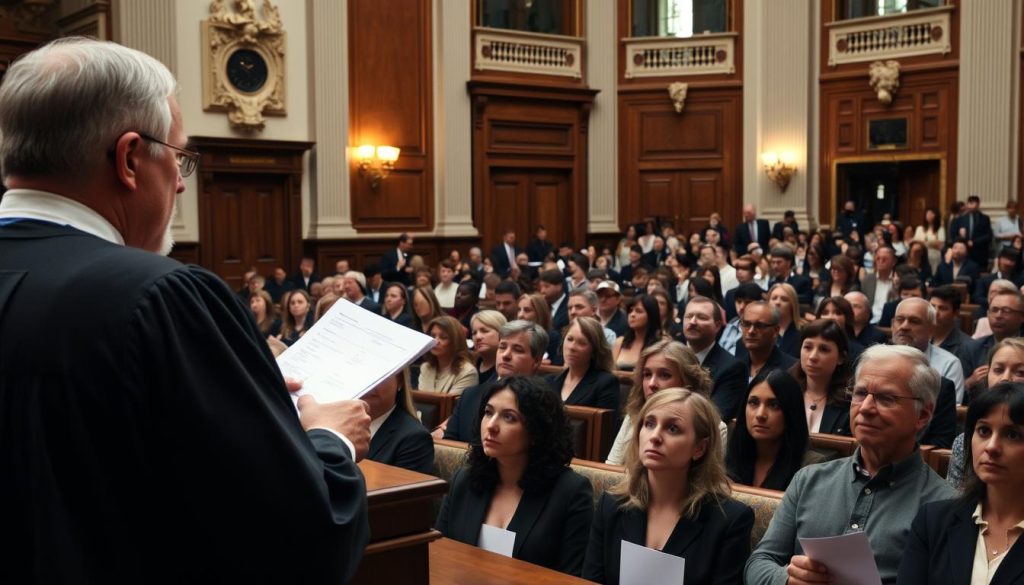
Jury duty is vital to the American justice system. Many people want to know how to boost their chances of being picked1. Each year, about 30% of eligible citizens get summoned, but only 15% end up serving1.
Courts pick jurors randomly from voter lists, DMV records, and state tax files. They aim for diverse groups to ensure fair trials. Knowing the process can help you fulfill this civic duty1.
To increase your chances, be an active, responsible citizen. You must meet basic requirements, like being 18 and living in the area1. Responding quickly to your summons is crucial2.
Key Takeaways
- Jury duty is a critical civic responsibility for U.S. citizens
- Selection is random but requires active participation
- Respond promptly to jury summons
- Be prepared to demonstrate civic engagement
- Understand the importance of jury service in the legal system
Understanding Jury Duty Qualifications and Requirements
Jury duty is vital to the American judicial system. It requires potential jurors to meet specific qualifications and understand their legal responsibilities. Knowing the basic requirements can make jury service more manageable.
To be considered for jury duty, individuals must meet several key requirements. These include being a U.S. citizen and at least 18 years old. They must also live in the county or judicial district issuing the summons.
Potential jurors should be able to read, write, and understand English. These basic eligibility criteria form the foundation of jury qualification.
- Be a United States citizen3
- Be at least 18 years old34
- Reside in the county or judicial district issuing the summons34
- Be able to read, write, and understand English4
Legal Considerations for Potential Jurors
Legal factors can impact jury duty eligibility. Individuals may be disqualified if they have been convicted of indictable offenses. Those on parole, probation, or with unresolved felony charges may also be ineligible.
- Have been convicted of indictable offenses3
- Are currently on parole or probation3
- Have unresolved felony charges4
Documentation and Preparation
Potential jurors should gather essential documents to support their qualification. Proper preparation can help avoid dismissal and streamline the selection process. Having the right paperwork ready is crucial.
| Required Documents | Purpose |
|---|---|
| Government-issued ID | Proof of identity |
| Proof of residency | Verify local jurisdiction |
| Summons notice | Official jury duty invitation |
Some individuals may qualify for exemptions or deferrals. Juror qualification recommendations include potential excusal for certain situations. These situations can include medical conditions, active military service, financial hardship, or caregiving responsibilities.
Knowing these qualifications helps potential jurors prepare for their civic duty. It allows them to approach the jury selection process with confidence and understanding.
Maximizing Your Chances During Voir Dire
Jury selection success requires strategic preparation and understanding voir dire. Attorneys carefully evaluate responses and demeanor during this process. Many courts use questionnaires to gather background information about potential jurors.
Honesty is your most powerful tool in voir dire. Judges and attorneys seek impartial individuals who can provide transparent, thoughtful responses. They want jurors who can objectively consider evidence without bias.
Some judges may require more than a simple fairness assertion. They might ask for a firm commitment to remain unbiased throughout the trial.
Understanding excusal from jury duty tips is crucial. Attorneys aim to identify receptive panel members and eliminate problematic jurors. They focus on the top 10-20% of potentially problematic candidates.
Research the jury selection process beforehand to enhance your chances. Show genuine interest and provide clear, concise answers. Maintain a neutral demeanor to improve your likelihood of selection6.
FAQ
Who is eligible to serve on a jury?
Jury duty eligibility requires U.S. citizenship and being at least 18 years old. You must live in the county and understand English. A clean criminal record and sound mental and physical health are also necessary.
How are potential jurors selected?
Jurors are randomly picked from voter lists, driver’s licenses, and other government databases. This method creates a diverse jury pool that represents the local community.
What documents do I need to bring to jury duty?
Bring a valid government-issued photo ID and your jury summons. Additional documents may be required as stated in the summons.
If seeking an exemption, bring proof of employment or other supporting documents.
Can I be excused from jury duty?
Valid reasons for excusal include medical conditions, financial hardship, and caregiving responsibilities. Critical work commitments may also qualify.
You must provide proof and follow the court’s procedures for requesting an exemption.
What happens during the voir dire process?
Voir dire is the jury selection interview. Attorneys and judges ask potential jurors questions to determine their suitability.
This process helps identify biases or conflicts that might prevent a fair trial.
How can I increase my chances of being selected for jury duty?
Be professional, attentive, and honest when answering questions. Show impartiality and a willingness to listen to evidence objectively.
Express a genuine commitment to civic duty to improve your chances of selection.
What should I wear to jury duty?
Dress in professional, business-casual attire that’s neat and conservative. Avoid overly casual clothing like shorts, tank tops, or flip-flops.
A collared shirt, slacks, or a modest dress are appropriate choices that show respect.
How long does jury duty typically last?
Jury duty length varies by case and jurisdiction. Some services last a day or two, while complex trials may take weeks.
Most courts provide estimated service times in your summons.
What if I can’t take time off work for jury duty?
Most employers must legally provide time off for jury duty. Federal law protects employees from discrimination for serving.
Some areas offer compensation for lost wages, but the amount varies by location.
Can I be dismissed during the jury selection process?
Yes, attorneys can dismiss potential jurors through challenges or for cause. Being dismissed doesn’t reflect negatively on you.
It’s part of ensuring a fair and impartial jury for the specific case.
Source Links
- How to Actually Be Chosen for Jury Duty | Lifehacker – https://lifehacker.com/how-to-actually-be-chosen-for-jury-duty-1849763249
- Frequently Asked Questions – Jury Service | Western District of New York – https://www.nywd.uscourts.gov/frequently-asked-questions-jury-service
- Frequently Asked Questions About Jury Service – https://www.njcourts.gov/jurors/faq
- Juror Qualifications, Exemptions and Excuses – https://www.uscourts.gov/court-programs/jury-service/juror-qualifications-exemptions-and-excuses
- Jury Duty FAQ | Pennsylvanians for Modern Courts – https://www.pmconline.org/resources/jury-duty-faq
- CorpCFall11.indd – https://www.cravath.com/a/web/413/3315319_1.pdf

