
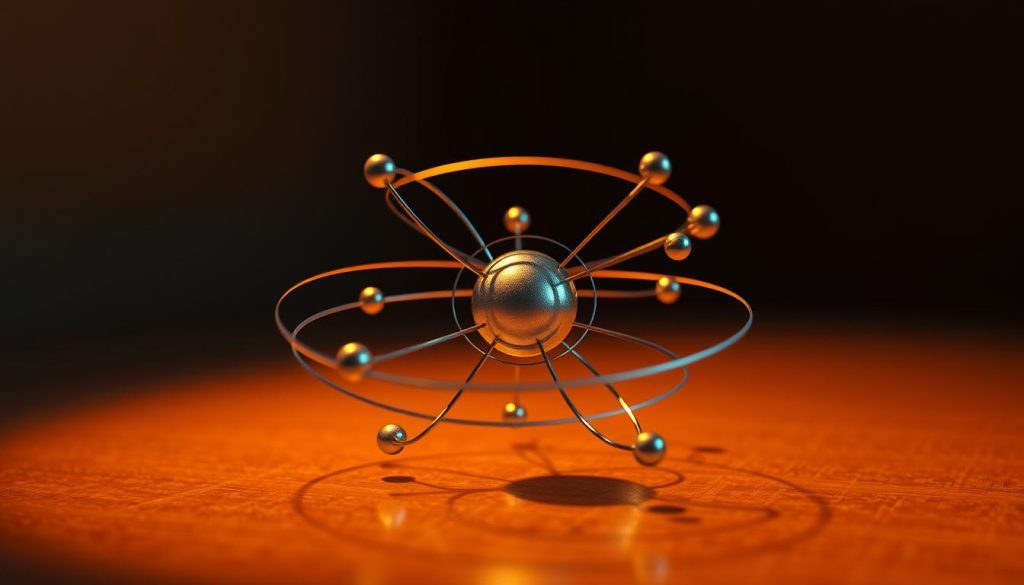
Electrons are key to an atom’s structure and behavior. They shape chemical interactions and atomic properties. The periodic table’s atomic number helps determine electron count1.
Neutral atoms have equal electrons and protons. Scientists use quantum principles to map electron arrangements1. Four quantum numbers describe each electron’s position and movement1.
The periodic table is crucial for identifying electron totals. Each element has a unique electron setup. This arrangement defines its chemical traits2.
Orbital shells hold different electron amounts. The first shell fits 2 electrons. The second takes 8, while the third holds 182. This pattern helps explain an atom’s electronic structure.
Key Takeaways
- Electrons equal the number of protons in a neutral atom
- Quantum numbers help describe electron positioning
- The periodic table provides essential electron information
- Orbital shells have specific electron capacity limits
- Electron configuration impacts chemical behavior
Understanding Atomic Structure and Basic Components
Atoms are the building blocks of matter. They combine intricate particles that define unique characteristics. Quantum mechanics explains how these tiny structures work and interact3.
An atom’s core has three main particles: protons, neutrons, and electrons. These particles determine the element’s properties and behavior3.
Protons: The Identity Makers
Protons have a positive charge and define an element’s atomic number. They live in the nucleus and weigh about 1.67 × 10^-24 grams4. The number of protons identifies each chemical element.
Neutrons: Nuclear Stabilizers
Neutrons help stabilize the nucleus and have no electrical charge. They weigh about the same as protons. Neutrons also help determine an atom’s isotope3.
Electrons: Orbital Dynamics
Electrons are light particles with a negative charge. They weigh about 9.11 × 10^-28 grams4. Electrons orbit the nucleus in complex shells and subshells.
- Electron configuration determines chemical behavior
- Orbitals represent specific energy levels
- Quantum mechanics governs electron movement
Neutral atoms have equal numbers of electrons and protons. This balance creates electrical equilibrium3. It allows atoms to form molecules and compounds.
Determining electrons in an atom
Knowing an atom’s electron count is key to understanding its chemical behavior. For neutral atoms, electrons match the atomic number. You can find this number on the periodic table of elements.
Electrons follow specific rules as they orbit the nucleus. These rules shape how electrons arrange themselves in atoms.
- Aufbau principle: Electrons fill orbitals from lowest to highest energy levels
- Pauli exclusion principle: No two electrons can have identical quantum states
- Hund’s rule: Electrons occupy empty orbitals before pairing up
Scientists use a step-by-step method to count electrons. First, they find the element on the periodic table. Next, they identify its atomic number.
Finally, they count the protons, which equals electrons in neutral atoms. This process helps determine the electron count accurately.
- Locate the element on the periodic table
- Identify its atomic number
- Count the number of protons (which equals electrons in neutral atoms)
Electron configuration becomes more complex with larger atoms. Scientists must carefully apply these basic principles. They use advanced methods to map electron distributions.
This helps us grasp atomic behavior and chemical interactions better. Understanding electrons is crucial for many scientific fields.
The precise arrangement of electrons determines an atom’s chemical properties and reactivity.
The Relationship Between Protons and Electrons
Protons and electrons are key to understanding atomic structure. In neutral atoms, proton and electron numbers match, creating electrical balance5. Protons have positive charges, while electrons have negative ones. They attract each other through electromagnetic interactions5.
Electron setup determines an atom’s chemical traits. Atomic structure shows electrons orbit the nucleus in a 3D “electron cloud”5. When atoms swap electrons, they become ions with unique electrical features.
Neutral Atoms vs Ions
Ions are atoms with changed electron counts, losing their electrical balance. Positive ions form when atoms lose electrons. Negative ions appear when atoms gain electrons6.
The periodic table helps track possible electron setups. It’s crucial for understanding how atoms change into ions.
Calculating Electron Changes in Ions
To find electron changes, compare an atom’s proton and electron counts. An atom with 10 protons usually has 10 electrons6. If it loses two electrons, it becomes a positive ion with 8 electrons and 10 protons.
The Role of the Periodic Table
The periodic table reveals electron setups, helping scientists predict atom behavior. It shows element positions and electron shell layouts. This info helps researchers guess how atoms might interact chemically.
FAQ
What is an atom’s basic structure?
An atom has three main particles: protons, neutrons, and electrons. Protons are positive, neutrons are neutral, and electrons are negative. Protons define the element, while neutrons help with nuclear stability.
Electrons orbit the nucleus in specific shells and orbitals. These tiny particles work together to form the basic structure of an atom.
How do I determine the number of electrons in a neutral atom?
In a neutral atom, electrons equal protons. Find the atomic number on the periodic table to get the proton count. This number also tells you how many electrons the atom has.
For example, carbon has 6 protons and 6 electrons in its neutral state. The periodic table makes it easy to find this information.
What are electron shells and orbitals?
Electron shells are energy levels around an atom’s nucleus. Orbitals are specific areas within these shells where electrons likely exist. Each shell can hold a maximum number of electrons.
These arrangements follow quantum mechanical principles. Understanding shells and orbitals helps explain an atom’s behavior and properties.
What is an ion, and how does it affect electron count?
An ion is an atom that has gained or lost electrons. This change results in a net electrical charge. When an atom loses electrons, it becomes a positive ion (cation).
Gaining electrons creates a negative ion (anion). The electron count in an ion differs from that of a neutral atom.
What is the Aufbau principle?
The Aufbau principle explains how electrons fill atomic orbitals. They start at the lowest energy levels and move up. Electrons occupy the lowest available state before moving higher.
This principle follows a specific order of orbital filling. It helps predict electron configurations in atoms.
What is the Pauli exclusion principle?
The Pauli exclusion principle states that no two electrons in an atom can be identical. Each electron must have a unique set of quantum numbers. This principle explains why electrons occupy different energy levels.
It’s crucial for understanding atomic structure and electron behavior. The Pauli exclusion principle shapes how atoms form and interact.
How does the periodic table help determine electron configuration?
The periodic table is a quick guide for atomic information. It shows an element’s atomic number, electrons, and general electron setup. Elements in the same column often have similar outer shell arrangements.
This tool helps scientists predict an atom’s properties and behavior. The periodic table is essential for understanding electron configurations.
What is Hund’s rule?
Hund’s rule says electrons fill equal-energy orbitals separately before pairing up. They have parallel spins when occupying different orbitals. This arrangement reduces electron-electron repulsion in the atom.
Hund’s rule also maximizes the atom’s total spin. It’s important for understanding atomic structure and chemical bonding.
Source Links
- Quantum Numbers for Atoms – https://chem.libretexts.org/Bookshelves/Physical_and_Theoretical_Chemistry_Textbook_Maps/Supplemental_Modules_(Physical_and_Theoretical_Chemistry)/Quantum_Mechanics/10:_Multi-electron_Atoms/Quantum_Numbers_for_Atoms
- How To Determine The Number Of Electrons With Quantum Numbers – https://www.sciencing.com/determine-number-electrons-quantum-numbers-10006316/
- 2.1.1: Overview of Atomic Structure – https://bio.libretexts.org/Bookshelves/Microbiology/Microbiology_(Boundless)/02:_Chemistry/2.01:_Atomic_Structure/2.1.01:_Overview_of__Atomic_Structure
- The Structure of the Atom – https://uen.pressbooks.pub/introductorychemistry/chapter/the-structure-of-the-atom/
- Lesson 4.1: Protons, Neutrons, and Electrons – American Chemical Society – https://www.acs.org/middleschoolchemistry/lessonplans/chapter4/lesson1.html
- 4.4: The Properties of Protons, Neutrons, and Electrons – https://chem.libretexts.org/Courses/University_of_British_Columbia/CHEM_100:_Foundations_of_Chemistry/04:_Atoms_and_Elements/4.4:_The_Properties_of_Protons_Neutrons_and_Electrons

