
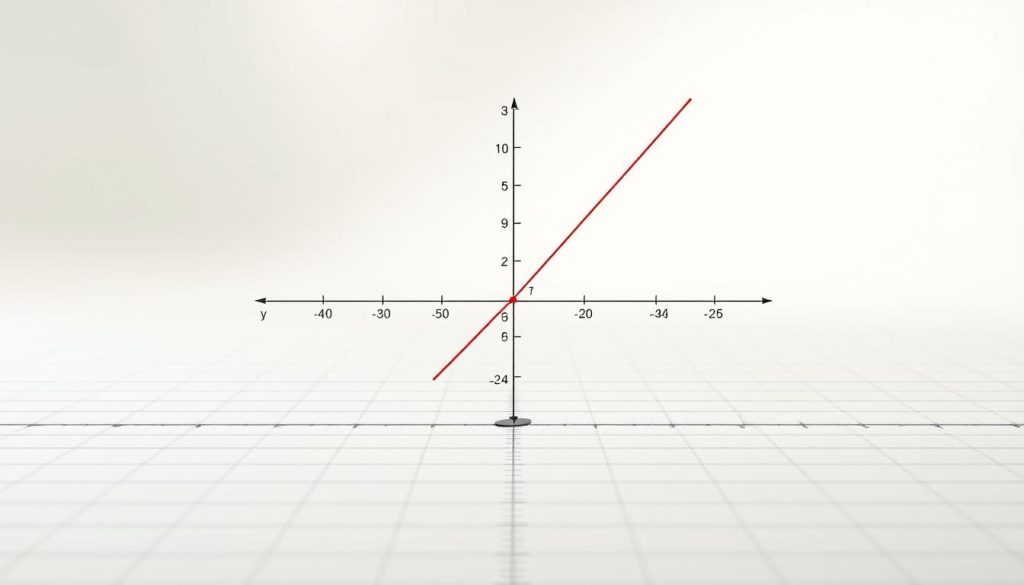
Grasping inverse functions is vital in mathematics. They undo the original function’s transformation, reversing its mathematical operation1. This concept is key for solving problems in various math fields.
Inverse functions are written as \( f^{-1}(x) \). This notation looks like an exponent but shows the function’s reversal1. It’s a way to flip the original function’s action.
For example, if a function adds 2 and squares, its inverse takes the square root and subtracts 21. This shows how inverses work in practice.
Mathematicians use function composition to check inverse functions. Applying a function and its inverse should return the original input value1. This proves the relationship between a function and its inverse.
Different functions have unique inverse-finding methods. Simple transformations, like multiplying by 10, have easy inverses like dividing by 101. Complex functions need careful math work to find their inverses.
Key Takeaways
- Inverse functions reverse the original function’s transformation
- The notation \( f^{-1}(x) \) represents an inverse function
- Function composition helps verify inverse relationships
- Not all functions have inverses
- Inverse functions reflect the original function’s mathematical operation
Understanding Inverse Functions and Their Properties
Inverse functions flip and transform mathematical relationships. They switch x and y coordinates, creating unique transformations. These functions open up new ways to explore math2.
Exploring One-to-One Functions
One-to-one functions link each input to a unique output. Mathematically, this means no two different x values produce the same y value. For a function to be invertible, it must be one-to-one3.
Inverse Function Characteristics
Inverse functions have key properties that make them crucial in math:
- Every one-to-one function has a unique inverse function3
- The input and output roles are completely reversed2
- Reflecting functions across the line y = x creates their inverse representation4
The Horizontal Line Test
The horizontal line test checks if a function can have an inverse. If a horizontal line crosses the graph more than once, the function fails. This means it can’t be inverted2.
One-to-one functions are used in finance and engineering. They help solve complex equations in these fields. Understanding these math relationships is key to tackling real-world problems2.
| Function Type | Invertibility | Horizontal Line Test Result |
|---|---|---|
| Linear Function | Invertible | Passes |
| Quadratic Function | Not Invertible | Fails |
| Exponential Function | Invertible | Passes |
Finding the inverse of a function: Step-by-step process
Inverse functions undo mathematical transformations. They map a function back to its original input. Mathematicians use f^-1(x) to represent the inverse function5.
To find an inverse, replace f(x) with y and swap x and y coordinates. Then, solve for the new variable. For f(x) = 7x – 4, the inverse is f^-1(x) = (x + 4)/75.
Graphically, the inverse reflects across the line y = x. This creates a mirror image of the original function5.
Verify your result by checking if f(f^-1(x)) = x and f^-1(f(x)) = x6. Linear functions like f(x) = 5x – 3 have straightforward inverses6.
Students can explore online math tutorials to deepen their understanding. These resources help unravel complex mathematical relationships.
Mastering inverse functions enhances problem-solving skills. It reveals new perspectives on mathematical relationships. Keep in mind that not all functions have inverses6.
FAQ
What exactly is an inverse function?
An inverse function undoes the original function’s work. It reverses the transformation of the input. Think of it as walking backwards through a math process.
How can I tell if a function has an inverse?
A function must be one-to-one to have an inverse. This means each input produces a unique output. Use the horizontal line test to check.
If a horizontal line crosses the graph more than once, it’s not one-to-one. Such functions can’t have an inverse.
What does the notation f⁻¹(x) actually mean?
f⁻¹(x) represents the inverse function, not a reciprocal or fractional power. It reverses the original function’s transformations. Remember, f⁻¹(f(x)) = x and f(f⁻¹(x)) = x.
How do I find the inverse of a function?
To find an inverse, follow these steps:
1. Replace f(x) with y
2. Swap x and y coordinates
3. Solve the equation for y
4. Replace y with f⁻¹(x)
5. Verify the domain and range restrictions
What’s the graphical relationship between a function and its inverse?
A function and its inverse are mirror images across the line y = x. If you folded the graph along y = x, they would perfectly overlap.
Can all functions have an inverse?
No, not all functions can have an inverse. Only one-to-one functions can have an inverse. Functions like y = x² or y = |x| aren’t naturally invertible.
These functions need domain restrictions to become invertible.
What’s the difference between an inverse function and a reciprocal function?
An inverse function reverses the original function’s transformation. A reciprocal function is simply 1/x. They are different mathematical concepts. Both involve “undoing” an original operation in their own way.
How do I know if I’ve correctly found an inverse function?
You can verify an inverse function by checking two conditions:
1. f(f⁻¹(x)) = x
2. f⁻¹(f(x)) = x
If both are true, you’ve found the correct inverse function.
Source Links
- Numeracy, Maths and Statistics – Academic Skills Kit – https://www.ncl.ac.uk/webtemplate/ask-assets/external/maths-resources/inverse-functions.html
- Understanding Inverse Graph and Inverse Functions | Albert Resources – https://www.albert.io/blog/understanding-inverse-graph-and-inverse-functions/
- Properties of Inverse Functions – https://www.onemathematicalcat.org/Math/Precalculus_obj/propInv.htm
- 5.2: Inverse Functions – https://math.libretexts.org/Courses/Cosumnes_River_College/Math_370:_Precalculus/05:_Further_Topics_in_Functions/5.02:_Inverse_Functions
- Finding the Inverse of a Function: Complete Guide — Mashup Math – https://www.mashupmath.com/blog/inverse-of-a-function-tutorial
- 2.5: One-to-One and Inverse Functions – https://math.libretexts.org/Courses/Monroe_Community_College/MTH_165_College_Algebra_MTH_175_Precalculus/02:_Functions_and_Their_Graphs/2.05:_One-to-One_and_Inverse_Functions

