
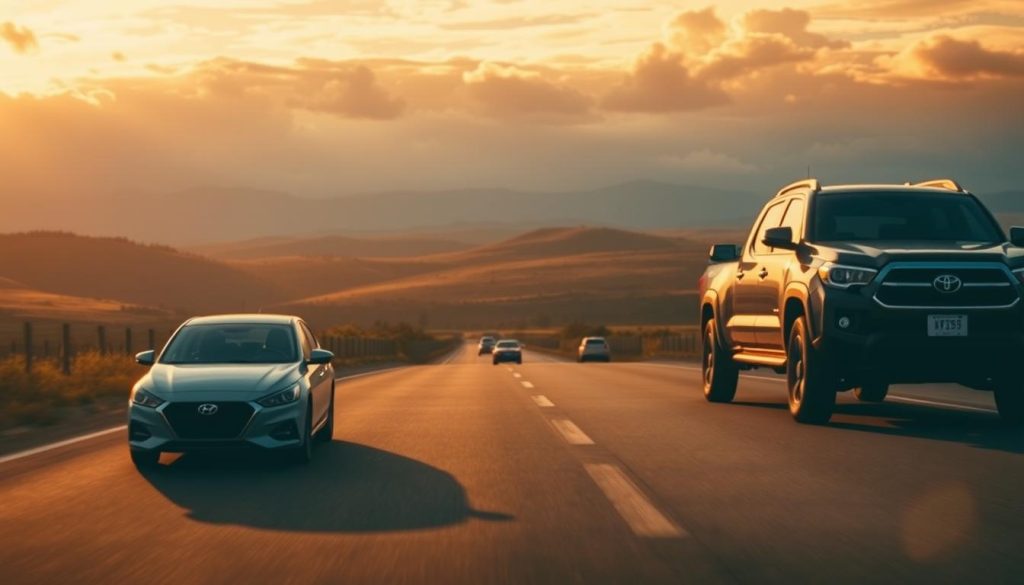
Knowing your vehicle’s miles per gallon (MPG) helps plan trips and save money. Modern drivers want to know their gas mileage and how different cars perform1.
Fuel efficiency varies greatly among vehicle types. Compact cars typically get 25 to 35 MPG, while sedans range from 20 to 30 MPG2.
Hybrid models greatly improve these numbers. SUVs and trucks use more fuel, averaging 15 to 20 MPG2.
Your driving distance depends on several factors. Vehicle type, driving habits, and maintenance all affect how far one gallon takes you1.
Key Takeaways
- MPG varies significantly across vehicle types
- Hybrid vehicles offer substantially improved fuel efficiency
- Driving habits directly impact fuel consumption
- Regular vehicle maintenance enhances MPG performance
- Understanding your vehicle’s efficiency can lead to cost savings
Understanding Vehicle Fuel Economy and MPG Basics
Fuel efficiency is crucial for saving money and reducing environmental impact. Learning about gas mileage helps you choose vehicles wisely and drive more efficiently3.
Vehicle mileage is measured in miles per gallon (mpg). It shows how far a car travels on one gallon of gas.
The EPA provides ratings for three key categories3:
- City driving mpg
- Highway driving mpg
- Combined mpg (average of city and highway)
Vehicle Types and Their Fuel Efficiency
Different vehicles have varying gas mileage. The average fuel economy for new cars in the U.S. has improved over time4.
- Mid-size cars typically achieve 21 mpg in city driving and 27 mpg on highways4
- Full-size SUVs average around 13 mpg in city driving and 16 mpg on highways4
- Modern passenger cars now average 25.4 miles per gallon4
Key Factors Influencing Fuel Consumption
Several elements impact a vehicle’s fuel efficiency, including:
- Engine size: Smaller engines typically consume less fuel
- Vehicle weight: Lighter vehicles require less energy to move
- Driving conditions: City driving with frequent stops reduces efficiency3
A 10% increase in gas prices can improve fuel economy by 2.04%. This shows how economic factors shape vehicle design and consumer choices4.
Maximizing Your Gallon of Gas Distance
Small changes in driving habits can greatly impact gas mileage. Reducing vehicle weight is an easy first step. Every 100 pounds of extra cargo can decrease fuel efficiency by 1%.
Consumer Reports recommends removing unnecessary items from your vehicle. This simple action can improve overall gas mileage and reduce fuel costs.
Driving techniques are crucial for maximizing fuel efficiency. Aggressive driving can reduce gas mileage by up to 30% on highways. In city traffic, this reduction can reach 40%5.
Smooth acceleration and maintaining a steady speed help optimize fuel economy6. Using cruise control can also improve your vehicle’s efficiency. Most vehicles achieve peak fuel efficiency around 50 mph5.
Regular vehicle maintenance is key to improving gas mileage. Properly inflated tires can boost fuel efficiency by up to 3%. A well-tuned engine can improve gas mileage by an average of 4%5.
Avoid excessive idling, which wastes fuel. Idling can consume between a quarter to half a gallon of fuel per hour6. These strategies can help drivers enhance their vehicle’s fuel efficiency significantly.
FAQ
How many miles can I drive with one gallon of gas?
Miles per gallon (MPG) varies by vehicle type. Compact cars usually get 30-40 MPG, while larger SUVs achieve 15-25 MPG. A Toyota Prius might travel 55-60 miles per gallon, but a Ford F-150 truck only covers about 20 miles.
What factors influence my vehicle’s fuel efficiency?
Key factors include vehicle weight, engine size, and driving conditions. Tire pressure, aerodynamics, and driving habits also play a role. Highway driving typically offers better fuel efficiency than city driving.
Proper vehicle maintenance and avoiding aggressive acceleration can significantly improve your gas mileage.
How can I improve my car’s fuel efficiency?
Regular maintenance and removing excess weight can boost fuel efficiency. Use cruise control on highways and avoid excessive idling. Keep tires properly inflated and adopt smooth driving techniques.
Gradual acceleration and anticipating traffic flow also help improve fuel economy.
Do different types of vehicles have different fuel efficiencies?
Yes! Compact cars and hybrids typically have the highest fuel efficiency, ranging from 35-55 MPG. Sedans average 25-35 MPG, while larger SUVs and trucks generally get 15-25 MPG.
Electric and hybrid vehicles offer impressive fuel economy, with some models achieving equivalent ratings over 100 MPG.
How does driving style affect gas consumption?
Aggressive driving can reduce fuel economy by up to 33% on highways and 5% in cities. Rapid acceleration and hard braking waste fuel. Maintaining steady speeds and using gentle acceleration help maximize each gallon of gas.
What’s the most fuel-efficient driving speed?
Most vehicles achieve optimal fuel efficiency between 50-60 miles per hour. Fuel economy decreases rapidly at speeds above 60 mph due to increased wind resistance.
Using cruise control on highways can help maintain a steady, fuel-efficient speed.
How does weather impact fuel efficiency?
Extreme temperatures can significantly affect fuel economy. Cold weather can drop efficiency by 10-20% due to increased engine warm-up time. Hot weather also impacts efficiency, especially when using air conditioning extensively.
Parking in shaded areas and avoiding extreme temperatures can help maintain better fuel economy.
Source Links
- How Many Miles Is One Gallon Of Gas? – https://www.copilotsearch.com/posts/how-many-miles-is-one-gallon-of-gas/
- How Many Miles Are In a Gallon of Gas? – Jerry – https://getjerry.com/car-help/how-many-miles-can-you-drive-on-one-gallon-of-gasoline/
- Fuel Economy: What To Know – NerdWallet – https://www.nerdwallet.com/article/cars/car-shopping/what-is-vehicle-fuel-economy
- Fuel economy in automobiles – https://en.wikipedia.org/wiki/Fuel_economy_in_automobiles
- Maximizing Fuel Efficiency: Easy Tips for Every Driver – EastRise – https://www.eastrise.com/blog/maximizing-fuel-efficiency-easy-tips-for-every-driver/
- Tips to Maximize Vehicle Gas Mileage – https://www.acg.aaa.com/connect/blogs/4c/auto/six-ways-to-maximize-your-fuel-economy

