
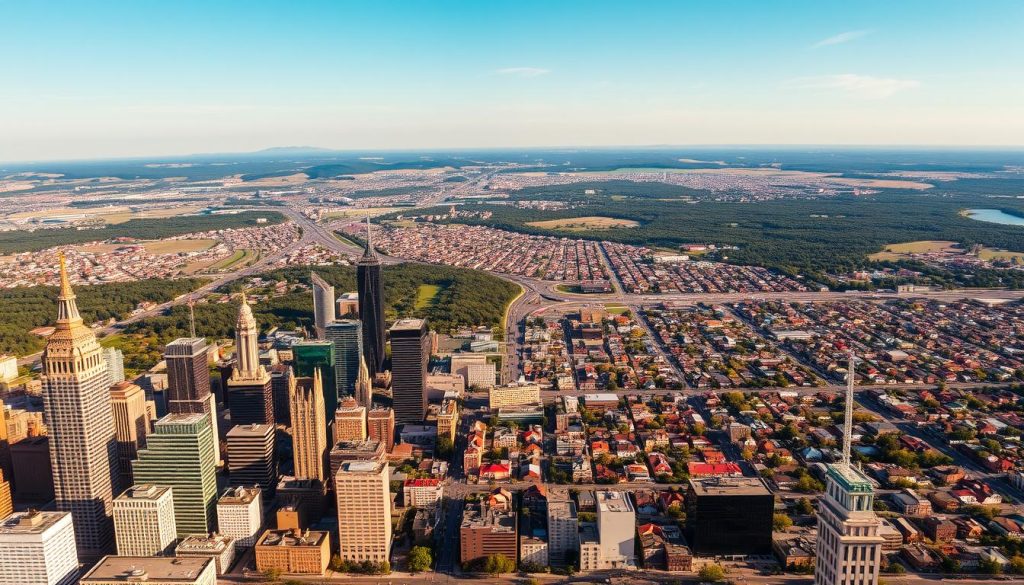
The United States has a rich tapestry of municipalities. There are about 19,500 incorporated places across the nation12. These include cities, towns, and villages of various sizes.
Urban areas are home to 82% of the U.S. population2. This shows how important cities are in America. Most places have small populations, but some are major urban centers1.
Only a few cities are considered large. About 336 cities have over 100,000 people1. Just ten cities boast populations exceeding 1 million. These big cities drive economic, cultural, and social growth nationwide.
Key Takeaways
- The US has approximately 19,500 incorporated places
- 82% of the population lives in urban areas
- Only 336 cities have populations over 100,000
- Urban areas continue to grow at about 1.5% annually
- Cities vary dramatically in size and population density
Understanding Cities and Towns in the US
Urban centers in the United States are diverse and complex. They shape city economies and feature intricate infrastructure systems. These settlements play a vital role across the nation3.
Defining Urban Settlements
Cities and towns differ in population and governance. The U.S. Census Bureau sets specific criteria for urban classification:
- Urban areas require a minimum population of 2,500 residents4
- Cities typically have more complex governmental structures
- Towns often have limited municipal powers
Municipal Classifications
The United States has various municipal classifications. Approximately 19,500 incorporated cities and towns exist nationwide3. These urban centers vary in size and governance:
| Classification | Population Range | Governance Type |
|---|---|---|
| Small Cities | Under 30,000 | Council-Manager |
| Medium Cities | 30,000-100,000 | Mayor-Council |
| Large Cities | Over 100,000 | Complex Municipal |
Governance and Population Dynamics
City governments in the U.S. use different administrative models. The mayor-council form is used by 57% of cities, while 28% use council-manager3.
About 70% of the U.S. population lives in urban areas. This highlights the importance of city infrastructure and services3.
Current Distribution of Cities in the US
The US urban landscape paints a captivating picture. As of 2020, the 100 largest cities house 64,537,560 people. This represents 19.47% of the total national population5.
Urban populations have grown significantly. Between 2010 and 2020, they increased by 6.4%6.
City attractions and culture reflect their geographic spread. Urbanization patterns vary greatly by region. The West Region leads with 88.9% urban population.
In contrast, the Midwest has the lowest urban population percentage6.
- New York City remains the largest urban center with 8,804,190 residents5
- California has the highest urban population at 37,259,4906
- The average population of the top 10 largest cities is approximately 3,800,0005
Urban governance shows interesting diversity. Of the 100 largest cities, 62 have strong mayor systems. Meanwhile, 32 use council-manager systems5.
This complexity highlights the dynamic nature of US metropolitan areas.
The urban landscape continues to evolve, reshaping America’s social and economic fabric.
Major Cities and Metropolitan Areas in the US
The United States has a diverse urban landscape with many metropolitan regions. These urban centers drive economic growth and cultural innovation across the country. They represent the dynamic spirit of American city history and development.
Metropolitan statistical areas show remarkable diversity and complexity7. New York City leads with 8,097,282 residents. Los Angeles follows with 3,795,936, Chicago with 2,638,159, and Houston with 2,319,119 residents7.
These city economies are key drivers of national economic development. They attract talent, investment, and innovation from all over. The US has 350 cities with over 100,000 people, showing steady urban growth7.
California tops the list with 74 such cities. Texas follows with 44, and Florida has 307. These urban centers offer unique attractions. From world-class cultural spots to tech hubs, they draw both residents and visitors.
Metropolitan regions like New York-Newark-Jersey City are complex urban ecosystems. Los Angeles-Long Beach-Anaheim and Chicago-Naperville-Elgin also fit this description8. Their populations exceed 9 million, 13 million, and 9 million respectively.
These areas showcase the intricate networks of modern American urban life. They blend social, economic, and cultural aspects into vibrant communities. Each city offers its own unique flavor and opportunities.
FAQ
How many cities and towns are currently in the United States?
The United States has about 19,500 incorporated cities and towns. These range from small rural areas to large metropolitan centers. They include tiny towns with fewer than 100 people and big cities like New York with over 8 million residents.
What defines a city versus a town in the United States?
The difference between cities and towns varies by state. It often involves population size, governance structure, and legal incorporation. Cities usually have more complex systems and offer broader municipal services than towns.
The U.S. Census Bureau uses specific population thresholds to classify urban areas.
How are municipal classifications determined?
State laws determine municipal classifications. These can include villages, towns, cities, boroughs, and counties. Each class has specific legal rights and governance structures.
They also have responsibilities for providing public services. These include infrastructure, emergency services, and local government administration.
Which regions of the United States have the most urban concentration?
The Northeast and West Coast regions have the highest urban concentrations. States like California, New York, and Texas host significant metropolitan areas.
Major urban corridors include the Boston-Washington stretch and California’s coastal cities. The Texas urban triangle connects Dallas, Houston, and San Antonio.
What are the largest metropolitan areas in the United States?
The largest metro areas include New York City, Los Angeles, Chicago, Dallas-Fort Worth, and San Francisco Bay Area. These regions are economic powerhouses that contribute significantly to national GDP.
They represent diverse cultural and economic landscapes across different parts of the country.
How does population density vary across major U.S. cities?
Population density varies greatly among U.S. cities. New York is compact with 27,000 people per square mile. Phoenix is more spread out with 3,000 people per square mile.
Factors affecting density include geographical constraints, historical development patterns, and local zoning rules.
What factors drive urban growth in the United States?
Many factors drive urban growth. These include job opportunities, tech innovation, economic development, and infrastructure investment. Quality of life also plays a role.
Emerging tech hubs like Seattle and Austin have grown due to their strong technology and startup scenes.
How do urban areas impact the U.S. economy?
Urban areas are vital economic engines, generating about 85% of the U.S. GDP. Major metro regions drive innovation and provide concentrated job markets.
They support diverse industries and serve as centers for technological advancement. These areas are crucial for economic productivity in the country.
Source Links
- List of United States cities by population – https://en.wikipedia.org/wiki/List_of_United_States_cities_by_population
- U.S. Cities Factsheet – https://css.umich.edu/publications/factsheets/built-environment/us-cities-factsheet
- Knowing Your Roles: City and Town Governments – https://mrsc.org/stay-informed/mrsc-insight/january-2024/roles-in-city-and-town-governments
- What Is The Difference Between A City And A Town? – https://www.worldatlas.com/cities/what-is-the-difference-between-a-city-and-a-town.html
- Largest cities in the United States by population – https://ballotpedia.org/Largest_cities_in_the_United_States_by_population
- Nation’s Urban and Rural Populations Shift Following 2020 Census – https://www.census.gov/newsroom/press-releases/2022/urban-rural-populations.html
- Largest US Cities by Population 2024 – https://worldpopulationreview.com/us-cities
- Which Metropolitan Areas in the United States Have the Largest Populations? – https://www.thoughtco.com/largest-metropolitan-areas-1435135

