
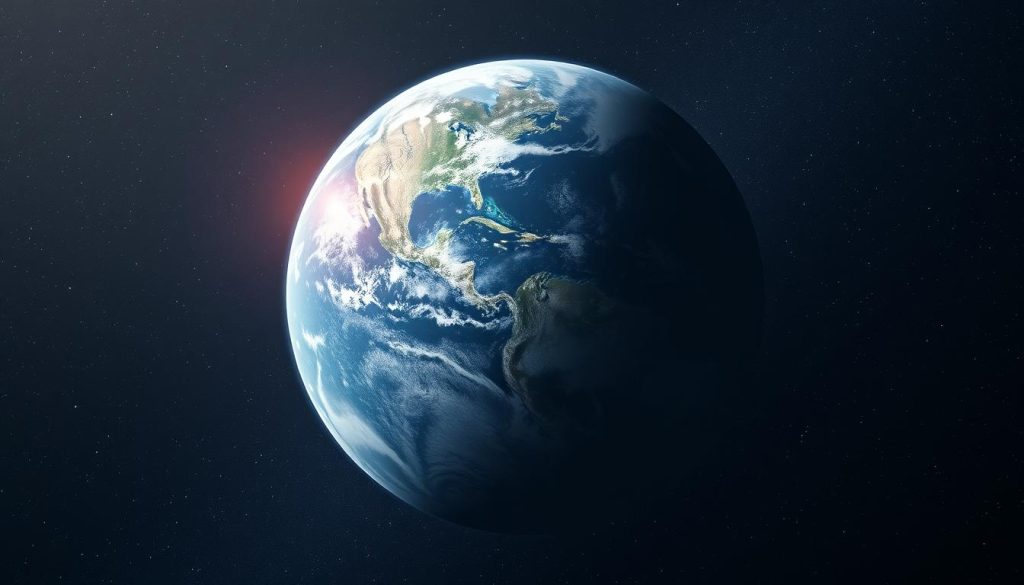
Earth’s circumference offers fascinating insights into our planet’s geography. It spans about 24,901 miles around the equator. This measurement reveals Earth’s complex spheroid shape, challenging simple geometric assumptions12.
Geographical measurement techniques have evolved dramatically since ancient times. The equatorial circumference differs slightly from the polar one. This difference stems from Earth’s unique rotational dynamics1.
Scientists have found that our planet isn’t a perfect sphere. It’s an oblate spheroid, deviating about 0.3% from a perfect spherical shape2.
This subtle variation impacts navigation and satellite positioning. It also enhances our understanding of planetary mechanics.
Key Takeaways
- Earth’s equatorial circumference is approximately 24,901 miles
- The planet is an oblate spheroid, not a perfect sphere
- Circumference varies between equator and poles
- Geographical measurements reveal complex planetary geometry
- Ancient and modern techniques have refined our understanding
Understanding Earth’s Shape and Size
Earth isn’t a perfect sphere. Scientists in geodesy have found it’s an ellipsoid, specifically an oblate spheroid3. This shape reveals fascinating aspects of how planets form.
The Oblate Spheroid Form
An oblate spheroid is a slightly flattened sphere. Earth’s rotation causes this shape, creating a bulge around the equator3. The planet’s meridional and equatorial circumferences differ due to this unique feature.
- Earth spins at over 1,000 miles per hour at the equator3
- The diameter varies between polar and equatorial regions
- Spherical approximation fails to capture the planet’s true shape
Polar vs Equatorial Dimensions
Earth’s dimensions show key differences. The polar circumference is slightly shorter than the equatorial one. The planet’s diameter is about 8,000 miles, with small variations between poles and equator3.
Effects of Earth’s Rotation on Shape
Earth’s spin creates a force that pushes material outward at the equator. This process forms a noticeable bulge, making the planet wider in the middle.
The 23.5-degree axial tilt also influences Earth’s unique shape3. These factors combine to create our planet’s distinct geometry.
The Earth’s shape is a testament to the complex interplay of gravitational and rotational forces.
Earth’s Circumference: Measurements and Calculations
The Earth’s circumference has intrigued scientists for millennia. Around 240 BC, Eratosthenes made a breakthrough in measuring our planet’s size45. He used sunlight angles to estimate the Earth’s circumference at 39,350 km, close to modern figures4.
Eratosthenes’ method involved tracking shadows and solar angles. He used a spherical approximation to calculate the distance between Alexandria and Syene45. His approach was remarkably accurate, with an error margin between -2.4% and +0.8%.
Today, satellite geodesy provides more precise measurements. We now know the Earth’s shape varies slightly between equatorial and polar regions. The accepted circumference is about 40,075 km4.
These accurate measurements are crucial for modern technology. They help develop GPS systems and support important climate research. Our understanding of Earth’s size continues to shape various scientific fields.
FAQ
What is the exact circumference of the Earth?
Earth isn’t a perfect sphere. It’s an oblate spheroid. The equatorial circumference is about 24,901 miles (40,075 kilometers). The polar circumference is slightly shorter at 24,860 miles (40,008 kilometers).
Why isn’t Earth a perfect sphere?
Earth’s rotation causes it to be an oblate spheroid. The spinning creates a bulge around the equator. This makes Earth wider at the equator and slightly flattened at the poles.
This shape is important for accurate measurements. It also helps scientists understand our planet better.
How did ancient scientists measure Earth’s circumference?
Eratosthenes made the first accurate measurement around 240 BCE. He used shadow angles in two locations to calculate Earth’s size. His estimate was impressively close using only basic geometry and observation.
How do modern scientists measure Earth’s circumference?
Satellite geodesy provides the most precise measurements today. GPS, satellite laser ranging, and global positioning systems are used. These tools allow scientists to measure Earth’s circumference down to millimeters.
Why is knowing Earth’s circumference important?
Knowing Earth’s size is crucial for many fields. These include navigation, GPS technology, climate science, and space exploration. Accurate measurements help create maps and track global positioning.
They also aid in studying planetary changes. This knowledge is vital for planning satellite and space missions.
How does Earth’s rotation affect its shape?
Earth’s rotation creates an equatorial bulge. This makes the planet about 43 kilometers wider at the equator than pole-to-pole. This effect has been ongoing since Earth’s formation.
Can the Earth’s shape change over time?
Earth’s shape can change slightly over time. Factors include tectonic plate movements, massive earthquakes, and ice cap melting. These changes happen very slowly, usually measured in millimeters or centimeters.
How do scientists distinguish between different Earth measurements?
Scientists use specific terms for Earth’s dimensions. These include equatorial circumference, polar circumference, mean radius, and ellipticity. Geodesy is the field that specializes in these complex geographical measurements.
Source Links
- How Many Miles Around the Earth? – https://www.universetoday.com/66515/how-many-miles-around-the-earth/
- Earth’s circumference – https://en.wikipedia.org/wiki/Earth’s_circumference
- What Is Earth? (Grades 5-8) – NASA – https://www.nasa.gov/learning-resources/for-kids-and-students/what-is-earth-grades-5-8/
- Eratosthenes Measures Earth’s Circumference – https://outreach.as.utexas.edu/marykay/assignments/eratos1.html
- The Eratosthenes experiment: calculating the Earth’s circumference – https://www.scienceinschool.org/article/2023/calculating-earths-circumference/

