
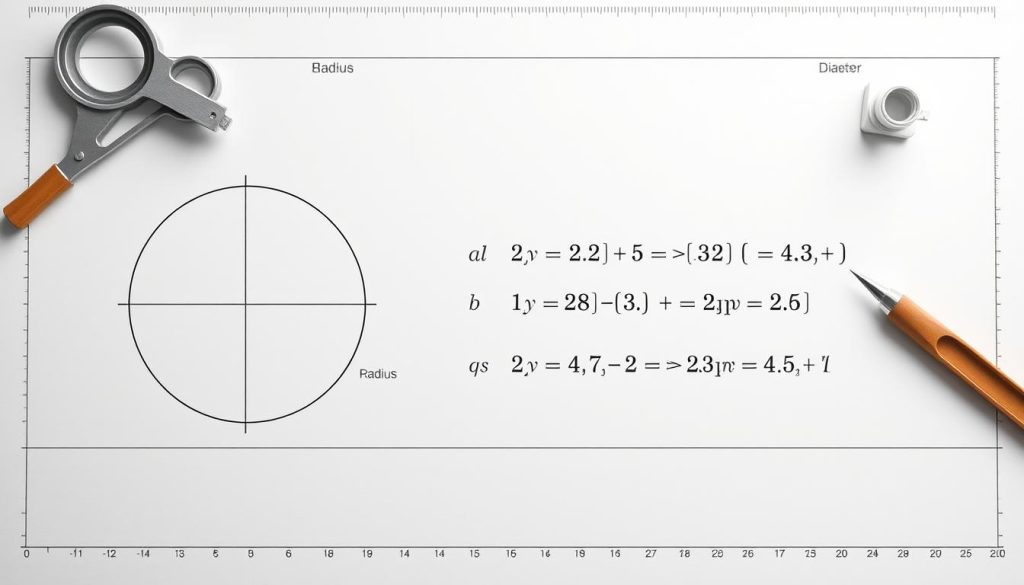
Circle measurements are key in geometry. A circle’s shape is defined by its radius and diameter. These parts are vital for understanding circles.
The diameter is the longest line through the circle’s center. It’s crucial for math calculations. Knowing the diameter helps solve many geometric problems.
Calculating diameter is simple. Just multiply the radius by two: D = 2r. This easy formula works for all circles.
Math pros use circle measurements often. The diameter helps find a circle’s size and area. It’s useful for solving tricky geometry questions.
Exact measurements matter in circles. Pi (π), about 3.14, is a key number1. Experts use special formulas to get precise circle dimensions.
Key Takeaways
- Diameter is the longest chord passing through a circle’s center
- The diameter formula is D = 2r, where r represents the radius
- Pi (π) is crucial in circle measurements
- Circle calculations involve multiple geometric relationships
- Accurate diameter measurement is essential in mathematics and engineering
Understanding Circle Basics and Components
Circles are fascinating shapes in math and nature. They have a unique property: all points on the edge are equidistant from the center2. This makes circles vital in science and practical applications.
Key circle components enable circumference calculation. These include the center, radius, diameter, and circumference itself.
- Center: The central point from which all distances are measured
- Radius: A line segment connecting the center to any point on the circle2
- Diameter: The longest chord, equal to twice the radius2
- Circumference: The total distance around the circle
Essential Parts of a Circle
The radius-to-diameter conversion is crucial for accurate measurements. The diameter equals twice the radius: D = 2r3. This relationship is key in pi applications and precise geometric calculations.
The Role of Pi (π) in Circle Calculations
Pi (π) is a constant approximately equal to 3.14159. It links a circle’s diameter to its circumference3. This number allows for precise calculations involving circular shapes.
The formula C = πd shows how pi relates a circle’s dimensions3. It creates a consistent relationship between diameter and circumference.
Circles are perfect examples of mathematical elegance, where simple rules create complex and beautiful patterns.
Calculate the Diameter of a Circle
Circle Area Determination hinges on key math calculations. Diameter is vital in Mathematical Word Problems. It’s the distance across a circle’s center4.
The basic formula for diameter is D = 2R. Here, R stands for the radius5.
- Using Radius: Multiply the radius by 25
- Using Circumference: Divide circumference by π6
- Using Area: Calculate diameter through advanced formulas5
Let’s look at some real-world calculation examples:
| Measurement Type | Value | Diameter Calculation |
|---|---|---|
| Radius | 15 units | D = 2 × 15 = 30 units5 |
| Circumference | 52 units | D = 52 / π ≈ 16.55 units5 |
| Area | 20 unit² | D = 2√(20/π) ≈ 8.03 units5 |
Pro tip: Always double-check your math. Use π as 3.14 for most everyday tasks6.
Accurate circle measurements are crucial in fields ranging from engineering to design.
Practical Methods for Measuring Circle Diameter
Measuring a circle’s diameter requires precise techniques and geometric formulas. These methods help determine the size accurately. Let’s explore some practical ways to measure circle diameters.
Understanding Direct Measurement Techniques
Direct measurement is the simplest way to find a circle’s diameter. Professional tools like digital calipers and measuring tapes provide quick, accurate results.
- Digital calipers: Precise measurement for small circular objects
- Measuring tape: Ideal for larger circular surfaces
- Diameter wheel: Professional tool for precise circular measurements
Indirect Measurement Strategies
Geometric formulas help calculate the diameter when direct measurement isn’t possible. You can find the diameter by dividing the circumference by π (pi)7.
| Measurement Method | Calculation Formula |
|---|---|
| Circumference-based | Diameter = Circumference ÷ π |
| Area-based | Diameter = 2 * √(Area ÷ π) |
These methods are useful for measuring tree trunks, pipe diameters, and hard-to-reach circular objects. They provide accurate results in challenging situations8.
Pro tip: Use multiple measurement techniques to double-check your results. This ensures the highest accuracy in your circle measurements7.
Conclusion
Calculating a circle’s diameter is vital in many fields. It’s useful in engineering, design, and everyday problem-solving. The diameter is the longest line through a circle’s center9.
You can find the diameter using radius, circumference, or area. These methods provide insights into geometric principles10.
Key formulas make circle area calculations easier. The diameter is always twice the radius. The ratio of circumference to diameter is always π9.
This consistency helps solve complex geometric problems. It’s useful for both professionals and students10.
Practice is the best way to master these calculations. Try different scenarios and measurement techniques. This helps develop an intuitive understanding of circle geometry9.
Each method has its advantages in different situations. Direct measurement and formulas both have their place.
Circle dimension skills apply to many areas. They’re used in construction and scientific research. These math principles help us understand geometric relationships better10.
Learn more about the diameter formula and its applications. It’s a valuable tool for spatial understanding.
FAQ
What is the diameter of a circle?
The diameter is a line that cuts a circle in half. It passes through the center and connects two points on the edge. It’s the longest distance across the circle.
How do I calculate the diameter if I know the radius?
Calculating the diameter is easy! Just multiply the radius by 2. The formula is Diameter = 2 × Radius (D = 2R). For example, a 5-inch radius equals a 10-inch diameter.
What is pi (π) and why is it important in circle calculations?
Pi (π) is about 3.14159. It’s the ratio of a circle’s edge to its diameter. Pi helps us figure out circle measurements like area and circumference.
Can I calculate the diameter if I know the circumference?
Yes! Use this formula: Diameter = Circumference ÷ π. Since the circumference is π times the diameter, just divide by π.
What tools can I use to measure a circle’s diameter?
You can use calipers, tape measures, rulers, or digital tools. The best choice depends on the circle’s size and type.
How accurate are indirect measurement methods?
Indirect methods can be very accurate if done carefully. Using circumference or area calculations works well when you can’t measure directly.
Where are circle diameter calculations used in real life?
Diameter calculations are key in many fields. They’re used in engineering, construction, manufacturing, and astronomy. Even cooking and home projects often need diameter measurements.
What’s the difference between diameter and radius?
The radius is half the diameter’s length. It goes from the circle’s center to its edge. The diameter spans the whole circle through its center.
How do I calculate a circle’s area using diameter?
Use this formula: Area = π × (Diameter/2)². You can also use Area = π × (Radius)². These formulas help you find the space inside the circle.
Are there any common mistakes to avoid when calculating diameter?
Watch out for mixing up radius and diameter. Don’t forget to divide by 2 when switching between them. Use the right value for π. Always double-check your math and measurements.
Source Links
- How To Calculate Diameter From Circumference – https://www.sciencing.com/calculate-diameter-circumference-5130961/
- Circles in Maths – Definition, Formulas, Properties, Examples – https://byjus.com/maths/circles/
- Circle Formulas For Diameter, Area and Circumference – GeeksforGeeks – https://www.geeksforgeeks.org/circle-formulas-for-diameter-area-and-circumference/
- Diameter, Radius, & Circumference of Circles (Video) – https://www.mometrix.com/academy/the-diameter-radius-and-circumference-of-circles/
- How to Calculate Diameter of a Circle – GeeksforGeeks – https://www.geeksforgeeks.org/how-to-calculate-diameter-of-a-circle/
- How to Find the Diameter of a Circle – https://www.insight-security.com/how-to-find-the-diameter-of-a-circle
- Diameter of a Circle (Definition, Formulas, Properties & Examples) – https://byjus.com/maths/diameter/
- Area of a Circle Formula – https://www.edulyte.com/maths/area-of-a-circle-formula/
- Circumference to Diameter: Conversion, Formula, Meaning, Example – https://www.splashlearn.com/math-vocabulary/circumference-to-diameter
- Diameter Formula – Explanation, Solved Examples and FAQs – https://www.vedantu.com/formula/diameter-formula

