
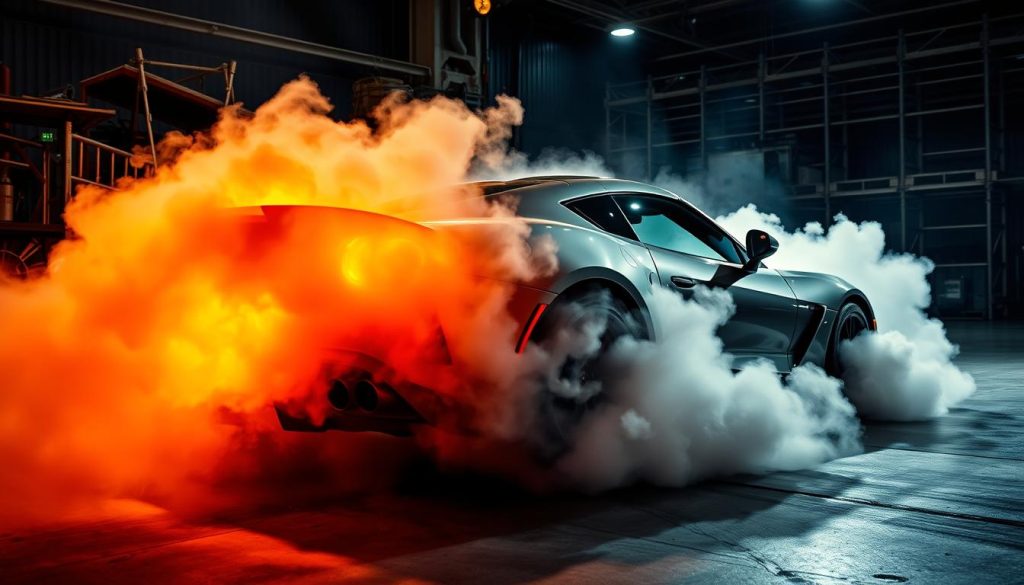
Burnouts have evolved from a drag racing technique to an exciting automotive spectacle. They now captivate car fans worldwide. This high-octane performance art has gained huge popularity in Australia and North America1.
A burnout isn’t just about making tire smoke. It’s a skill that needs precision and understanding of car mechanics. Burnouts are now celebrated at professional drag races and local car meetups2.
Learning to do a burnout takes knowledge, technique, and a powerful car. You need the right mix of horsepower, drivetrain, and driving skills. These elements can turn a regular car into a smoke-making machine2.
Key Takeaways
- Burnouts originated in drag racing as a tire preparation technique
- Proper vehicle selection is crucial for a successful burnout
- Safety and controlled environments are paramount
- Tire wear is a significant consideration
- Mechanical understanding enhances burnout performance
Understanding Burnouts and Their Origins
Burnouts showcase raw automotive power in drag and street racing. These tire-squealing displays highlight the intense bond between driver, vehicle, and mechanical performance3.
What Creates the Perfect Burnout
A perfect burnout needs specific vehicle traits. Key elements include:
- Powerful engine with high torque output
- Rear-wheel drive configuration
- Narrow tires to reduce road friction
- Manual transmission for better control
The Science of Tire Smoke
Tire smoke during burnouts comes from complex chemical reactions. Rapid tire heating vaporizes rubber tread compounds, creating dramatic white smoke.
Moisture and tire composition play crucial roles in smoke production.
Essential Vehicle Requirements
Not all vehicles can perform spectacular burnouts. High-performance cars with specific features are best suited.
The power-to-weight ratio greatly affects a car’s ability to overcome road grip4.
The art of the burnout is a delicate balance between mechanical power and precise driver control.
How to Do a Burnout: Step-by-Step Instructions
Burnouts require skill and knowledge of your car’s limits. For muscle cars, revving the engine is key. Find a safe, controlled area away from public roads before attempting this stunt.
For automatic cars, start in Drive and hold the brake pedal. Rev the engine to 3,000-5,000 RPM. This range is best for spinning tires. Let go of the brake to start the wheelspin.
Be careful, as burnouts can stress your car’s parts. Tire temps can reach over 204°C, possibly damaging them. Learn the essential techniques to avoid harm56.
Manual car drivers should use first gear and rev the engine. Press the clutch fully, then lock the handbrake. Release the clutch to spin the tires.
Remember, burnouts are illegal on public roads in most states. Get pro guidance to stay safe during these stunts6.
Mastering burnouts takes practice and knowing your car’s limits. Safety should be your top priority. Long burnouts can wear tires fast and damage your car75.
Always follow local laws. Only do burnouts in controlled, professional settings.
FAQ
What exactly is a burnout?
A burnout is a car technique where driven wheels spin rapidly while stationary. It creates impressive tire smoke through friction between tires and road. Burnouts showcase the power of high-performance vehicles and are popular among car enthusiasts.
Are burnouts legal?
Burnouts are usually illegal on public roads and can lead to fines or license suspension. They should only be done on closed tracks or designated areas with proper authorization.
What type of vehicle works best for burnouts?
Rear-wheel-drive cars with manual transmissions are ideal for burnouts. Muscle cars and sports cars with high horsepower provide the most impressive tire-smoking displays.
Do I need special tires to do a burnout?
Special tires aren’t necessary, but street or slightly worn tires can produce better smoke. Racing tires with softer compounds tend to create more dramatic smoke effects.
How dangerous are burnouts?
Burnouts can be extremely dangerous if not done correctly. Risks include loss of control, tire damage, and potential accidents. Always prioritize safety and perform burnouts only in controlled environments.
How long can a typical burnout last?
Most burnouts last between 5-15 seconds. Longer burnouts can cause excessive tire wear and increase risk of vehicle damage. Professional drivers usually limit burnout duration to protect their vehicles.
What’s the difference between a burnout and a peel-out?
A burnout involves spinning wheels while stationary, creating tire smoke. A peel-out is quick acceleration from a stop with significant wheel spin. Both showcase a vehicle’s power and traction.
Can automatic transmission vehicles do burnouts?
Yes, automatic cars can perform burnouts, but the technique differs from manual vehicles. Most modern automatics require specific methods like brake-torque or disabling traction control.
What causes tire smoke during a burnout?
Tire smoke occurs when rubber compounds heat up and break down under extreme friction. The high-temperature reaction between tire rubber and road surface produces the characteristic white/blue smoke.
Are burnouts bad for my vehicle?
Yes, frequent burnouts can cause significant mechanical stress to your vehicle. Potential damages include accelerated tire wear, transmission damage, and drivetrain component failure. Occasional, controlled burnouts are less harmful than repeated aggressive performances.
Source Links
- How to do a perfect burnout – https://www.tyroola.co.nz/blog/how-to-do-a-perfect-burnout/?srsltid=AfmBOop9_S2NZfFUxk60fGQQuO19zQJAJnQ2xKIy7Xg-6Qju_70OOcMs
- How to Do a Burnout: The Complete Guide – https://autowise.com/how-to-do-a-burnout/
- Depression: Learn More – What is burnout? – InformedHealth.org – https://www.ncbi.nlm.nih.gov/books/NBK279286/
- Understanding the burnout experience: recent research and its implications for psychiatry – https://pmc.ncbi.nlm.nih.gov/articles/PMC4911781/
- Let’s Roast Some Tires and Teach You How To Do a Burnout! – https://www.thedrive.com/cars-101/39174/how-to-do-a-burnout
- A Step-By-Step Breakdown Of How To Do A Burnout In A Manual Car – https://carbuzz.com/car-advice/a-step-by-step-breakdown-of-how-to-do-a-burnout-in-a-manual-car/
- How To Do A Burnout In A Manual For Beginners – https://carfromjapan.com/article/how-to-do-a-burnout-in-a-manual/

