
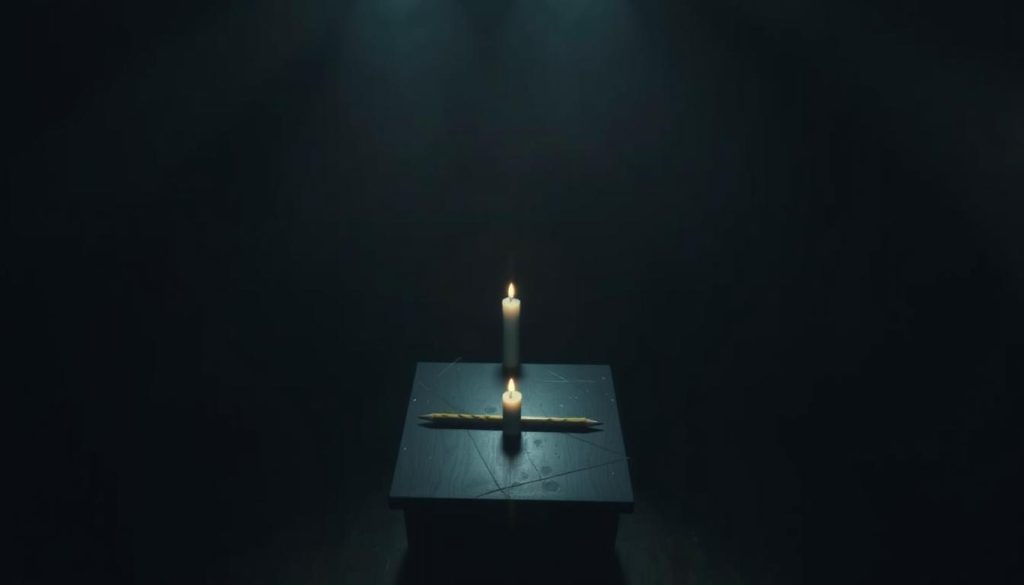
The Charlie Charlie Challenge is a viral game that attracts people curious about paranormal activity. This pencil game swept social media, challenging players to talk with supernatural entities. Teens worldwide became fascinated by the idea of contacting spirits through this game1.
The challenge boomed in 2015, driven by the #CharlieCharlieChallenge hashtag and numerous social media posts. A YouTube newscast on April 29, 2015, boosted its Twitter popularity. The game quickly became a global sensation, sparking excitement and controversy12.
Some saw the Charlie Charlie Challenge as harmless fun. Others, like Christian critics and exorcists, warned it could be demonic. Studies showed that 70% of players felt scared or anxious while playing12.
Key Takeaways
- The Charlie Charlie Challenge went viral in 2015
- Game involves psychological manipulation and suggestion
- Participants often experience heightened anxiety
- Multiple countries have raised concerns about the game
- The challenge is based on psychological phenomenon
Understanding the Charlie Charlie Challenge Origins
The Charlie Charlie Challenge is a Mexican supernatural game that went viral worldwide. This pencil ritual became a global social media sensation3.
Millions were captivated by its mysterious nature. The game’s simple setup led to its quick spread across the internet.
The game’s origins are not as simple as they seem. It’s not based on authentic Mexican folklore. Instead, it’s a modern version of a Spanish game called Juego de la Lapicera4.
This older game, known as the Pencil Game, inspired the Charlie Charlie Challenge. The new version gained popularity through social media platforms.
Viral Spread and Social Media Impact
Social media was key in making the Charlie Charlie Challenge famous worldwide. In just 48 hours, over 2 million people used the #CharlieCharlieChallenge hashtag3.
Famous social media personalities helped boost the game’s popularity. Their endorsements led to a surge in people trying the challenge.
Cultural Dynamics of the Challenge
- Blend of supernatural traditions like Ouija board and cootie catcher4
- Primarily played in group settings, enhancing social bonding4
- Accessible game requiring only two pencils4
The game has many stories about who “Charlie” is. Some say he’s a dead Mexican child. Others think he’s a supernatural being4.
Psychologists note that teens are drawn to these supernatural social experiences. The game’s group nature adds to its appeal.
Supernatural Game Phenomenon
The Charlie Charlie Challenge claims to summon spirits. However, it’s more about psychology than real supernatural communication. The pencil moves due to the ideomotor effect4.
This effect happens when mental focus causes unconscious physical reactions. It explains the seemingly magical movements in the game.
Do the Charlie Charlie Challenge: Step-by-Step Instructions
The Charlie Charlie Challenge is a pencil ritual that’s caught teens’ attention worldwide. It’s an exciting dare that spread quickly through social media5.
- Grab a blank sheet of paper
- Draw a cross dividing the paper into four equal quadrants
- Label two opposite quadrants “Yes” and the other two “No”
- Place two pencils carefully in a cross formation
- Balance one pencil on top of the other
The challenge exploded in popularity during Memorial Day Weekend 2015. Hundreds of thousands of teenagers joined in on the fun6.
To start, say “Charlie, Charlie, are you here?” Watch closely. The top pencil might seem to move by itself5.
Safety tip: Always play with friends and approach the pencil ritual as a fun experience, not a serious supernatural encounter.
This game has roots in Mexican and Spanish traditions. It’s called Juego de la Lapicera in those cultures6.
Some take the dare seriously, but most see it as a fun social media challenge5. It’s sparked talks about supernatural beliefs among players.
Scientific Explanation Behind the Challenge
The Do the Charlie Charlie Challenge seems mysterious, but science offers fascinating explanations. Researchers have uncovered key factors that demystify this viral game7. Basic physics principles, like unstable equilibrium, cause the pencil’s movement7.
Psychological mechanisms play a big role in the Charlie Charlie Challenge. The ideomotor effect suggests people can unconsciously influence movements7. Studies show that expectations and suggestibility add to the game’s supernatural feel8.
Psychologist Stuart Vyse sees these challenges as social bonding for young people7. The game reflects a trend of viral internet challenges that excite teens8. Psychologist Mark Griffiths believes these activities are usually harmless7.
Understanding the science behind Charlie Charlie makes it less spooky. It’s an interesting mix of physics, psychology, and youth culture8. The game’s appeal lies in how we interpret simple movements as mysterious.
FAQ
What exactly is the Charlie Charlie Challenge?
The Charlie Charlie Challenge is a viral pencil ritual. Players try to “summon” a supernatural entity using pencils on paper. It became popular among teenagers globally in 2015.
Is the Charlie Charlie Challenge real or just a game?
It’s a psychological game with no supernatural basis. The pencil’s movement is caused by natural physics. Air currents, breathing, or unconscious muscle movements can make the pencil move.
Where did the Charlie Charlie Challenge originate?
It’s not traditional Mexican folklore. The game is a modern take on “Juego de la Lapicera”. This Spanish pencil game went viral on social media in 2015.
How do you perform the Charlie Charlie Challenge?
Draw a cross on paper with four “yes” and “no” quadrants. Place two pencils in a cross shape. Balance one pencil on top of the other.
Ask “Charlie, Charlie, are you there?” Watch if the top pencil moves.
Why do people find this challenge so interesting?
The game mixes mystery and adolescent daring. It taps into our fascination with supernatural experiences. The unexplained pencil movements intrigue many people.
Is the Charlie Charlie Challenge dangerous?
It’s not physically dangerous, but can be unsettling for some. Approach the game with a rational mindset. Understand the science behind the pencil’s movement.
What causes the pencil to move during the challenge?
Scientific explanations include gravity and air currents. Subtle breathing can also cause movement. The ideomotor effect may play a role too.
This effect involves unconscious muscle movements causing seemingly spontaneous actions.
Can anyone do the Charlie Charlie Challenge?
Anyone can try the challenge, though it’s popular with teens. Keep a playful attitude when participating. Remember, it’s a psychological game, not a real paranormal experience.
Source Links
- Charlie Charlie challenge – https://en.wikipedia.org/wiki/Charlie_Charlie_challenge
- Everything you need to know about #CharlieCharlieChallenge, and why you’re not being haunted by a Mexican demon – https://www.independent.co.uk/tech/charlie-charlie-challenge-explained-it-s-not-a-mexican-demon-being-summoned-it-s-gravity-10276557.html
- Where did Charlie Charlie Challenge come from? – https://www.bbc.com/news/blogs-trending-32887325
- “Charlie, Charlie, are you there?” Why teens are summoning demons, explained. – https://www.vox.com/2015/6/5/8735481/charlie-charlie-challenge-explanation
- What is the Charlie Charlie Challenge and How to Play – https://www.scarystudies.com/charlie-charlie-challenge/
- Hundreds of thousands of teenagers spent the weekend on Instagram and Vine trying to ‘summon a demon’ named Charlie – https://www.businessinsider.com/how-to-do-the-charlie-charlie-challenge-2015-5
- The Charlie Charlie Challenge | Skeptical Inquirer – https://skepticalinquirer.org/2015/11/the-charlie-charlie-challenge/
- What Is the Charlie Charlie Challenge, and Why Are Teens Playing It? – https://www.yahoo.com/tech/what-is-the-charlie-charlie-challenge-and-why-are-120042900744.html

