
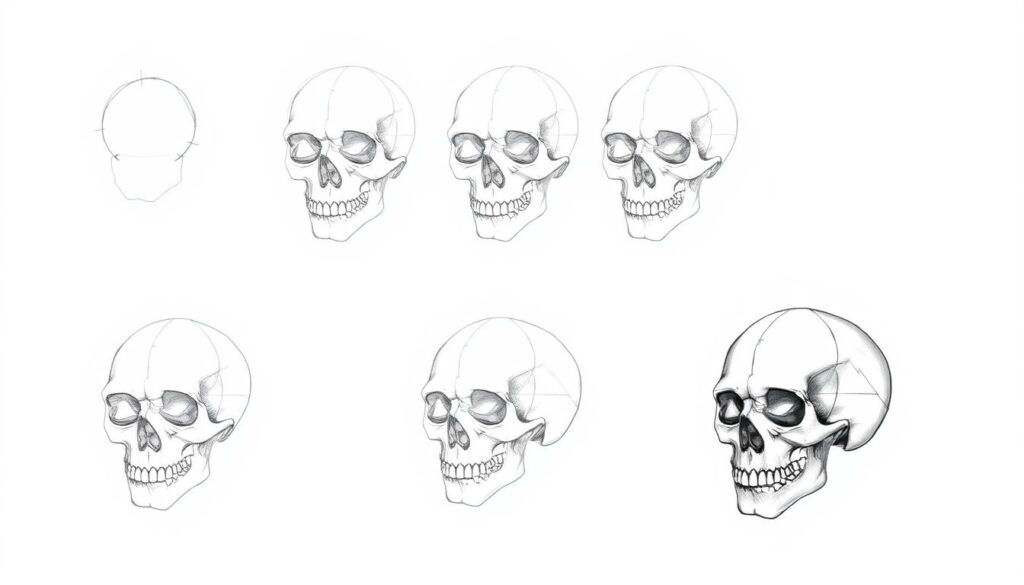
Drawing a skull can be an exciting artistic journey. It helps you understand anatomical details and improve your sketching skills. With patience and practice, you can master this fascinating art form1.
Start by exploring basic techniques and various drawing materials. You can use pencils, markers, or crayons to create your artwork1.
The process involves creating guidelines and sketching key features. Adding depth through shading techniques is crucial for a realistic look2.
Begin with a circular base for the skull. Then, add detailed features like eye sockets, teeth, and nasal cavities1.
Try drawing from different angles to challenge yourself. Use light erasure to fix any mistakes along the way2.
Key Takeaways
- Learn fundamental skull drawing techniques
- Understand anatomical proportions
- Practice with different drawing materials
- Focus on precise guidelines and symmetry
- Develop shading skills for realistic depth
Understanding Skull Anatomy
The human skull is a fascinating structural marvel. It protects your brain and shapes your face. This complex structure has many intricate parts worth exploring.
Key Features of the Skull
Your skull consists of multiple interconnected bones. Adult human skulls have 22 individual bones. Of these, 21 are fused into a single unit3.
The mandible, or lower jaw, is the only movable bone. It stands out in this intricate system3.
- Cranium: Consists of 8 bones protecting the brain4
- Facial bones: Provide structural support for facial features4
- Unique bone connections: Formed through 33 specialized sutures5
Different Skull Types
The skull has two main sections: the braincase and facial skeleton. These are also known as neurocranium and viscerocranium5.
The facial skeleton has 14 distinct bones. These include important structures like the maxilla, mandible, and zygomatic bones5.
Proportions to Keep in Mind
Knowing skull proportions helps with accurate drawing. The skull has specific spatial relationships:
- Brain case occupies about two-thirds of the total skull volume
- Facial bones comprise the remaining one-third
- Eye sockets are centrally aligned
- The nasal cavity sits between eye sockets
Pro tip: Observing these proportions will help you create more realistic skull drawings.
“The skull is nature’s masterpiece of protection and design” – Anatomical Insight
Gathering Your Drawing Materials
The right drawing materials are key for successful skull sketching. Good tools can greatly improve your skull drawings. This applies to both beginners and experienced artists.
Essential Tools for Beginners
Starting your skull drawing journey requires a few key materials. Here are some fundamental tools to consider:
- Technical pencils with multiple point sizes (0.3mm, 0.5mm, 0.7mm, and 0.9mm) for precise line work6
- STEEL F-301 Retractable Ballpoint Pen for outlining
- Zensations Technical Drawing Pen for detailed cross-hatching6
- White eraser for clean corrections6
Recommended Paper Types
The right paper can greatly enhance your skull drawings. Look for smooth textures that allow detailed rendering. Here are some options:
- Sketch paper for preliminary drawings
- Bristol board for final, refined pieces
- Heavyweight drawing paper to prevent bleeding
Optional Accessories
To boost your skull sketching techniques, try these extra tools:
- Blending stumps for smooth shading
- Fine-tipped pens for intricate details
- Compass for creating perfect circular guidelines7
Pro tip: Always practice on a separate piece of paper to refine your skills before creating your final drawing6.
Remember, the right materials can transform your skull drawings from basic sketches to professional-level artwork.
Step-by-Step Skull Drawing Process
Mastering skull illustration tips requires patience and a systematic approach. This guide will help you create an impressive skull art piece. You’ll learn valuable skills, whether you’re a beginner or looking to improve.
Sketching the Foundational Outline
Begin your skull art journey by drawing a basic circle for the cranium8. Divide the skull’s height into six equal parts for proper proportions9.
Use light pencil strokes to create guidelines for symmetry10. These will help you maintain balance throughout your drawing.
- Begin with a light circle for the cranium
- Add vertical and horizontal guidelines
- Mark key anatomical points9
Adding Intricate Details and Shadows
Define key features like eye sockets, nasal cavity, and jaw. Use different pencil grades to create depth and dimension.
A 2B pencil works best for darkest areas such as eye sockets and jaw8. For softer shading, switch to an HB or 2H pencil10.
Perfecting Your Skull Illustration
Refine your drawing by adding subtle textures and shadows. Use a tortillion for blending and create cast shadows for a 3D effect8.
Try cross-hatching techniques to add stylistic elements to your skull art8. This will give your drawing more character and depth.
Pro Tip: Layer your shadows gradually to build depth and contrast in your skull drawing.
Practice is key to developing your skull illustration skills. Each drawing will improve your technique and understanding of skull anatomy.
Tips for Improvement and Practice
Improving skull drawing skills takes dedication and smart practice. Study techniques of professional artists who excel in anatomical illustration11. Notice how they capture intricate details and subtle nuances of skull anatomy12.
Online resources offer great skull drawing practice. Find tutorials with 10 essential tips to refine your skills11. They often suggest using 3D models, anatomy books, and real skull references.
Learn different techniques like exploring lighting, shading, and adding textures to your drawings11. Consistent practice is crucial for mastery. Try different angles and mark-making techniques to boost your skills11.
Sketch skulls from various views using tools like mechanical pencils and rulers12. Start with light lines that are easy to adjust. This allows for refinement as you progress12.
Learning from Other Artists
Find inspiration from pros and art communities. Join online forums, workshops, or drawing groups for feedback. These can provide valuable insights into skull illustration techniques11.
Online Resources and Tutorials
Use online tutorials for step-by-step skull drawing guidance. Look for resources that simplify complex anatomical details. These can help break down the learning process11.
Practicing Regularly for Mastery
Create a consistent drawing routine. Set daily time to sketch and try new styles. Push your artistic limits to grow your skills11.
FAQ
What are the basic materials I need to start drawing a skull?
You’ll need HB and 2B pencils, a good eraser, and a ruler. Sketch paper or bristol board works well for smooth textures.
Optional items like blending stumps and fine-tipped pens can add more detail to your skull drawing.
How do I start drawing a skull if I’m a complete beginner?
Start with a light circle for the cranium and add guidelines for symmetry. Sketch the basic shapes of eye sockets and nasal cavity.
Add details like the jaw, cheekbones, and teeth gradually. Use light, loose lines at first.
Don’t worry about perfection. Keep practicing to improve your skills.
What are the key proportions I should know when drawing a human skull?
The cranium is about 1.5 times larger than the facial area. Eye sockets align with the skull’s center.
The nasal cavity sits between the eye sockets. The jaw extends halfway from the eyes to the chin.
These proportions will help you create a more realistic skull drawing.
How can I make my skull drawing look more realistic?
Focus on shading techniques to create depth and dimension. Pay attention to eye sockets and cheekbones.
Use varying pencil pressures for shadows and highlights. Study anatomy books and reference images.
Understanding the skull’s bone structure and subtle details will improve your drawing.
How long does it take to get good at drawing skulls?
Improving your skull drawing skills requires consistent practice. Sketch different angles and types of skulls regularly.
Watch online tutorials and join art communities. Don’t be afraid to try various styles.
Remember, every artist started as a beginner. Be patient with yourself as you learn.
Can I add my own artistic style to a skull drawing?
Absolutely! Once you know the basic anatomy, feel free to experiment. Create stylized, decorative, or whimsical skull illustrations.
Try different shading techniques or add color. Incorporate unique patterns and textures to make the skull drawing yours.
What are some common mistakes to avoid when drawing a skull?
Common mistakes include incorrect proportions, symmetry issues, and overlooking bone structure details. Start with light guidelines.
Take your time with symmetry and study real skull references. Don’t rush the process.
Remember that erasing and redrawing is part of learning to draw skulls well.
Source Links
- How to Draw Skulls: Easy Step-by-Step Instructions for Drawing Seven Different Skulls! — Art is Fun – https://www.art-is-fun.com/how-to-draw-skulls
- How to Draw a Skull (with Pictures) – wikiHow – https://www.wikihow.com/Draw-a-Skull
- The Skull | Anatomy and Physiology I – https://courses.lumenlearning.com/suny-ap1/chapter/the-skull/
- 7.3 The Skull – https://open.oregonstate.education/aandp/chapter/7-3-the-skull/
- Skull – https://www.kenhub.com/en/library/anatomy/the-skull
- Spooky Ballpoint Illustration: How to Draw a Skull & Crow – https://www.zebrapen.com/blogs/creative-inspiration/spooky-skull-ballpoint-tutorial?srsltid=AfmBOoqTKMkgNRQ0jpqE0Fzal17DUTver1nj6m0YUvI161ZivunwhNTt
- How To Draw Skull Step By Step – For Kids & Beginners – https://how-to-drawa.com/skull/
- How To Draw A Skull In 3/4 View – https://mydrawingtutorials.com/how-to-draw-a-skull-in-34-view/
- How to Draw a Skull – https://lifedrawing.academy/drawing-lessons/how-to-draw-skull
- Skull Drawing Guide In 5 Easy Steps [Video + Images] – https://www.biowars.com/blog/skull-drawing/
- 10 Essential Skull Drawing Tips: Guide for Artists – https://blog.daisie.com/10-essential-tips-for-drawing-skull-references-a-practical-guide-for-artists/
- How to Draw a Skull – https://www.studydrawing.com/draw-skull

