
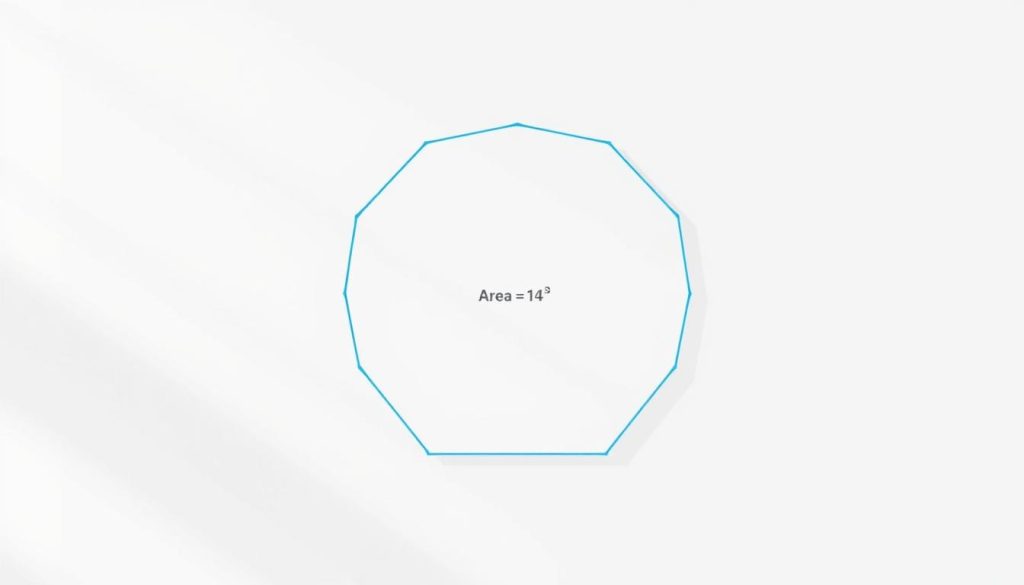
Regular pentagons are five-sided shapes with equal sides and angles. Calculating their area is a precise and fascinating process. It requires understanding the pentagon’s unique geometric properties.
The regular pentagon area formula offers multiple approaches. Each internal angle measures 108 degrees, creating a symmetrical structure. This makes calculations straightforward for various professionals.
To find a regular pentagon’s area, you need to know its basic parts. The shape has five equal sides and matching angles. These features simplify the math for area determination1.
Key Takeaways
- Regular pentagons have five equal sides and angles
- Internal angle measurement is consistently 108 degrees
- Multiple formulas exist for area calculation
- Precise measurements are crucial for accurate results
- Pentagon geometry connects to advanced mathematical concepts
Understanding the Regular Pentagon’s Basic Properties
Pentagon geometry is a world of mathematical precision. A regular pentagon has five equal sides and angles. It’s a key figure in geometric studies and crucial for calculating pentagon area2.
What Defines a Regular Pentagon
A regular pentagon stands out in pentagon math. Five equal sides and five equal angles define its perfection2. Each interior angle is 108°, while exterior angles are 72°2.
Essential Components of a Pentagon
- Five equal sides
- Five lines of symmetry2
- Five rotational symmetries2
- Total interior angle sum of 540°2
Key Measurements to Know
Several critical measurements are important in pentagon geometry. These measurements help in understanding and calculating various aspects of pentagons.
| Measurement | Description |
|---|---|
| Side Length | Fundamental to area calculations3 |
| Apothem | Perpendicular distance from center to side |
| Diagonal | Length follows golden ratio approximately 1.6182 |
Understanding these components is key to mastering pentagon geometry. It builds a strong base for calculating pentagon area accurately. This knowledge opens doors to more complex geometric concepts.
Find the Area of a Regular Pentagon: Step-by-Step Methods
Regular pentagons have unique geometric properties. Calculating their area involves specific formulas. The polygon area calculation offers multiple approaches based on available measurements4.
One method uses the side length. The formula is: Area = a² × √(25 + 10√5) / 4. Here, ‘a’ represents the side length5.
This formula helps when you know the pentagon’s side length. It’s a straightforward way to find the area.
- Method 1: Side Length Formula
Area = a² × √(25 + 10√5) / 4 - Method 2: Circumradius Formula
Area = 5R² × √[(5 + √5)/2] / 4 - Method 3: Apothem and Side Length
Area = 5ar / 2
Choose the method that fits your available information. Use the first method with side length. Apply the second formula if you know the circumradius5.
Pro Tip: Always verify your measurements before calculating to ensure accuracy in your polygon area calculation.
These formulas have real-world uses. Architects and designers apply them in their work. They create precise geometric designs and measure irregular spaces5.
Conclusion
Learning to find a regular pentagon’s area opens doors to geometric exploration. Pentagon math needs precision and a systematic approach. Key calculations involve side lengths, angles, and specialized formulas6.
These techniques help tackle complex geometric challenges with pentagonal shapes7. The methods we’ve discussed provide practical tools for real-world geometric problems. The principles stay the same, whether working with small or large pentagons6.
Mathematicians and engineers use these skills to design structures and analyze spatial configurations. They can develop innovative geometric solutions for various projects. Mastering these skills enhances problem-solving abilities in many fields.
To learn more, explore additional resources on geometric calculations. This comprehensive guide offers further insights into mathematical problem-solving. Practice is key to mastering pentagon geometry.
Each calculation strengthens your mathematical foundation. The journey of understanding geometric principles never ends. Every formula you master brings you closer to becoming a skilled geometric thinker.
FAQ
What exactly is a regular pentagon?
A regular pentagon is a five-sided polygon with equal sides and angles. All sides have the same length. Each interior angle measures exactly 108 degrees. It’s a unique, symmetrical shape in the world of polygons.
What are the key measurements I need to know for calculating a pentagon’s area?
The most important measurements are side length, apothem, and circumradius. The apothem is the distance from the center to any side. The circumradius is the distance from the center to any vertex.
These measurements are crucial for accurately calculating the pentagon’s area using different formulas.
How many different ways can I calculate the area of a regular pentagon?
There are three main methods for calculating a regular pentagon’s area. You can use side length, circumradius, or apothem and side length. The best method depends on the information you have available.
Which formula should I use if I only know the side length?
If you know the side length, use this formula: Area = a² × √(25 + 10√5) / 4. In this formula, ‘a’ represents the length of one side of the pentagon.
Where are pentagon area calculations typically used?
Pentagon area calculations are important in many fields. These include architecture, design, urban planning, and landscape architecture. They’re also used in advanced geometric studies.
These calculations help create precise architectural designs, floor plans, and geometric models.
Is calculating a pentagon’s area difficult?
Calculating a pentagon’s area might seem complex at first. However, it becomes easier once you understand the basic formulas. Having the right measurements is key.
Practice and familiarity with geometric principles make the process much simpler.
What’s the difference between a regular and irregular pentagon?
A regular pentagon has equal sides and identical interior angles of 108 degrees. An irregular pentagon has sides and angles of different lengths and measurements.
Calculating the area of an irregular pentagon is more complex than a regular one.
Can I use a calculator for these pentagon area calculations?
Yes, you can use a scientific calculator for pentagon area calculations. Look for one with trigonometric and square root functions. Input values precisely and follow the specific formula for accurate results.
Source Links
- How to Find the Area of a Pentagon (Formula) – https://tutors.com/lesson/how-to-find-the-area-of-a-pentagon
- Area of a Pentagon: Formula, Definition, and Examples – GeeksforGeeks – https://www.geeksforgeeks.org/area-of-pentagon/
- How to Find the Area of a Pentagon in 3 Easy Steps — Mashup Math – https://www.mashupmath.com/how-to-find-the-area-of-a-pentagon
- All About Pentagons – Definition, Examples, Formulas – https://www.dreambox.com/math/skills/shapes/pentagons
- Area of a Pentagon Formula – https://www.edulyte.com/maths/area-of-a-pentagon-formula/
- Area of a Pentagon – Definition, Formula, Examples, Facts, FAQs – https://www.splashlearn.com/math-vocabulary/area-of-a-pentagon
- Area of Pentagon – https://unacademy.com/content/jee/study-material/mathematics/area-of-pentagon/

